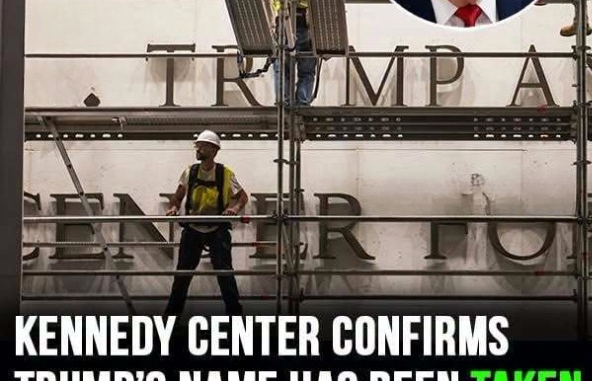
The John F. Kennedy Center has recently taken steps to remove Donald Trump’s name from sections of its building and from official references, following a court ruling that found the earlier renaming to be in violation of federal law. This development has triggered immediate and intense reactions across the political spectrum, drawing attention far beyond the institution itself.
Supporters of the decision argue that the change was both necessary and appropriate in order to restore the Kennedy Center’s original identity and reinforce its long-standing role as a nonpartisan cultural institution. From their perspective, the removal helps protect the integrity of the center and ensures that it remains focused on the arts rather than political influence or affiliation.
On the other hand, critics—particularly Trump supporters—have strongly condemned the move, describing it as politically driven and unfair. They argue that it represents an effort to diminish or erase recognition connected to the former president, framing it as part of a broader pattern of political bias in public institutions.
What initially began as a legal ruling over naming rights has now expanded into a much wider national debate. The situation has sparked ongoing discussions about the relationship between politics and cultural institutions, how historical recognition should be handled, and to what extent political figures should be represented—or removed—from prominent public landmarks.
Leave a Reply