PART 1
The first thing that caught my attention wasn’t the decorations or the birthday cake.
It was the silence.
Not the warm, happy quiet that settles over a room before someone blows out the candles. This silence was heavy, spreading across the table until every conversation faded and every smile disappeared.
It was my husband Daniel’s thirty-eighth birthday, and his mother, Patricia, had insisted on hosting a family dinner.
“Only immediate family,” she had cheerfully said over the phone. “The people who truly belong.”
Looking back, I should have understood what she really meant.
Daniel had two children from his previous marriage—Mason, who was sixteen, and thirteen-year-old Chloe. I had never tried to replace their mother. Instead, I treated them with kindness, respected their boundaries, and over the years we built a genuine relationship.
My daughter, Lily, was seven.
She was born before Daniel and I met, but he had been raising her since she was only three. He packed her lunches, attended every school play, read bedtime stories, and loved her with all the devotion of a father.
To Patricia, though, Lily was never truly accepted.
She was always introduced as “Emma’s little girl.”
Never Daniel’s daughter.
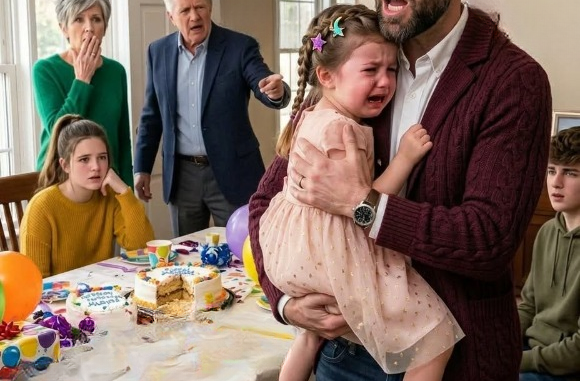
The dining room was beautifully decorated with balloons, wrapped presents, and a large chocolate birthday cake waiting on the buffet. Lily sat proudly beside me in the bright blue dress Daniel had picked out because she insisted it made her feel like royalty.
She couldn’t stop smiling.
Then Patricia approached our table.
She leaned down and quietly whispered something into Lily’s ear.
The smile disappeared from my daughter’s face instantly.
“Grandma Patricia says I should eat in the family room,” Lily murmured.
I looked up.
“Why would she say that?”
Patricia straightened with a practiced smile.
“We need these seats for Daniel’s real children and immediate family.”
My fork stopped halfway to my plate.
“She is his family.”
Patricia ignored me completely.
Instead, she rested a hand on Lily’s shoulder and gently started leading her toward the hallway.
“Patricia,” I said firmly, rising from my chair, “take your hands off her.”
Lily looked back at me, confused.
“Mom?”
Before I could reach them, Patricia ushered her into the den and closed the doorway behind her.
The entire room went still.
Just then Daniel returned from taking a work call outside.
He immediately noticed Lily wiping tears from her cheeks.
Something shifted in his expression.
It wasn’t loud anger.
It was something far more controlled.
He knelt beside Lily, gently brushed away her tears, and took her hand before leading her back into the dining room.
Then he faced everyone gathered around the table.
Finally, his eyes settled on his mother.
“My real children?” he asked quietly.
No one answered.
He nodded once.
“Let me make something perfectly clear.”
His voice remained calm.
“Lily became my daughter the day I chose to love her, protect her, and be there for her. Anyone who believes DNA matters more than love is welcome to leave my birthday dinner right now.”
PART 2
The room became painfully quiet.
Patricia looked completely stunned.
Several relatives stared down at their plates, clearly wishing they were somewhere else.
Daniel wasn’t finished.
When Patricia insisted Lily wasn’t truly his daughter, his face hardened.
“She is my daughter,” he replied. “And if you can’t respect that, then this celebration is over.”
His father, Harold, quickly stepped in.
“Your mother didn’t intend any harm.”
Daniel silently pointed toward two unused chairs leaning against the wall.
“There was room for everyone.”
Nobody had an answer.
“The problem wasn’t space,” he continued.
“It was kindness.”
Then something unexpected happened.
Mason spoke first.
“She’s only seven,” he said, staring at his grandmother. “How could you treat her like that?”
Moments later Chloe stood up, walked over to Lily, and offered her own chair.
“Sit next to me.”
Lily’s eyes filled with tears once again.
For the first time all evening, Patricia realized nobody was standing beside her.
Not even her own grandchildren.
Before we left, Lily handed Daniel the birthday present she had spent weeks making.
It was a small wooden picture frame she had painted herself.
Inside was a photograph from the county fair showing the three of us smiling together.
Across the bottom she had carefully written:
My Family.
Daniel hugged the frame against his chest before turning back toward his parents.
“You wanted my real family here tonight,” he said softly.
“And you tried to send her away.”
We left before anyone cut the birthday cake.
The gifts stayed unopened.
Nobody said goodbye.
Driving home, Lily quietly held Daniel’s hand from the back seat.
After several miles she whispered,
“Are you still my daddy?”
Daniel immediately pulled onto the shoulder of the road.
His eyes filled with tears.
“I was your daddy yesterday,” he told her gently.
“I’m your daddy today.
And I’ll still be your daddy tomorrow.”
Lily wrapped her arms around his neck.
Neither of them wanted to let go.
During the following week Patricia tried changing the story.
According to her, she’d only been rearranging seating.
She insisted she never pushed Lily away.
She claimed she never used the phrase “real children.”
No one believed her.
Not Daniel.
Not Mason.
Not Chloe.
Not even Daniel’s former wife, Rachel.
When Rachel heard what had happened, she was horrified.
“Patricia should be ashamed of herself,” she said.
Her support meant more than she probably realized.
A few weeks later Patricia arrived at our house carrying cupcakes, pretending she wanted to make peace.
Daniel gave her exactly one opportunity.
“Apologize to Lily.”
Patricia looked at my daughter and reluctantly said,
“I’m sorry if your feelings got hurt.”
Daniel immediately handed the cupcake box back.
“That’s not an apology.”
PART 3
Patricia’s patience finally snapped.
Then Lily surprised every adult in the room.
She calmly looked at Patricia and said,
“I’m not angry.
I just remember.”
Silence filled the room.
Patricia completely lost her composure.
She admitted she still didn’t see Lily as one of Daniel’s real children.
That was the moment everything changed forever.
Daniel asked his parents to leave.
Mason held the front door open for them.
Chloe announced she no longer wanted to visit their house.
Only then did Patricia understand she wasn’t simply losing an argument.
She was losing her family.
Several months later Daniel made an important decision.
He officially filed adoption papers.
When he explained everything to Lily, he told her that in his heart he had always been her father.
The paperwork would simply make it legal.
Lily smiled.
“You chose us.”
The adoption hearing was simple and beautiful.
There were no dramatic speeches.
Just a judge, a few signatures, and a little girl who already knew the answer.
“Do you want Daniel to become your legal father?” the judge asked.
Lily grinned.
“He already is.
Now everyone else gets to know.”
There wasn’t a dry eye in the courtroom.
Afterward we took family pictures outside the courthouse.
For the first time, everything felt complete.
Patricia learned about the adoption through social media.
She sent one angry text accusing us of tearing the family apart.
Daniel deleted it without responding.
“She doesn’t get to decide who belongs anymore,” he said.
That Thanksgiving we hosted dinner ourselves.
Rachel joined us.
Mason accidentally burned the rolls.
Chloe laughed so hard she nearly dropped her plate.
Lily carefully made handwritten place cards for every guest.
The house was noisy, imperfect, and filled with joy.
As everyone gathered around the table, Daniel looked at all three children and smiled.
“I’m thankful,” he said, “for the people who taught me that family isn’t defined by blood. It’s defined by the way we love each other.”
Lily immediately raised her hand.
“Yes?” Daniel laughed.
“Can we finally eat?”
Everyone burst into laughter.
Later that evening Daniel looked toward the children playing together in the living room and quietly said something I’ll always remember.
“I used to think keeping the peace meant staying silent.”
“And now?” I asked.
He smiled.
“Now I know peace means making sure everyone at your table knows they belong.”
In that moment, I understood something too.
Patricia could keep her traditions, her rules, and her narrow idea of what family meant.
In our home, every seat was reserved for someone who was loved.
Leave a Reply