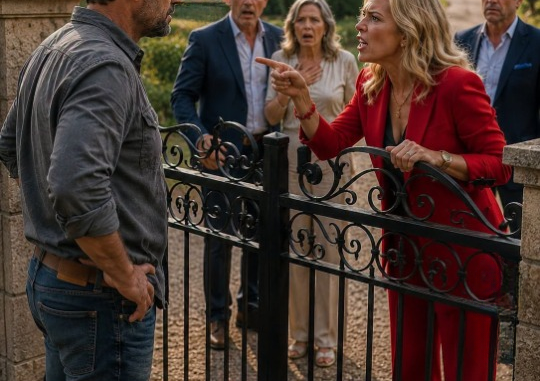
Just before dawn, the first egg splattered across Caleb Rourke’s pickup truck. Moments later, another struck his shirt as Mrs. Delaney stood at the end of his driveway with a satisfied smile. Behind her, a crowd of Willow Creek Estates residents had gathered in golf carts, holding protest signs and recording the scene with their phones, convinced Caleb was the villain. For weeks, the homeowners association had refused to pay his $38,100 bill for maintaining the entrance gate and private access road, despite the fact that the only entrance to their neighborhood crossed land he legally owned. The gate, its motor, the roadway, and the first section beneath it all belonged to Caleb. HOA leaders insisted an old easement gave them permanent rights, but they had only shown homeowners the first page of the agreement. The remaining pages revealed the truth—the easement had been temporary, required renewal, and had expired long ago.
Rather than argue with the angry crowd, Caleb calmly opened a red folder filled with documents. Inside were unpaid invoices, certified letters, a recent land survey, and the complete easement agreement. When Sheriff Avery arrived, Mrs. Delaney immediately accused Caleb of illegally blocking access to the neighborhood. After carefully reviewing every document, the sheriff confirmed Caleb’s position. The entrance road and gate were private property, emergency access had already been arranged through the proper channels, and the protesters were standing on Caleb’s own driveway. The situation took another turn when residents began asking about a road maintenance reserve they had each contributed to the previous year. Seventy-two homeowners had paid into the fund, yet Caleb’s invoice remained unpaid.
Later that afternoon, homeowner Peter Marsh stopped by Caleb’s property carrying paperwork that suggested the dispute was far larger than an unpaid maintenance bill. According to Peter, the HOA had quietly been negotiating with Hartwell Development on a proposed expansion project that appeared to include part of Caleb’s north ridge. The plans showed future roads, building lots, and access routes extending across land Caleb still legally owned. Peter explained that Mrs. Delaney had assured residents the property was abandoned or could eventually be obtained without much difficulty. Suddenly, refusing to pay Caleb no longer seemed like a financial oversight—it looked more like an effort to keep him distracted while a much bigger development moved ahead.
That evening, the HOA board meeting descended into chaos as frustrated homeowners demanded explanations about the missing reserve fund and Hartwell Development’s involvement. Not long afterward, Caleb noticed headlights moving along an old logging trail where no vehicles should have been. Sheriff Avery responded and discovered several men on Caleb’s land carrying survey equipment, marking paint, and printed development maps. Among them was Dennis Kline, the HOA treasurer. Inside his jacket deputies found a letter printed on HOA stationery granting Hartwell permission to enter Caleb’s property, complete with a forged version of Caleb’s signature. Then came the most unexpected revelation of all. Dennis recognized Caleb’s attorney, Mara Whitcomb, and disclosed that she had once worked for Hartwell Development. Before Caleb could make sense of that betrayal, three black SUVs appeared silently among the trees on the ridge, parked in a place where no road was supposed to exist.
Leave a Reply