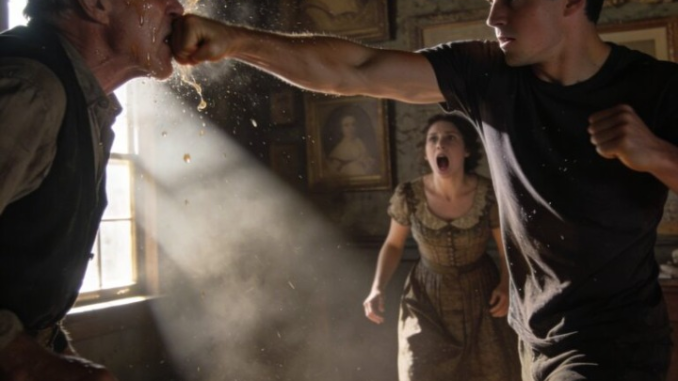
I smiled inwardly as I stayed on the sidewalk, my lip split, blood drying at the corner of my mouth.
Javier thought he had won.
Sofia too.
I saw her leaning against the doorframe, glass of wine in hand, watching me like I was some annoying old man finally put in his place.
What neither of them realized was simple: I hadn’t been broken. I had been awakened.
I stood slowly, said nothing, placed the small brown-paper package I’d brought for my son’s birthday on a stone planter, and turned away.
Javier laughed behind me.
—That’s it, get out.
I didn’t respond. Sometimes dignity isn’t in words—it’s walking away with your head high and letting reality speak.
I drove to my apartment in Chamartín, calm in a way that even surprised me. Not anger—rage is explosive. I was beyond that. I was in the zone where decisions are made and can’t be undone.
First, I washed my face. The blood was gone, but the heat lingered. I looked in the mirror: a sixty-eight-year-old man, swollen cheek, eyes unnervingly calm.
“Thirty times,” I murmured. Thirty.
I went to the studio, grabbed the blue folder from El Mastín Investments, and called my lawyer.
—Ignacio, sell the house in La Moraleja tomorrow.
Silence. Then his cautious, precise voice:
—Has something happened?
—My son hit me thirty times in front of his wife.
No questions. Just:
—Understood. Eight in the office.
I slept four hours. By eight, I was reviewing deeds, powers, and occupancy clauses—everything set up five years ago so the house was mine until I chose otherwise.
Javier never owned it. He thought he did. That belief had spoiled him. For five years, I watched. Laziness wrapped in arrogance. Luxury paid by others’ prestige. I endured. Until that night.
By noon, Ignacio had a buyer. By 6 p.m., eviction papers were ready. My only request: deliver them at 10:30 while Javier was in the office and Sofia present. Ignacio nodded. No judgment.
That night, no toast, no celebration. I ate reheated soup, opened the birthday package—a simple steel clock belonging to my father. I laughed. He hadn’t earned it. I put it away.
Next morning, Sofia called. I let it ring three times. Her voice was shaken.
—Arturo? There are men here with papers saying the house was sold.
—That’s what it means.
—You can’t do this to us!
—I didn’t. Your husband did it when he hit me.
Silence, then pleading:
—Please. Let’s talk.
—I have nothing to say.
—And Javier?
I glanced at the clock. Fifteen minutes before he learned the truth.
—Much less.
Javier called next. I didn’t answer. Audio message: disbelief, fear, and finally—
—You can’t leave us on the street.
He hadn’t said that while slapping me. I didn’t call back. I wanted him to see it in person. Six o’clock, my office. He arrived early, disheveled, trembling. He noticed the yellow mark on my cheek.
—Dad…
I raised a hand.
—Don’t. We aren’t clearing a misunderstanding.
—I’m sorry.
I laughed shortly.
—No. Feel it. An investment fund evicted you from the master bedroom.
He swallowed. —I was drunk.
—You became what you are when nobody held you back.
—I’m not like that.
—Yes, you are.
He paced like a child caught. I pointed to the chair. —Sit. He obeyed.
—I’ll explain: First, the house was never yours. Second, thirty blows turned a family issue into a business decision.
He paled. —Thirty…
—I counted.
He lowered his head, not in remorse, but as if discovering he was watched.
—You can’t just sell like that. My children…
—Your children will be fine. The fund gave them 72 hours. I gave them a week. My last act of decency.
—So you still want to help?
—No. Help isn’t boundaries.
—Then what?
—Work. Cut expenses. Move within your means.
He hated me, but shame crept in. The truth hit hard: he had grown soft in comfort, pride before character.
Sofia called it cruel. I nodded. —Comfortable people call the end of privilege cruelty.
He cried silently for the first time. —I don’t know how to do this.
—I know. You solved everything. That was my mistake.
I continued: —I gave you a house before you could support yourself. That’s why you thought walls were natural, comfort a right. I didn’t raise a monster, Javier. I raised a soft man who valued pride over character.
—And that’s it? You take my house?
—No. One thing remains.
I placed a beige folder on the desk. The complaint. He didn’t open it. He read: injuries and assault.
—Are you reporting me?
—I already did.
No jail time. No public record. Temporary restraining order, testimony, humiliation. The week-long eviction was a war of boxes, shouting, and lost luxury.
I wasn’t happy. But I wasn’t surprised. Marriages built on smoke suffocate once a window opens.
I moved on. Bought a small building near the mountains, turned it into temporary housing for retired workers without pensions or thrown out by “stressed” children. I called it Dignity.
A year later, Javier returned, thinner, no flashy possessions, without Sofia, toolbox in hand. I let him work—carrying sacks, cleaning, painting. No privileges. No office. Work.
Months later, one elderly resident teased him:
—You look like a real bastard of a son.
He lowered his head. —Yeah.
I heard. And for the first time, thought maybe something could be salvaged.
We don’t live together. No house, no illusions. Sometimes we work in the yard. Sometimes he hands me tools. Sometimes coffee, no tension. He never asked me to forget. I never promised to forgive.
The cheek healed. The memory didn’t. One day, checking the roof before a storm, he said:
—Thank you for selling the house.
—I wasn’t doing it for you.
—I know. But if you hadn’t… I’d still think I was a man.
I didn’t answer. Not needed. The wind came cold, like that February night. This time, he carried the hammer, no false illusions.
My son hit me thirty times. I sold his house. But what truly fell wasn’t the roof—it was the lie he lived, confusing inheritance with right, comfort with courage, patience with weakness. Sometimes, to save what’s worthwhile, walls must be torn down, and a child exposed to learn to build something real with their own hands.
Leave a Reply