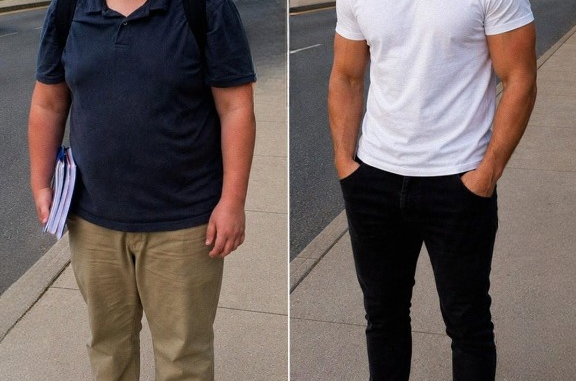
A man who spent years rebuilding himself after a painful past decides to take a small chance on a dating app. But when a familiar face shows up on his screen, a simple swipe pulls him into a confrontation he never saw coming.
The city outside my window had that soft evening rhythm, the kind of noise that used to feel like loneliness and now just felt like background life.
I filled a glass of water, kicked off my shoes, and dropped onto the couch in the apartment I spent a decade working to afford. For a moment, I caught my reflection in the dark glass and didn’t turn away.
Thirty years old. Six-foot-three. A career I built from nothing.
Someone my younger self would barely recognize.
Her voice still had a way of sticking in my mind after all these years.
I sometimes thought about that kid. The oversized boy in the back of the classroom, hoodie pulled low, hoping not to be noticed. The one who ate lunch alone because the cafeteria felt like a stage he didn’t belong on.
“Hey, big guy, finish the whole vending machine again?”
Madison. The prom queen. The one everyone liked, teachers praised, and guys followed with their eyes. The one who always seemed to find me, no matter where I tried to hide.
I remembered the moment I stopped trying to fit in.
After one more round of laughter at my expense in sophomore year, I went home and buried myself in textbooks instead of tears. Books didn’t mock me. Books gave me a way out.
And I built a different life.
“You should come to the reunion,” my mom said last month.
“Not happening,” I told her.
“People change, Daniel.”
“Some do,” I said.
I changed everything I could. Early mornings at the gym. Therapy every Tuesday. Carefully chosen friendships. Marcus, who never let me hide behind excuses.
And still, that younger version of me lingered somewhere underneath. He showed up at odd moments—when laughter carried too close behind me, or when a word like “weird” slipped into conversation.
“Just download the app,” Marcus kept saying. “One date.”
I didn’t like dating apps. I told him that.
“You don’t like trying,” he said. “That’s different.”
He wasn’t wrong.
Eventually, I gave in. I opened the app and started swiping without much thought.
A woman with a yoga mat. A woman holding a drink. A woman posing with a dog that definitely wasn’t hers.
Then I stopped.
“This is ridiculous,” I muttered, half amused.
And for a second, it felt easy—low stakes, just strangers on a screen.
Until it didn’t.
Because there she was.
Madison.
Older. Sharper around the edges, but unmistakable. That same tilted smile that used to come before words I never forgot.
I froze.
Then, almost without thinking, I swiped right.
A second later:
IT’S A MATCH.
Her message arrived almost instantly.
“Hey stranger. You’ve got kind eyes. What do you do for work?”
I stared at the screen.
Kind eyes. Years ago, she had once said something very different about them in a crowded hallway.
I replied carefully, vague enough to mean nothing.
She responded fast, enthusiastic. Interested. Almost too interested.
That’s when Marcus got my call.
“You’re not going to believe who just matched with me.”
“Please tell me it’s not someone from your past,” he said.
“It’s Madison.”
A pause.
“The Madison?”
“Yeah.”
“And you swiped right?”
“I did.”
“Why?”
I didn’t have a clean answer.
“Curiosity,” I said finally.
“That sounds like revenge dressed up as curiosity,” he replied.
Maybe it was.
Her next message came in before I could think too hard about it.
“Want to grab a drink Friday? There’s a wine bar I love.”
I stared at it for a long time.
Then I said yes.
Friday arrived faster than I expected.
I stood in front of the mirror, adjusting my shirt, studying the man looking back. Broader shoulders. Steadier eyes. Someone built, piece by piece, out of years I didn’t talk about.
The boy she once knew wasn’t supposed to exist anymore.
That was the point.
The wine bar was dim and warm, glasses catching soft light. Madison smiled like we were old friends catching up instead of two people with history neither of us named.
She leaned in when I spoke. Asked questions that felt thoughtful. Remembered details I barely mentioned.
Then she laughed and said, “I feel like I’ve known you forever.”
Something about that made my chest tighten—not in nostalgia, but recognition of something off.
“So,” I said casually, “what was high school like for you back home?”
Her tone shifted instantly, lighter, nostalgic. She told stories about friends, about harmless chaos, about a boy she described like an afterthought.
A “weird kid,” she said, laughing.
I stopped moving.
She kept talking, enjoying herself now.
And I realized I already knew every part of the story she was telling.
Because I had lived it.
Her voice carried on, casual and amused.
“We used to give him nicknames,” she said. “Just dumb teenage stuff.”
I set my glass down a little more carefully than I meant to.
“I shouldn’t even say them,” she added, still smiling.
But she did.
And I recognized them immediately.
The same words that had followed me through hallways, across lunch tables, into silence at home.
“You think that was funny?” I asked quietly.
She shrugged. “It was high school. Everyone was dramatic.”
She took a sip of wine, unconcerned.
I waited. Let the moment stretch until it was clear she didn’t remember me at all.
Then I said the names back to her.
Slowly. Exactly.
The shift was immediate.
Color drained from her face.
“…Daniel?” she whispered.
And just like that, everything caught up to her.
“It’s been a long time,” I said.
She started talking fast. Apologies. Excuses. Time. Maturity. Kids being kids.
Then came the real reason—carefully softened, carefully aimed.
She had seen my company. My success. She thought maybe we could “connect.” Maybe I could help her break into my industry.
Not a coincidence. A strategy.
I let her finish.
When she stopped, I leaned back.
“So this wasn’t about me,” I said.
“No—yes—I mean, I like talking to you,” she rushed. “It’s just… also practical.”
“Practical,” I repeated.
She tried to smile again. It didn’t land the same way.
And for the first time all night, I wasn’t looking at the girl who used to laugh at me.
I was looking at someone who had never thought she needed to remember me at all.
“I’m not angry,” I said after a moment.
That surprised even me.
Because I wasn’t.
“I spent years becoming someone who doesn’t need your approval anymore,” I added. “You just didn’t notice it happened.”
She had nothing to say to that.
I paid for my drink, stood up, and gave her a polite nod.
Outside, the air felt colder and clearer than I expected.
I called Marcus as I walked.
“Done?” he asked.
“Yeah,” I said. “It’s done.”
“And?”
I looked up at the streetlights.
“She never had any power over me,” I said. “I just finally understood that.”
Then I deleted the app.
Leave a Reply