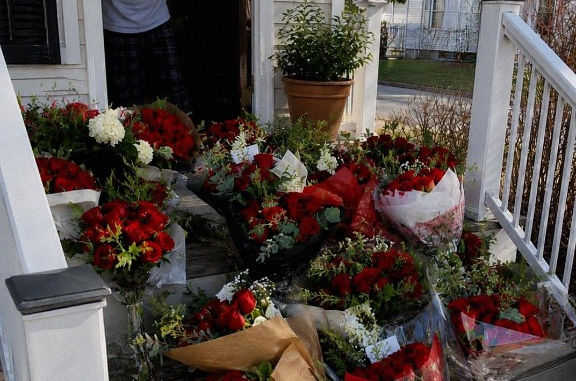
When I came home from a week-long work trip and saw a hundred roses covering my front porch, my first thought wasn’t romance—it was suspicion. Someone was clearly trying to send a message to my wife. Maybe even steal her.
Then I found the note that changed everything.
I knew something was off before I even shut off the engine.
For seven years, every time I returned from a work trip, Jane was already waiting outside. Sometimes she’d be on the porch before I even parked, waving like I’d been gone for months instead of days. Other times she’d be barefoot in one of my old sweaters, smiling like the house could finally breathe again.
This time, the porch was empty.
“Jane?” I called out under my breath.
That’s when I saw the flowers.
At first, I thought it was just a few bouquets near the door. But as I got closer, I realized the entire porch was covered—roses everywhere. Red, white, pink, yellow. Wrapped carefully, stacked neatly, spilling across the steps like someone had tried to bury the house in them.
There had to be at least a hundred.
I parked too fast, stepped out slowly, and just stared.
“What the hell…”
The smell hit me next—sweet, heavy, overwhelming. It should’ve felt romantic. It didn’t. It felt wrong.
Bouquets lined the railing, the swing, even the welcome mat.
Then the front door opened.
Jane stepped out wearing jeans and a cardigan, her expression tired in the way it had been lately. The moment she saw me, she lit up—until she followed my gaze.
She stopped dead.
“Mark… what did you do?”
I frowned. “What did I do?”
She walked onto the porch carefully, eyes scanning the flowers.
“You didn’t send these?”
“No,” I said. “I just got here.”
That silence between us changed everything.
“Then who did?” she whispered.
I tried to laugh it off, but it came out strained. “That’s what I was hoping you’d tell me.”
Her face tightened. “Mark, I swear I don’t know.”
But I could already feel it—the doubt creeping in anyway.
Then I saw it.
A small white envelope tucked into one of the bouquets near the swing.
I reached for it before she could speak again.
“Mark—wait.”
Too late.
I opened it.
Inside was a folded note written in uneven handwriting. My eyes scanned the first line, then froze on the second.
Jane saw my face change.
“Read it,” she whispered.
So I did.
And by the time I reached the end, my hands were shaking.
Because it wasn’t love letters. It wasn’t romance.
It was a child’s handwriting.
Big, uneven letters. Crooked lines. Words pressed like they mattered more than neatness ever could.
“Please don’t quit.”
Jane covered her mouth instantly.
“We love you so much.”
Her breath caught.
“We are so sorry.”
The porch went completely still.
When I looked up, Jane wasn’t looking at me anymore. She was staring at the roses like she finally understood what she was seeing.
“No…” she whispered.
Then, softer, like it hurt to say it out loud:
“No, they didn’t.”
That broke her.
Not quietly. Not gently. She crumpled into tears right there among the flowers, like something inside her had finally been given permission to fall apart.
I dropped the envelope and pulled her into me.
“Hey,” I said. “Talk to me.”
But I already knew.
These weren’t from strangers.
These were from her students.
For months, I had watched Jane come home smaller each day.
Teaching wasn’t just her job—it was who she was. She stayed late grading papers, bought supplies with her own money, remembered every kid’s quirks like they mattered.
But lately, it had been wearing her down.
One night I found her at the kitchen table, staring at her laptop at 2 a.m.
“I can’t keep doing this,” she had said quietly.
Another night:
“I feel like I’m failing every day.”
And then came the message she sent to parents—honest, exhausted, and raw. She admitted she was overwhelmed. That she didn’t know how much longer she could continue like this.
She regretted it immediately.
“Teachers aren’t supposed to say that,” she told me afterward.
Now I stood on a porch full of roses, realizing something had happened because she finally did say it.
People had listened.
We started opening the cards one by one.
“Thank you for believing in Ethan.”
“Thank you for helping my daughter enjoy school again.”
“School feels safe because of you.”
Each message hit her harder than the last.
And with every note, I watched something shift in her face.
Not just sadness anymore.
Relief.
Because she hadn’t been invisible.
She had just been exhausted.
By the time we carried the flowers inside, the entire house smelled like a garden.
Counters. Tables. Shelves. Every surface covered in roses and handwritten notes.
Jane stood in the middle of it all, slowly turning like she couldn’t believe it was real.
Then she found another envelope.
Dozens of signatures inside.
At the bottom, one final message:
The world needs teachers like you. Please don’t give up on us.
That one broke her again.
But differently this time.
Because it wasn’t despair.
It was release.
“I really was going to quit,” she admitted.
“I know,” I said.
She looked around the room.
Then she smiled.
Small at first. Then real.
“I think…” she said, wiping her eyes, “I need to show up on Monday.”
I let out a breath I didn’t realize I was holding. “You think?”
She laughed through tears.
And for the first time in months, the sound didn’t feel heavy.
That night, we sat on the couch surrounded by roses, the house finally quiet again.
When I arrived home earlier, I thought those flowers meant betrayal. A threat. A stranger trying to pull my wife away.
Instead, they were something completely different.
Proof that people notice more than they say.
Proof that impact isn’t always visible while it’s happening.
And proof that sometimes, the people who feel like they’re failing… are actually the reason someone else keeps going.
Do you think teachers usually realize how much they matter in real time, or does it only become clear to them later—when someone finally says it out loud?
Leave a Reply