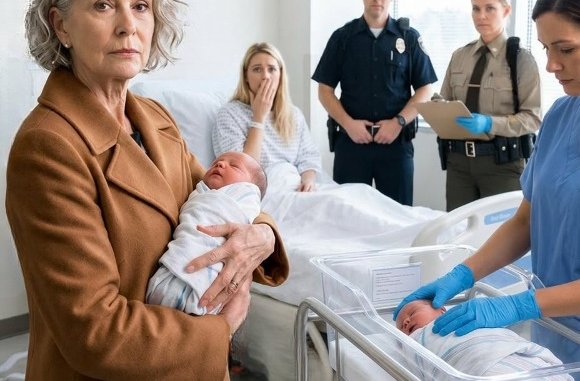
I first heard a scream—muffled, warped, as though it were rising from underwater. My drugged mind couldn’t place it at first; everything had narrowed to the steady beep of a monitor and the sharp, tearing pain across my lower abdomen.
After a C-section, your body feels unfamiliar, almost like a place you no longer belong. Pain comes in waves, dragging you in and out of awareness, leaving you suspended between clarity and fog.
My head pressed into the pillow, mouth dry, thoughts slow. But one sound cuts through everything: a baby’s cry. It reaches something primal, something that doesn’t belong to anesthesia or exhaustion.
And that cry was wrong.
“Take your hands off that baby.”
The voice was calm—too calm. Controlled in a way that stripped it of warmth. It belonged to someone used to obedience, not negotiation.
The hospital security chief.
I tried to sit up, but my body rebelled, stitches burning as if they might split open. A nurse, Rachel, rushed in, urging me to stay still. But I couldn’t. My son, Noah, was crying—and Margaret Whitfield, my mother-in-law, was holding him.
She wasn’t cradling him like family. She held him like something to be claimed. Her expression was tight with anger, not concern.
“This woman is unstable,” she said immediately, voice sharp and practiced. “Postpartum psychosis. She needs to be contained. The child is mine to protect.”
It wasn’t the first time she had spoken like that—certain, commanding, as if reality bent around her expectations. I had spent years letting her speak over me, dismissing me, rewriting me into something smaller than I was. I stayed quiet for the sake of my marriage, for the fragile peace Daniel insisted we preserve.
I had even hidden who I truly was. Daniel knew, but he asked me not to reveal it to his family. It was easier, he said. Less conflict. Less resistance.
So to her, I was nothing. Unemployed. Dependent. Harmless.
That version of me had always served her well.
But now, in this hospital room, everything she had assumed began to collapse.
A guard moved closer. The nurse called for backup. Margaret tightened her hold on my son and insisted I was dangerous, unraveling, unfit. It was disturbingly convincing—my condition, my weakness, the chaos of childbirth—all of it could be weaponized against me.
Then the security chief looked at me differently. Not as a patient, but as someone he recognized.
“Your Honor?” he said quietly.
The room shifted. Even the air felt heavier.
“Judge Caroline Monroe, United States District Court,” he clarified.
The effect was immediate. Margaret’s certainty faltered, then broke entirely. The story she had constructed around me collapsed in seconds.
Still, she refused to release my son.
Until she had no choice.
When Noah was finally placed back beside me, I broke—not from fear alone, but from the shock of what had almost happened. The realization came in waves: how close they had come, how carefully it had been planned, how easily it might have succeeded.
And then the truth emerged fully. This wasn’t impulsive. It was coordinated. Documents, timing, preparation—everything pointed to intent.
Even Daniel’s arrival, when it finally came, felt like another turning point. He saw the bruising on my face. He saw the police. He saw Noah safe. And for the first time, the distance between what he wanted to believe and what was real could no longer be bridged.
“Mom said you weren’t yourself,” he said weakly.
But that explanation no longer held.
The cameras had recorded everything.
And silence, once again, had consequences.
In the hours that followed, statements were taken, evidence collected, and pieces of a larger plan surfaced—Melissa waiting outside, an empty car seat in the vehicle, documents prepared to seize my child under false pretenses.
It had all been arranged for a moment when I would be weakest.
When they asked if I wanted to call Daniel, I hesitated—not because I didn’t want him there, but because I needed to know what he would choose when he arrived.
He came forty minutes later.
He looked at me, at the bruise, at the police, at our son—and something in him changed. Not suddenly, but irrevocably.
My voice stayed steady when I told him what had happened. His didn’t.
For a long moment, he said nothing at all.
And in that silence, something between us fractured beyond repair—or possibility of repair.
Later, alone, he asked why I had never told his family who I really was. I told him the truth: because he had asked me not to. Because silence had felt safer than confrontation. Because I had mistaken avoidance for peace.
But peace like that always comes at a cost.
And mine had almost been my child.
By the time we left the hospital days later, nothing about our life felt intact. There were no celebrations, no reassurance that things would return to normal. Only the quiet reality of what had been exposed.
At home, I locked the door with a finality I hadn’t used before. The house felt the same, but I didn’t.
The babies slept. The paperwork sat on the table. And for the first time in a long time, no one else defined what my life was supposed to be.
I didn’t know what would come next—whether trust could be rebuilt, whether the damage could be contained, whether any of it could ever fully heal.
But I knew this much with certainty:
Silence had nearly cost me everything.
And I would not live that way again.
Leave a Reply