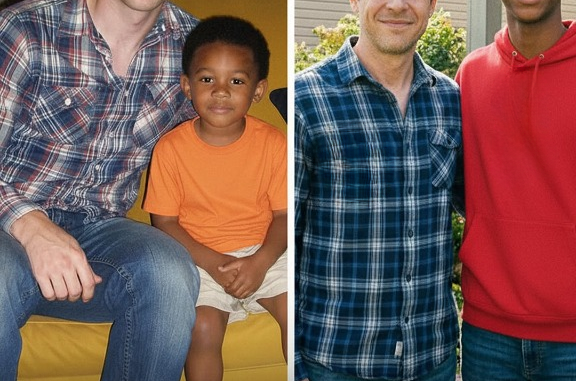
I raised the son of the woman I loved and spent years convincing myself that was enough. Then, on his 18th birthday, he handed me an envelope written in her handwriting—and everything I believed about our shared life began to change.
I met Laura when we were nineteen.
She had a way of walking into a difficult week and making it feel bearable—not by fixing it, just by softening it.
We became close friends.
And by the time I realized my feelings ran deeper, Laura already had Jimmy.
She was raising him alone, overwhelmed with bills and exhaustion, carrying more than she could comfortably manage.
So I stayed in her life the way she allowed me to.
I was there when Jimmy was born, sitting in hospital chairs through the night, bringing coffee she never managed to drink.
I was there when he was a toddler discovering chaos, and when he was injured and Laura called me in panic, trusting me to come without hesitation.
I should have told her how I felt then.
Instead, I stayed silent.
Then one night, everything changed.
Laura was gone suddenly in an accident, and Jimmy—only four—was left without her.
He asked where she was, confused and searching for answers no child should have to ask.
With no one else stepping forward, I became his guardian.
It wasn’t immediate or simple. There were legal steps, evaluations, and scrutiny. But eventually, it was official.
By then, Jimmy already had a life built around me being there—his routines, his space, his sense of safety.
He grew up asking about his mother in small pieces, then less and less as time passed.
I never called myself his father, not formally. But I did everything one would do: school runs, illnesses, late-night projects, everyday care.
When he turned thirteen, he joked that I was the reason he believed in responsibility.
And then came his 18th birthday.
I walked into the kitchen and found him holding an envelope.
He told me he had found something in the attic weeks earlier—letters from Laura.
One was addressed to him. One was for me.
He had waited until the day she instructed.
My hands shook as I recognized her handwriting.
Inside, Laura wrote that she had planned for Jimmy’s future and had trusted me more than anyone to raise him if she couldn’t.
Then came the words I wasn’t prepared for—she had known how I felt, and she had felt it too.
There were more letters. One for each stage of Jimmy’s life.
In them, she spoke about him growing up, about guidance, about trust—and about me always being the one she believed would stay.
Then Jimmy showed me something else.
Legal paperwork for adult adoption—already filled out, signed by him.
He told me it was his choice.
Not out of obligation, but certainty.
We went through the attic together afterward and found more of Laura’s life preserved—photos, keepsakes, and letters she had written for every milestone Jimmy would reach without her.
Each one carried her voice, her care, and her belief in what our life would become.
When we later visited her attorney, we learned she had attempted to formalize her wishes before she died—naming me as the person she wanted to raise her son.
It hadn’t been completed, but her intent was clear.
That night, Jimmy and I sat with the truth of it all.
The next day, we filed the adoption papers together.
Not because he owed me anything—but because it already reflected what our life had become.
A few weeks later, it was finalized.
We celebrated quietly, the way we had always lived—sharing a meal, remembering her, reading her letters again.
And when he finally called me “Dad,” it didn’t feel like a beginning or an ending.
Just confirmation of something that had already been true for years:
Family isn’t only where you come from.
Sometimes it’s who stays.
And who chooses to stay back.
Leave a Reply