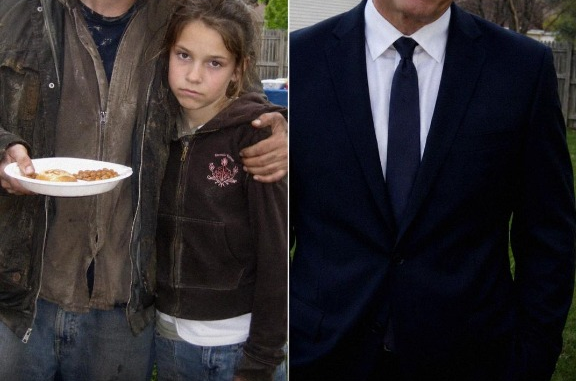
I grew up believing my mother cared more about a homeless man than about me. For twenty years, she cooked meals every day for Victor, a man who lived in a makeshift shelter behind our house. Even after she passed away, I continued bringing him food only because I had promised her I would.
The day after her funeral, I discovered Victor’s shelter was empty. Soon afterward, I found him standing beside a black SUV, wearing clean clothes and holding my mother’s silver locket—the same one she had claimed to have lost years earlier. When I asked where he got it, he revealed that my mother had given it to him and that she had hidden the truth about his identity for decades.
As a child, I often resented Victor. My mother and I struggled financially, yet she always made sure he had food. Whenever I questioned why she treated him as though he were family, she refused to explain, insisting only that he was important.
Over the years, Victor quietly helped us in small ways. He repaired things around the house, left firewood during winter, and watched over us from a distance. Still, I never understood why my mother was so devoted to him.
Before she died of cancer, she made me promise to continue feeding Victor. She also warned me not to let my Uncle Mark get his hands on a blue box she had hidden among her belongings.
After her funeral, Mark immediately began sorting through her possessions, claiming he was helping. Remembering my mother’s warning, I grew suspicious. The next day, Victor finally revealed the secret she had kept all these years.
Victor was not a stranger. He was my mother’s brother.
He showed me the locket, which contained a childhood photograph of the two of them and the words “My safe place.” He explained that they had been very close growing up, but family conflicts and false accusations had driven him away. Mark had spent years portraying Victor as a threat, convincing my mother that keeping him close could jeopardize her ability to raise me.
Following Victor’s clues, I found the blue box. Inside were old photographs, letters, and a final message from my mother. In it, she explained that Victor had always protected and cared for her. After one mistake in his youth, the family unfairly judged him and eventually pushed him out. Mark continued using that incident to turn everyone against him.
Terrified of losing custody of me, my mother felt trapped. She chose to support Victor from a distance while allowing me to believe he was nothing more than a homeless man living behind our house.
Armed with the truth, I confronted Mark. When the rest of the family learned he had hidden Victor’s existence and manipulated the situation for years, they turned against him. Unable to justify his actions, Mark left.
Afterward, I invited Victor inside and called him “Uncle Victor” for the first time. We sat together at my mother’s kitchen table and shared a meal. For the first time in twenty years, Victor wasn’t eating outside. He was sitting where he had always belonged—with family.
Leave a Reply