The usher looked young enough to still be in school himself. His badge said Brandon, and he avoided my gaze as he spoke.
“Ma’am, I’m sorry, but those front-row seats are no longer available. You’ll need to stand in the back.”
I tightened my hold on the graduation program and looked past him. From where I stood, I could still see Row B—two reserved seats, each marked with name cards. I had watched my son place them there earlier that morning after pulling me into a hug outside the venue.
“Front row, second from the aisle,” he had said proudly. “I saved it for you.”
But now one of those cards was gone. Not entirely—just torn cleanly in half and pushed under the seat in front. My name, Sarah Evans, split right down the middle in his careful handwriting.
“That was my seat,” I said softly. “My son reserved it.”
Brandon shifted awkwardly.
“The woman in the blue dress said there was a seating issue.”
I followed his glance.
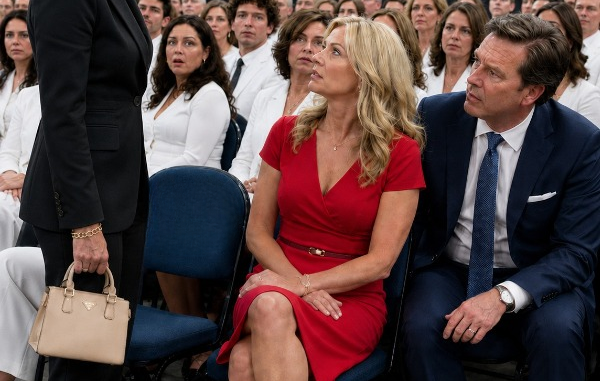
There she was—Chloe, my ex-husband David’s new wife. Young, polished, dressed in an expensive blue dress, sitting in the exact center of Row B like she had every right to be there.
She turned slowly, saw me standing at the back, and smiled.
It wasn’t warm. It was deliberate.
Then she lifted her phone and started recording.
Before I explain what happened next, you need to understand what led here. Otherwise it would be easy to mistake restraint for weakness. I wasn’t weak. I was careful—and careful rarely looks like strength from the outside.
David left when Michael was six.
He came home one afternoon and said he had “outgrown” me, like I was something he no longer needed. There was someone else. A new life. A clean break.
That night, Michael stood in Spider-Man pajamas watching me cry on the kitchen floor. I picked him up and told him we would be fine. He held on so tightly I could feel him shaking.
We started over.
We stayed with my sister Claire for a while, then moved into a cramped apartment above a restaurant where the heat barely worked and the door never closed properly. Michael got the room. I got the couch.
Money was always gone before the month was over.
David rarely paid what he was supposed to. There was always a reason, always an excuse. Eventually I stopped expecting anything from him.
I worked mornings cleaning offices and nights doing alterations. Sleep became optional. Everything else became secondary.
Everything except Michael.
He never had luxury, but he always had stability. Books. School supplies. A mother who showed up.
Every single time.
He grew into a brilliant student. Teachers noticed early. So did everyone else. I drove him across town for better schools, competitions, camps—whatever gave him a chance.
David showed up twice in twelve years. Both times just long enough for a photo.
Photos were his specialty. Presence was not.
So when Chloe took my seat that day, I didn’t move. Not because I didn’t care—but because I refused to turn my son’s achievement into a spectacle for someone else’s satisfaction.
I stayed under the exit sign and waited.
This wasn’t the first time Chloe had tried to erase me in small, calculated ways—posts, comments, quiet provocations meant to diminish me without ever crossing a visible line.
My attorney even kept a record of it. We called it the Chloe file.
By graduation day, it had become a pattern.
That morning, Michael hugged me outside the auditorium.
“I love you, Mom,” he said.
Then he added quietly, “I know everything you did for me.”
Later, he told me not to cry.
“Why would I cry?” I asked.
“Because today’s going to be a good day,” he said.
I didn’t understand him then.
Not yet.
An hour later, I was standing at the back while Chloe sat in my son’s seat. My sister Claire was furious beside me.
“She took your place,” she whispered.
“Not today,” I said. “This day is his.”
So I stayed still.
Then the principal stepped up.
“And now,” he announced, “our valedictorian—Michael Evans.”
The room erupted.
David stood immediately, clapping like he had earned something. Chloe raised her phone again.
Michael walked onto the stage.
But he didn’t look at them.
He looked at me.
Then he unfolded his speech, paused, and folded it back up.
“I wrote something,” he said into the microphone. “But I’m not reading it.”
The room went silent.
“I was going to thank everyone who helped me get here,” he continued.
Then his gaze shifted briefly toward Chloe.
“But something happened this morning that I can’t ignore.”
The atmosphere changed instantly.
“You thought nobody saw what you did,” he said, pointing directly at her. “You thought you could take what wasn’t yours.”
He held up the torn name card.
“My mother worked two jobs for eighteen years to get me here.”
His voice steadied.
“She cleaned offices before sunrise. She worked through the night. She never missed a single step of my life.”
Then he pointed to the back of the auditorium.
“I’m here because of her.”
Every head turned.
Six hundred people looked at me.
Not at Chloe. Not at David.
At me.
And in that moment, standing beneath the exit sign, I understood what my son had been preparing all along.
Every sacrifice had already been seen.
And this—this was his way of making sure no one could ever deny it again.
Leave a Reply