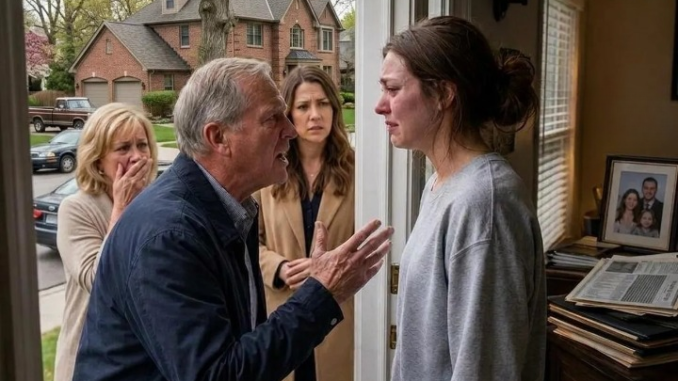
When Claire learned the heartbreaking news that her husband Ethan and their two young children, Lily and Noah, had died in a tragic highway crash, her life was shattered in an instant. In her deepest grief, she turned to her parents for comfort, hoping they would stand by her during the worst moment imaginable. Instead, she was met with a devastating response: her father said they would not attend the funeral because it conflicted with her sister Melissa’s long-planned birthday celebration. Alone in a hospital chapel, Claire realized something she had long avoided admitting—her needs had always been treated as secondary. Losing her husband and children made that painful truth impossible to ignore.
The funeral was one of the most painful days of her life. Standing beside the caskets of Ethan and their children, Claire was supported not by her own family, but by Ethan’s relatives, who stayed close and helped her through every moment. His parents never left her side, and her Aunt Ruth traveled hours just to be there after hearing the news. Meanwhile, Claire’s parents, sister, and most of her relatives were absent. Days later, her mother messaged her, upset that Claire had not called to celebrate Melissa’s birthday. Rather than engaging in conflict, Claire quietly distanced herself from her family. Over the following months, she focused on grieving, healing, and slowly rebuilding her life with the help of those who truly showed up for her.
As time went on, Claire made major changes. She updated her legal arrangements, removed her parents from key roles in her affairs, and created the Miller Memorial Road Safety Foundation in honor of her husband and children. When a legal settlement from the accident became public, media coverage also revealed her family’s absence from the funeral. Suddenly, relatives who had been silent began reaching out. One day, her parents and sister arrived demanding to talk, but Claire saw clearly that their renewed interest came only after public attention and money were involved. With her attorney and Aunt Ruth by her side, she confronted them calmly and made it clear that real support is proven in moments of loss, not when benefits appear.
That conversation became a turning point. Claire finally let go of the expectation that her family would change. She told them what she had always needed was simple: to have her parents beside her when her world collapsed. That moment had already passed. After they left, she didn’t feel anger as much as relief. In the months that followed, she devoted herself to her foundation, turning her grief into purpose and helping other families facing similar tragedies. On the anniversary of the accident, she visited her family’s resting place and reflected on their memory. The pain remained, but so did a quiet strength. She had learned that healing isn’t about forgetting—it’s about moving forward with dignity, holding on to love while choosing peace and self-respect.
Leave a Reply