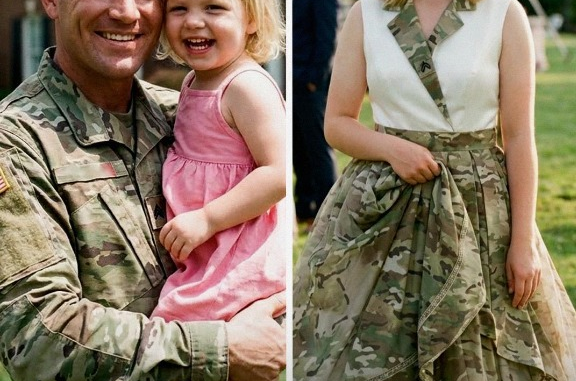
Prom night was meant to be ordinary—until I walked out wearing a dress I’d sewn from my dad’s old uniform. My stepfamily mocked me, but everything changed with a single knock at the door. That night, I learned what loyalty, loss, and reclaiming my own story truly meant.
The first time I started sewing, my hands shook so badly I pierced my thumb with the needle. I swallowed the pain, wiped away the blood, and kept going, careful not to stain the worn olive fabric spread across my bed. If Camila or her daughters found out I was using Dad’s uniform, I knew I’d never hear the end of it.
His jacket was worn at the edges, softened by years of use. The night we found out he wasn’t coming home, I held it close, breathing in the faint traces of his scent. Now, every cut of the scissors and every stitch felt like I was piecing myself back together.
I never cared much about prom the way my stepsisters, Lia and Jen, did. While they obsessed over dresses and details, I stayed quiet, pretending it didn’t matter. But deep down, I remembered the small moments with Dad—him teaching me how to sew, guiding my hands with patience. After my mom passed, those memories became everything.
When Dad married Camila, the house changed. Her kindness disappeared whenever he wasn’t around, and I was left with endless chores while my stepsisters treated me like I didn’t belong. Sometimes, I’d stand in Dad’s closet, holding his jacket and whispering how much I missed him.
That’s when I decided: I would wear his uniform to prom—not as it was, but transformed into something new. Something that carried his memory and my strength.
For weeks, I worked in secret, sewing late into the night after finishing my chores. It became my quiet escape, my way of staying close to him. When I finally finished and tried it on, I didn’t see the girl everyone overlooked—I saw someone strong, someone who had built something meaningful from what she’d been left.
On prom night, the house buzzed with chaos. No one noticed me until I walked down the stairs. Then came the laughter. My stepmother mocked me, my stepsisters sneered, and their words stung—but I refused to let them break me.
Then the doorbell rang.
A military officer stood outside, accompanied by an attorney. They asked for me. My father had left instructions—something to be delivered on prom night. As Camila read the letter aloud, her voice trembled. My dad had placed the house in my name, with one condition: that I be cared for. If that promise was broken, everything would revert to me.
And it had been broken.
In that moment, everything shifted. The house was mine. Their control over me was gone.
The officer told me my father had one more wish—that I still go to prom. Outside, a car was waiting.
When I arrived, I braced myself for more judgment. Instead, people noticed. They understood. What I expected to be ridicule turned into quiet admiration, then applause. For the first time, I felt seen—not as someone small, but as someone strong.
Later that night, I returned home to silence. My stepfamily was packing. On the table sat one final letter from my dad.
“You’re braver than you think.”
I held those words close, standing in the home that was finally mine again. For the first time since he was gone, I realized something important:
I hadn’t just honored him that night—I had found myself.
Leave a Reply