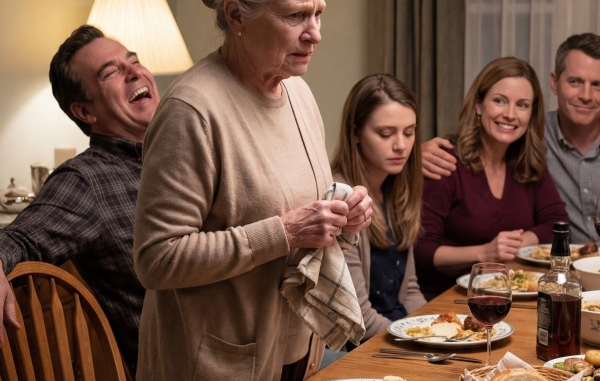
Laughter spread across the table.
And in that moment, something inside me quietly shattered.
I rose slowly, dabbed my lips, and said in a low voice,
“Excuse me.”
No one met my eyes.
No one noticed my silence.
But the next morning, when the bank called…
she was the first to stop laughing.
It had been a Sunday evening dinner at my daughter Laura’s house.
The table was full, wine was being poured, and conversation flowed easily.
I barely spoke—at seventy-two, I had grown used to listening more than talking.
Then, suddenly, my son-in-law Javier laughed out loud and said,
“Is this old woman going to eat everything again?”
Some tried to hide it.
Others laughed openly.
No one corrected him.
I felt heat rush to my face.
It wasn’t the first time he’d made a remark like that—but it was the first time he’d done it so openly, without shame.
I looked at my daughter, hoping she would speak.
She just stared down at her plate.
That’s when I realized how alone I was at that table.
I didn’t respond.
I’ve never been one for scenes.
I simply set down my utensils, wiped my lips, and stood up with what dignity I had left.
“Excuse me,” I repeated softly.
No one stopped me.
Behind me, the laughter lingered for a few seconds before the conversation moved on, as if nothing had happened.
As I put on my coat, I thought of everything I had done for them—
the money I had lent, the time I had given, the bills I had quietly covered when things got hard.
I had never asked for gratitude.
Only respect.
I didn’t cry that night.
The humiliation ran too deep for tears.
Instead, when I got home, I opened a folder I kept hidden away in my closet.
Inside were the loan papers I had backed with my savings—documents my son-in-law had barely glanced at.
I reviewed the dates, the terms, the clauses.
Then I picked up the phone, took a steady breath, and called my bank.
When they answered, I knew everything was about to change—for both of us.
The next morning, I met with my branch manager, Mr. Morales, who had handled my accounts for years.
I got straight to the point.
I told him I wanted to withdraw my guarantee from Javier’s business loan.
He hesitated, reminding me that the loan existed largely because of my backing.
Without it, the bank would need to reassess everything.
“I understand,” I said calmly. “But I’m no longer willing to carry that risk.”
We went over the details.
Legally, I had the right to step away—and given the missed payments, the situation had clearly changed.
I knew about those delays.
I had quietly covered two of them myself.
I wouldn’t do it again.
I signed the papers without hesitation.
This wasn’t impulsive—it was the result of years of small humiliations, careless words, and the assumption that my help was owed.
Mr. Morales warned me there could be serious consequences.
I simply nodded.
“Things can’t go on like this,” I said.
Two days later, the bank contacted Javier.
His credit line was under review, and he was asked to provide new guarantees immediately.
Without my support, his business no longer looked secure.
The missed payments surfaced.
He was called in for an urgent meeting.
That same afternoon, my phone rang.
It was Laura, crying.
“Mom, do you know anything about the bank? Javier is panicking—they might cancel the loan.”
I closed my eyes before answering.
“Yes. I withdrew my guarantee.”
There was a long pause.
“Why would you do that?” she asked, her voice trembling.
I thought about that dinner—the laughter, her silence.
“Because I won’t keep paying for a seat at a table where I’m not respected.”
That decision didn’t just affect a business.
It changed the balance of our family.
In the days that followed, everything felt heavy—like the air before a storm.
Javier called repeatedly.
I didn’t answer.
Not out of anger, but because I had already said everything that mattered.
Without my backing, the bank tightened the terms.
Interest increased. Conditions worsened.
Suppliers grew cautious.
The stability he had relied on began to unravel.
A week later, Laura came to see me alone.
She looked exhausted—her face pale, her hands tightly gripping her bag.
We sat in the kitchen, where she used to do her homework as a child.
“Mom… I didn’t realize he spoke to you that way,” she said softly. “I thought it was just joking.”
I looked at her calmly.
“Jokes don’t hurt when there’s respect,” I told her. “When respect is gone, it’s no longer a joke—it’s disguised contempt.”
I told her everything—the money, the sacrifices, the silent help.
Not to blame her, but to make her understand.
She cried.
But this time, she didn’t look away.
She listened.
In the end, Javier had to sell part of his business and renegotiate under harsher conditions.
I didn’t destroy him.
I simply stopped protecting him from consequences.
Months later, he came to my house.
No gifts. No rehearsed speech.
Just discomfort and humility.
“Mrs. Carmen… I’m sorry,” he said. “I was wrong.”
I didn’t answer immediately.
I let him in, made coffee, and listened.
Apologies don’t erase the past.
But they can open the door to something different—if they’re real.
Time would tell.
Eventually, I sat at the table with them again.
Same place. Same people.
But something had changed.
No one mocked me.
No one made careless remarks.
The room wasn’t louder—but it was more respectful.
And I understood something important:
Respect isn’t always demanded with words.
Sometimes, it’s built by setting clear, firm boundaries.
When a woman stops supporting what diminishes her, she doesn’t destroy anything—
she simply teaches others to stand on their own.
Leave a Reply