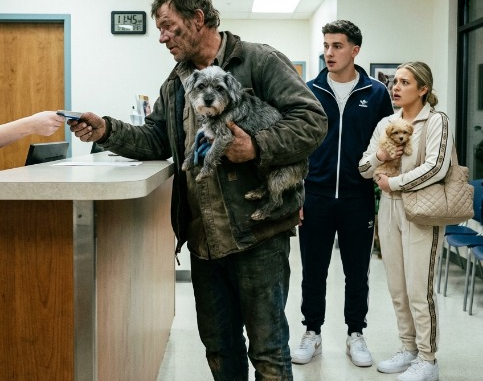
He looked like nothing more than a typical sewer worker—the sort of person most people pass by without a second glance. But after a small act of kindness shared online, his life shifted in ways he never expected.
That night, the first thing people noticed about me wasn’t my dog.
It was the smell.
Not the kind you can politely overlook—it was the kind that makes people instinctively wrinkle their noses. A mix of damp earth, corroded metal, sweat soaked into fabric, and that sour odor that clings after hours spent waist-deep in sewer water.
I couldn’t really blame them.
If I’d crossed paths with someone like me at two in the morning, I probably would’ve reacted the same way.
The truth is, I was supposed to be nowhere but a muddy trench outside Ridgefield. A main sewer line had collapsed beneath an old road, and when that happens, timing doesn’t matter—midnight or a holiday morning, it has to be fixed before sewage backs up into people’s homes.
So there I was, shovel in hand, body aching, boots stuck deep in sludge, when my phone started buzzing in my jacket.
It was my neighbor, who looks after my dog during my late shifts.
“Levi,” she said as soon as I answered, “I think Winston’s not okay.”
Those words can hit harder than anything.
Winston wasn’t just a pet.
He’d been with me for twelve years.
A scruffy terrier mix with a crooked tail and mismatched ears—one sticking straight up, the other drooping to the side.
He’d been there through my divorce, through losing jobs, through long, quiet nights when the house felt empty.
So when she said he’d been whining and his stomach felt hard, I didn’t hesitate.
I climbed out of the trench, still soaked in sewer water, tossed my tools into the truck, and drove.
That’s how I ended up at 2:15 in the morning, sitting in the waiting room of North Valley Emergency Veterinary Hospital, looking like I’d crawled straight out of a drain.
That’s when I noticed the couple.
They stood out immediately.
They looked like they belonged in a fitness magazine—matching white hoodies, spotless sneakers that probably cost more than everything I owned, and a tiny golden puppy tucked into a designer carrier.
They smelled clean and expensive.
I smelled like a broken sewer line.
The woman noticed me first, her nose tightening slightly before she turned away. The man leaned toward her, whispering something, and they both glanced at my mud-covered boots.
I pretended not to notice.
My attention stayed on Winston, curled in my lap, trying to shrink away from the pain. His breathing was shallow, his belly tense under my hand.
“Hang in there, buddy,” I whispered.
Across the room, their whispers grew louder.
“God, that smell,” the man muttered. “Why bring a pet here if you obviously can’t afford it?”
The woman hushed him softly but clutched her purse closer.
“It’s sad,” she said. “If he can’t even clean himself up, how would he pay for surgery? Maybe the kindest thing would be to just…”
She didn’t finish, but she didn’t have to.
My jaw tightened, but I stayed silent.
I kept stroking Winston’s head while the vending machine hummed and the fluorescent lights flickered overhead.
Then the receptionist called their name.
Their puppy had swallowed a sock.
I listened as the vet tech explained the cost.
“An endoscopy and observation will be about thirty-two hundred dollars. We’ll need a deposit first.”
The man confidently handed over a sleek black credit card.
Beep.
Declined.
He forced a laugh. “That’s strange. Try this one.”
Another card.
Another beep.
Declined again.
Panic slowly spread across his face.
The woman leaned in, whispering urgently.
“You said we maxed out the travel card in Cabo.”
“I know,” he snapped. “Check the savings.”
“The bank’s closed.”
They stood there, frozen.
The people who had looked like they had everything suddenly seemed unsure, like the ground beneath them wasn’t as solid as they thought.
Then the technician called my name.
“Mr. Mercer?”
I stood, bits of dried mud falling from my jeans onto the clean floor.
The vet examined Winston quickly, her expression tightening.
“It looks like gastric torsion,” she said. “We need to operate immediately. It’s serious, but treatable. The cost will be around seventy-five hundred dollars.”
Behind me, the couple went quiet.
They expected hesitation. Bargaining. Maybe desperation.
Instead, I pulled out my debit card.
“Do it,” I said.
The receptionist hesitated. “All of it?”
“Whatever he needs.”
The machine beeped.
Approved.
I kissed Winston’s nose before they carried him away.
“Stay strong, old man.”
Then I sat back down.
The couple stared at me, stunned.
I grabbed two bottles of water from the vending machine and handed one to the man.
“Take a breath,” I said.
“I don’t understand,” he admitted.
I shrugged. “I work long hours doing jobs most people don’t even want to think about. It pays the bills.”
The woman looked down at her spotless shoes.
“We just wanted everything to look perfect,” she said quietly.
“That’s the problem,” I replied. “You’re chasing appearances instead of building something real.”
I nodded toward the surgery doors.
“My dog doesn’t care if I’m covered in dirt. He cares that I show up when it matters.”
Then, almost without thinking, I added, “Put their deposit on my card too.”
They immediately protested, but I raised my hand.
“Just promise me one thing,” I said. “Don’t judge people by how they look.”
Three days later, a video from that night surfaced online.
Someone had recorded everything.
By morning, millions had seen it.
Half the internet called me a hero. The other half called me foolish.
Strangers messaged me asking for money. Others accused me of faking it. Someone even drove past my house filming me.
Fame didn’t feel glamorous—it felt invasive.
A week later, Winston was healing, and I returned to the clinic for a checkup.
The couple was there again.
But this time, they looked different.
Their puppy—Sunny—lay wrapped in a blanket, barely moving. Their eyes were red from crying.
“His intestines are blocked,” the man said quietly. “We can’t afford surgery.”
People recognized them from the video.
Someone muttered, “Maybe they should’ve thought of that before.”
The woman broke down completely.
In that moment, it was clear—the internet had painted them as villains.
But standing in front of me were just two scared people who loved their dog.
So I did what felt right.
I pulled out my wallet again.
Not to prove anything—but because I remembered how helpless I’d felt watching Winston disappear into surgery.
“Use this,” I told the receptionist.
They stared at me, stunned.
“Why help us again?” she asked through tears.
I thought for a moment.
“Because one bad moment shouldn’t define your whole life,” I said. “And because the internet doesn’t decide who deserves kindness.”
Sunny survived.
Winston recovered fully.
The internet moved on within days.
But something stayed.
Months later, they came to visit—with a healthy, energetic Sunny—and handed me a note:
“You didn’t just save our dog.
You changed how we see people.”
The truth is, the world prefers simple stories—heroes and villains. But real life isn’t that clean. People make mistakes when they’re scared or overwhelmed, and those moments shouldn’t define them forever. Kindness shouldn’t depend on appearances, money, or approval. Sometimes the people who look the roughest carry the strongest sense of loyalty. And sometimes the most meaningful thing you can do is choose compassion, even when others don’t.
Leave a Reply