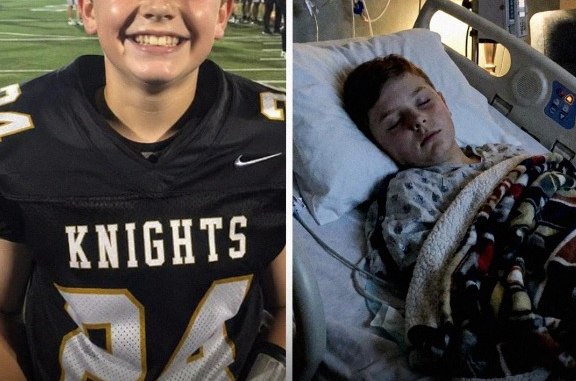
When my thirteen-year-old son slipped into a coma after a walk with his father, I felt as if my entire life had collapsed in an instant. But a hidden note in his hand—and a message I nearly overlooked—forced me to face a devastating truth that could destroy his father, and to decide just how far I would go to protect my son’s life.
I will never forget the hospital’s sterile smell or the harsh lights that burned at 3 a.m.
The day before, Andrew had left for a simple walk with his father and never returned the same—he was brought back unconscious, in a coma.
Andrew was vibrant, the kind of 13-year-old who wore through sneakers quickly and left his belongings scattered everywhere. I had reminded him as always, “Take your inhaler, just in case.”
He smiled and brushed it off.
That was the last real moment I had with him before a phone call shattered everything and turned my child into a body connected to machines.
By the time I reached the ER, Andrew was already unconscious. I rushed through the doors, gripping my bag so tightly my nails left marks.
Brendon, my ex-husband, sat nearby looking pale and shaken, repeatedly insisting he didn’t understand what happened. He said they were just walking when Andrew suddenly collapsed and emergency services were called immediately.
I wanted to believe him—but his history with Andrew’s health made that difficult. He had ignored medical advice before and dismissed concerns as overreactions.
Something inside me didn’t settle.
A doctor with exhausted eyes explained gently that Andrew had collapsed suddenly, experienced cardiac arrest, and had been revived, but remained in a coma. They were still searching for the cause, and time was critical.
As I stood beside my son’s bed, listening to the steady machines, everything else faded away.
Brendon cried loudly, but his reaction felt unsettling—almost rehearsed, as if he were trying to prove innocence rather than express shock.
I leaned over Andrew, whispering to him, holding onto hope even as fear pressed down on me.
I asked the doctor for his full medical history. Everything mattered now.
Brendon insisted again that nothing had been wrong during the walk. Too quickly. Too firmly.
Something in his expression flickered when I pressed him further, but he denied everything and blamed coincidence.
When visiting hours ended, I stayed with Andrew alone. In the silence, I noticed his hand was clenched tightly.
Inside it was a small, damp piece of paper.
My heart pounded as I carefully opened it.
The message inside froze me:
“Mom, open my closet for the answers. BUT DON’T TELL DAD!”
It wasn’t just a note—it was a warning.
Why would he hide something from his father?
I promised Andrew silently that I would follow his instructions.
Later that night, I went home and entered his room, the house feeling eerily still. His closet was slightly ajar, as if someone had already been there.
Inside, I searched carefully, my thoughts racing through every possibility.
At the top shelf, I found a blue box.
Inside were medical documents—an upcoming cardiology appointment, along with records showing a previous heart condition that required monitoring.
Then I saw it.
The appointment had been canceled.
Not postponed. Canceled entirely—by his father.
A note from Andrew was tucked inside: his father had told him it wasn’t necessary and that I would “panic.”
I froze, realizing decisions had been made without me—decisions that may have put my son at risk.
When I confronted Brendon over the phone, he dismissed it, saying it was unnecessary, too expensive, and that Andrew seemed fine. He accused me of overreacting.
But I knew better now.
Shortly after, I found something else I had missed in the chaos—a video message from Andrew recorded shortly before he collapsed.
In it, his voice was weak and frightened. He admitted he felt chest pain and dizziness. He said his father told him to stay quiet and not tell me, warning him not to “cause a scene.”
Then Brendon’s voice cut in the background, telling him to stop and insisting he was fine.
The video ended.
I sat in shock, overwhelmed by guilt. My son had tried to reach me—and I hadn’t known in time.
I immediately contacted the hospital and shared everything.
By morning, the medical team reviewed the evidence. I returned to the hospital, where tensions were high and emotions raw.
I told Brendon everything I had found. He defended himself, claiming he believed Andrew was okay and didn’t want to worry me.
But the truth could no longer be ignored.
I requested full medical review and intervention from hospital staff.
A social worker and doctor reviewed the documents and video. After careful consideration, they reassigned me as Andrew’s primary medical decision-maker and ensured no changes would be made without my consent moving forward.
They also confirmed Andrew’s care plan would be updated immediately.
It wasn’t justice—but it was protection.
Brendon stood silent as the reality settled in.
Later, the doctor told me there was still reason for cautious hope, and that Andrew was stable for the moment.
When I returned to his bedside, I held his hand and promised him I was there now—completely.
No more missed signs. No more silence.
When Brendon later apologized, I acknowledged the fear that had driven everything—but made it clear that Andrew would always come first.
That night, I stayed beside my son, watching the monitors and holding onto the smallest thread of hope.
Because even now, he was still fighting—and so was I.
Leave a Reply