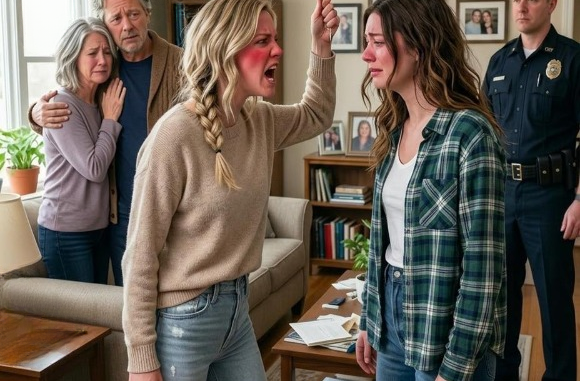
I bought my $550,000 house in secret because I knew my own family would try to take it the moment they found out. One day, I came home and froze—my sister was already inside, using a stolen spare key, rearranging my furniture and moving through my belongings as if she had every right to claim the house as hers. In that moment, I realized this was no longer a family disagreement but outright betrayal, so I called the police, and what happened next changed everything.
I had purchased the home without telling my family, and somehow that alone seemed to offend them before they even knew it existed.
The house sat at the end of a quiet street in Raleigh, North Carolina—blue-gray siding, white trim, a wide porch, and a fenced backyard I had imagined sharing with a future dog. It cost $550,000, far more than I had ever spent before, but at thirty-four, working as a senior project manager in medical software, I had built a life entirely on my own.
My name is Lauren Pierce, and I learned early that in my family, privacy was treated as betrayal whenever it prevented others from accessing what I had earned.
My younger sister Jenna had always acted as if boundaries were optional. She borrowed money she didn’t return, stayed far longer than she promised when she moved in, and always managed to position herself as the victim in every conflict. My parents excused her behavior, but I saw it clearly as entitlement reinforced over time.
So when I bought my house, I told no one except my realtor, attorney, and closest friend. I changed the locks immediately, installed cameras, and kept the address private.
Six weeks later, I came home from work and saw Jenna’s car outside.
The front door was unlocked.
Inside, my living room had been completely rearranged, my belongings displaced, and boxes labeled with her name placed near the stairs. Upstairs, I heard movement—drawers opening, things being shifted. Then I heard her casually speaking as if she belonged there.
For a moment, I couldn’t process it. Then she appeared on the stairs, acting as though my reaction was the only unreasonable part of the situation.
When I asked what she was doing in my house, she dismissed me and said our mother had expected me to react this way. That was when I realized this had been planned without me.
I demanded to know how she got a key, and she claimed our father had one. I had never given him one.
At that point, I understood this wasn’t confusion—it was unauthorized entry. I called 911.
Jenna panicked and tried to stop me, insisting it was a family matter, but I refused to hang up.
While I spoke to the operator, she called our mother, who arrived before the police. Instead of acknowledging what had happened, my mother insisted Jenna had every right to be there and framed my resistance as selfishness.
When the officers arrived, I explained everything and provided proof of ownership. Jenna claimed she had permission, but couldn’t explain how she entered without it. Eventually, it came out that my father had duplicated a key without my consent and passed it along.
The officers made it clear this was unauthorized entry. I formally trespassed her from the property and documented everything.
My parents reacted with anger, insisting I had overreacted and should have simply shared the space. But the decision had already been made for me the moment my trust was violated.
Jenna was required to leave immediately, and I changed every lock and tightened every security measure afterward. My family called it cruel. I called it necessary.
Months later, I adopted a rescue dog and began rebuilding my sense of peace in the same home they had tried to claim.
In the end, the situation revealed something I had been avoiding for years: my stability had been treated as something available for others to use, rather than something I had the right to protect.
What changed everything wasn’t just calling the police—it was finally accepting that setting boundaries meant losing the expectation that they would be respected.
And the house, once just a purchase, became something else entirely: a place that was finally mine, because I had made it clear no one else could take it.
Leave a Reply