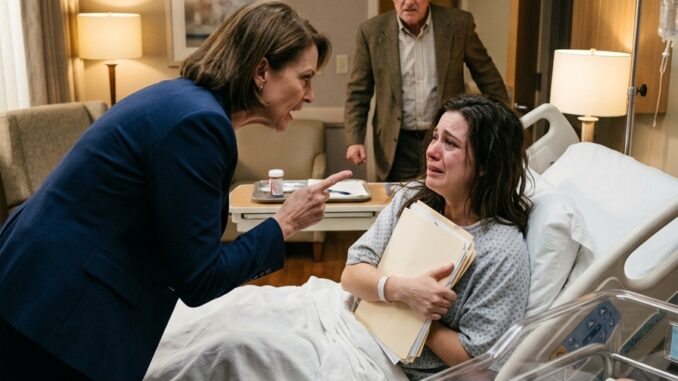
After I lost our baby, my mother-in-law struck me in the hospital and coldly snapped, “You’ve brought shame on this family, so stop pretending you’re the victim.” She humiliated me in front of my parents while my husband stood there, frozen and silent, too weak to defend me. She only grew louder and harsher until my father stepped forward and warned, “Touch my daughter again, and you’ll face the consequences.”
Part 1: The Room Where Everything Fell Apart
The hospital room carried the sharp scent of antiseptic, stale coffee, and fear. Harsh fluorescent lights hummed overhead, making everything look drained—including me. I was twenty-eight, and less than a day earlier, I had nearly died. A ruptured ectopic pregnancy had forced emergency surgery that saved my life but left me physically and emotionally shattered. A thick bandage stretched across my abdomen, pulling painfully whenever I moved, while machines beside me beeped steadily, monitoring a body that no longer felt like my own.
My husband, Ryan Mercer, stood near the window in a wrinkled suit, staring out at the rainy Chicago skyline. His posture—hands buried in his pockets, shoulders slightly hunched—was one I knew well. When things became difficult, he retreated, present in body but absent in spirit. At thirty, he had mastered the art of avoiding confrontation while letting others take control.
The doctors had ordered strict rest and limited visitors, but those instructions meant nothing when the door swung open and Diane Mercer walked in as if rules didn’t apply to her. Her perfume and presence quickly overwhelmed the sterile air. At fifty-five, she carried herself with wealth, entitlement, and a belief that she was above basic courtesy. She looked at me not with concern, but with irritation.
“So this is what you’re doing now?” she said sharply. “Lying in a hospital bed and forcing everyone to revolve around your drama? Ryan hasn’t slept in days because of you.”
Pain shot through me as I inhaled. “Mom, please,” Ryan muttered without turning. “She just had surgery.”
Diane ignored him, stepping closer. “Women have surgery all the time. They don’t use it to control their husbands or disrupt their schedules. Ryan missed an important meeting because you couldn’t handle something simple.” Whether she knew I had lost a child—or chose to dismiss it—was impossible to tell.
What she didn’t notice was my father, Daniel Brooks, standing quietly near the door. To her, he was insignificant—a retired man in simple clothes. In reality, he had spent decades as a formidable corporate lawyer, dismantling powerful opponents with precision. Silent and observant, he watched her closely, already anticipating the damage she was about to cause.
Part 2: The Moment Everything Escalated
“Please leave,” I whispered, my voice raw and fragile. “I can’t handle this today. I just lost—” The words caught in my throat as grief overwhelmed me. The monitor beside me began to quicken, reflecting my rising panic.
Diane showed no compassion. Instead, she leaned in closer, her tone sharpening. “Now you want boundaries? You didn’t care about boundaries when you pulled Ryan away from his family or convinced him to spend holidays with yours. You’ve been draining him from the start.”
I looked at Ryan, hoping for support. “Ryan, make her leave.”
He shifted slightly but didn’t intervene. “Mom, stop. The nurses will hear. Let’s just go.” He avoided confrontation, as always.
Diane turned back to me. “You’re not the victim here. You’re weak and manipulative—”
“Get out!” I cried, trying to sit up despite the pain.
Before I could react, her hand struck my face. The sound echoed through the room. My head snapped to the side, pain flaring instantly as I tasted blood. The monitor screamed as everything blurred.
Ryan reacted too late. My father didn’t. He stepped forward immediately, gripping Diane’s wrist firmly and positioning himself between us. His calm was more intimidating than anger.
“You touched my daughter once,” he said quietly. “Now you answer to me.”
She tried to pull away, protesting, but he remained steady. Then he took out his phone and made a call—not to hospital staff, but to someone with far greater authority.
Part 3: Consequences Begin
Within minutes, nurses rushed in, followed by police. Diane tried to twist the situation in her favor, claiming she was the victim. But it didn’t work.
She was placed under arrest for assault.
Ryan finally approached me, apologizing weakly, but it was far too late. My father stepped in again, his voice calm but final as he called out Ryan’s failure to act.
Then came another revelation: my father had quietly been the financial force behind Ryan’s company. A clause in their agreement allowed him to act if misconduct occurred—and Diane’s actions had triggered it.
With a single decision, everything Ryan had built began to collapse.
Part 4: Their World Unravels
In the days that followed, consequences unfolded quickly. Diane faced legal charges and public humiliation. Ryan lost control of his company and faced financial and professional fallout. Their lives, once built on status and control, began to unravel under the weight of their own actions.
Meanwhile, I returned to my parents’ home, beginning the long process of healing—physically and emotionally.
Part 5: Rebuilding My Life
As time passed, my strength slowly returned. The pain faded, and with it, the constant tension I had lived under. I began to feel like myself again—free from fear and judgment.
Six months later, I sat with my father, sharing news that I had signed a lease to open my own art gallery. His quiet pride meant more than anything else. He had not only protected me—he had reminded me what real support and love look like.
I also received messages from Ryan, filled with apologies and requests for help. I didn’t respond. I didn’t need to.
Part 6: A New Beginning
Two years later, my gallery opening was filled with life, energy, and possibility. Surrounded by art and people who supported me, I finally felt whole again.
The memory of that hospital room never fully disappeared, but it no longer controlled me. What was meant to break me had instead awakened something stronger.
When I raised a glass that night, I didn’t dwell on the past. I focused on what came after.
“To strength,” I said. “And to new beginnings.”
And for the first time in a long time, I truly meant it.
Leave a Reply