I spent fifteen days in a hospital bed after the car accident—fifteen long, indistinct days under bright fluorescent lights, surrounded by the steady beeping of machines. My body was injured in ways I didn’t fully understand yet, and I couldn’t speak, my voice lost somewhere between pain and medication.
The doctors said I was lucky to be alive, but it didn’t feel like luck. It felt like being stuck in a quiet, empty space while time kept moving without me. My children lived far away and couldn’t visit, my friends returned to their daily lives, and the hours dragged on—especially during the long, difficult nights.
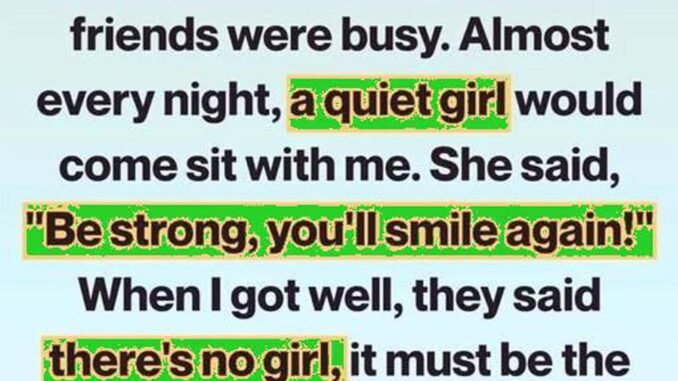
That’s when the loneliness truly set in, deep and overwhelming. Nearly every night, a girl appeared—quiet, around thirteen or fourteen, with dark hair tucked behind her ears and eyes that carried a maturity beyond her age.
She never said who she was or why she came. She would simply sit beside my bed, hands folded, as if she belonged there. I couldn’t speak or ask questions, yet somehow she seemed to understand.
One night, she leaned in and softly whispered, “Stay strong—you’ll smile again.” Those words became something I clung to whenever the pain and fear grew too intense.
Her visits became the one thing I could count on. When the pain worsened or the silence felt unbearable, I found myself waiting for the quiet scrape of the chair and the comfort of her presence.
She never touched the machines or interrupted the nurses—she just stayed. And in a place where I felt unseen, that simple presence meant everything.
When I finally regained my voice and asked the hospital staff about her, they gently told me no such visitor had ever been recorded.
They suggested it might have been the medication or the trauma—hallucinations brought on by stress. I accepted that explanation because I had no other answer.
Six weeks later, I was discharged and returned home, still weak but grateful. As I unlocked my front door, a familiar stillness came over me—the same feeling I had experienced during those quiet hospital nights.
Then I saw her standing outside my door. “My name is Tiffany,” she said, nervously fidgeting with her hands.
She explained that she was the daughter of the woman who had crossed into my lane and caused the crash—the mother who hadn’t survived despite surgeries and time in intensive care.
Tiffany told me she had spent those nights wandering the hospital corridors, unable to face going home alone, and that watching me fight had given her hope that her own mother might recover.
Then she placed something in my hand—a necklace that belonged to my grandmother, which I had thought was lost forever in the accident. She had found it and kept it safe, afraid it might disappear.
Overcome with emotion, I broke down and embraced her, both of us sharing the weight of our grief in that moment of connection. Over time, that bond only grew stronger. I became like a mother figure to her, and we stayed part of each other’s lives.
Even now, whenever she visits and I catch myself smiling, I think of the quiet girl who sat beside me when no one else could—and how, in the darkest moment of our lives, her simple kindness changed everything.
Leave a Reply