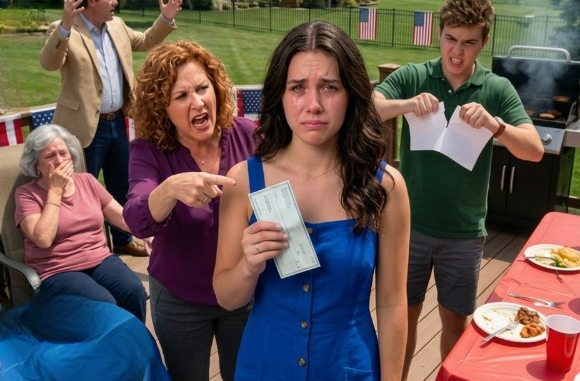
The Fourth of July cookout at my grandmother’s house was always loud, messy, and one wrong comment away from becoming an argument.
That year was no different. The air was thick with the smell of charcoal, corn on the grill, and lighter fluid. My grandmother, Gloria Bennett, sat in her usual chair beneath a faded umbrella, quietly observing everyone as if she were taking mental notes on who they really were. At 81, she was still sharp and aware, just quieter than she used to be—but when she spoke, people still paid attention.
At least, they used to.
By mid-afternoon, my stepmother Denise had already found fault with the food, someone’s appearance, and even the fireworks display. My stepbrother Tyler, 26 and directionless, was still acting like a teenager, splashing around in the pool. My dad just laughed along with everything Denise said—the same automatic laugh he used whenever he chose avoidance over confrontation.
I stayed near the cooler, helping with drinks and staying out of the way. After my mom died and my dad remarried, that had become my role. Denise made sure I never forgot I didn’t fully belong, and Tyler followed her lead. He once called me a “charity case” because I worked two jobs while attending community college. Everyone heard it. No one responded.
As the sun started to set, Grandma tapped her glass with a spoon.
“I have something for all of you,” she said.
The yard went quiet.
She handed each of us an envelope. Inside was a check—$15,000 each.
For a moment, no one spoke.
Tyler let out a low whistle. Denise laughed in disbelief. My dad stared at his like it might vanish.
Grandma simply said, “I wanted to do something while I’m still here to see it matter.”
Then Denise flipped hers over and smirked.
“This account was closed years ago,” she said.
Everything shifted instantly.
Tyler laughed and ripped his check in half. “Problem solved.”
Denise laughed harder. “This is worse than nothing.”
I looked at Grandma. She didn’t argue or defend herself—just watched, quietly hurt, like she already knew how it would go.
So while everyone mocked or destroyed theirs, I folded mine carefully and put it away.
Denise noticed. “You’re actually keeping that?”
“Yeah,” I said.
“Hope doesn’t cost anything,” she replied.
The next morning, I took the check to a credit union expecting it to be rejected.
Instead, the teller looked at it, paused, and immediately went to get her manager.
A few minutes later, I was told the truth.
The account hadn’t simply been closed—it had been moved into a trust created by my late grandfather. And it came with a condition: the check had to be preserved and presented within ten business days by the person it was issued to. If it was torn, discarded, or ignored, it was considered declined.
That meant Tyler’s was gone. Denise’s was invalid. My dad’s never made it.
Only mine was still valid.
And the trust held more than $400,000.
I left in shock—not just because of the money, but because of what it revealed.
When I returned to the house, everyone was already there trying to undo what they had done. Tyler was taping his torn check together like that could fix it.
The room went silent when I walked in.
Grandma watched quietly.
Tyler insisted his should still count, but Grandma shook her head.
“You tore it in front of me.”
“It was for all of us!” he argued.
“And you showed me what it meant to you,” she said simply.
My dad tried to intervene, but she didn’t change her mind.
“This wasn’t a trick,” she said. “It was a gift. Your actions decided what it became.”
Then my younger stepsister Kayla spoke up softly.
“I still have mine.”
For the first time that day, Grandma smiled.
In the end, only two checks were honored: mine and Kayla’s. The rest were void—destroyed or never submitted in time.
There was nothing left to argue.
Later, Grandma explained that my grandfather had designed the trust intentionally. He had watched the family dynamics for years and understood exactly what would happen when money entered the picture.
It wasn’t a test in cruelty.
It was a reflection.
Months later, sitting with her on the porch, she said something I never forgot:
“People think inheritance is about money. It isn’t. It’s about character. Money only reveals it.”
And I finally understood.
My grandfather hadn’t set a trap.
He had left a mirror.
And what it showed was worth far more than $15,000.
Leave a Reply