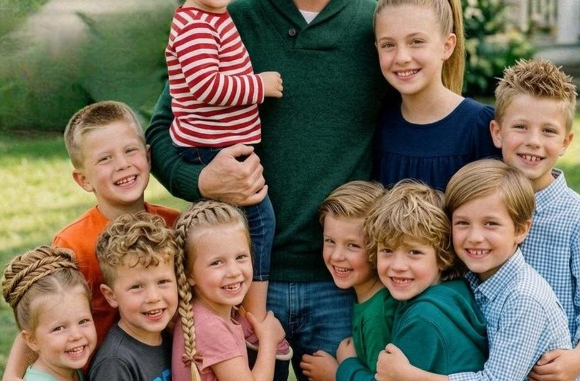
For seven years, I believed grief was the hardest thing our family had survived.
I spent that time raising the ten children my late fiancée left behind, convinced that losing her was the deepest wound we carried. Then, one night, my oldest daughter told me she was finally ready to reveal what really happened—and everything I thought I knew began to fall apart.
By seven in the morning, I had already burned toast, signed school forms, found a missing shoe in the freezer, and broken up two arguments before coffee. I’m forty-four now, and for seven years I’ve been raising ten children who aren’t biologically mine. It’s noisy, exhausting, and the only life I’ve known since Calla was gone.
Calla was supposed to be my wife—the steady center of our home, the one who could calm chaos with a glance or a song. Then, seven years earlier, her car was found near a riverbank: the door open, her purse still inside, her coat left on the railing above the water. Hours later, they found Mara, her eleven-year-old daughter, barefoot and silent on a roadside. She didn’t speak for weeks. When she finally did, she said she couldn’t remember anything. With no body recovered, we buried Calla after ten days of searching.
And I was left with ten children who suddenly had nowhere else to turn.
People told me I was foolish to fight for custody of all of them. Even my brother warned me that loving them was one thing, but raising ten children alone was another entirely. Maybe he was right. But I couldn’t let them be separated. So I learned everything—haircuts, school routines, medical schedules, comfort at 2 a.m., and how to be exactly what each child needed. I didn’t replace Calla. I stayed.
That morning, Mara asked if we could talk later. The way she said it stayed with me all day.
After dinner, she found me in the laundry room and said it was about her mother. Then she told me something I wasn’t ready for: she had never truly forgotten that night. She had remembered everything the entire time.
At first, I didn’t understand. Then she explained that Calla hadn’t drowned or disappeared. She had left. She had driven to the bridge, staged the scene with her coat and purse, and walked away. She told Mara she was drowning in debt, that she had someone waiting for her elsewhere, and that the children would be better off without her. She made an eleven-year-old promise to stay silent.
And Mara kept that promise—for seven years.
What broke me wasn’t just the abandonment. It was the fact that Calla had handed her guilt to a child and called it protection.
Then Mara showed me proof: Calla had contacted her weeks earlier. A photo. A message. A life rebuilt somewhere else, now resurfacing with an apology.
The next day, I went to a lawyer.
As their legal guardian, I had the authority to protect the children and control any contact. By the following day, formal notice ensured that any communication from Calla would go through legal channels—not through Mara again.
A few days later, I met Calla in a church parking lot.
She looked worn down, but that didn’t soften anything. She spoke about needing to leave, about believing I could give them a better home, about thinking time would heal everything. I told her plainly that abandonment wasn’t sacrifice. And that using a child to carry her secret was something I couldn’t excuse.
When I asked why she contacted Mara first, she admitted it was because she knew Mara would respond. That alone told me everything I needed to know.
When I returned home, I told Mara she no longer had to carry what her mother left behind. Then, with the lawyer’s help, I gathered all ten children and told them the truth as gently as I could.
There was shock, anger, confusion—silence that stretched too long. But then something shifted. One by one, they turned toward Mara instead of away from her.
They didn’t blame her. They stayed with her.
Later, Mara asked me what she should say if her mother tried to come back into their lives. I told her the truth.
Calla may have given them life, but I was the one who showed up for it.
And by then, we all understood those were not the same thing.
Leave a Reply