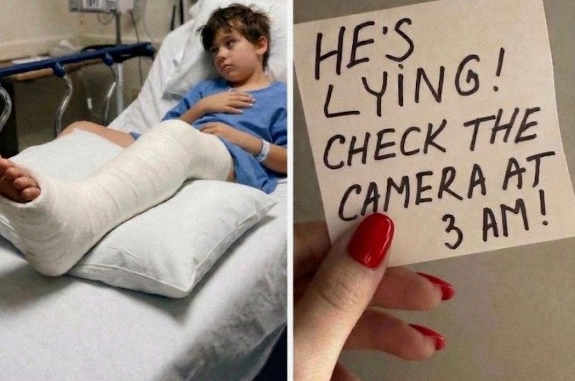
The fluorescent lights of the hospital corridor hummed with an uneasy intensity as I sat beside my ten-year-old son, Howard. His leg was wrapped in a thick blue cast that made his small frame look even more fragile. My ex-husband, Jasper, sat off to the side, absorbed in his phone, occasionally muttering about “bad luck” and a “freak accident.” He had called earlier that night, calmly explaining that Howard had fallen off his scooter while he was supervising him. It sounded simple enough—but the more I looked at Howard’s averted gaze and tense expression, the more something inside me didn’t sit right.
Howard was usually fearless, always pushing limits and brushing off scrapes like they meant nothing. But tonight, he seemed withdrawn, almost ashamed. When I gently asked what happened, Jasper immediately stepped in, repeating the same story about an accidental fall. The air in the room felt thick, like something unspoken was pressing down on all of us. It wasn’t until a nurse came in to check his vitals that things began to shift. She noticed the way Howard flinched slightly when Jasper adjusted his blanket. As she left, she passed me closely and slipped a folded note into my hand without a word.
I waited until Jasper stepped out before unfolding it. The message was brief but chilling: HE IS LYING CHECK THE CAMERA AT 3 AM. My pulse spiked instantly. When the time came, I followed her instruction, quietly making my way to the security office and asking to review the footage for Howard’s room.
At exactly 3:00 a.m., the monitor showed Howard sleeping quietly in his hospital bed. The chair beside him—supposedly where Jasper had been—was empty. Then the door opened. Jasper entered with a woman I didn’t recognize. They moved with unsettling ease, as though they had done this before. The audio revealed everything. Jasper wasn’t comforting Howard; he was instructing him. He told him to stick to the story, to say it was an accident, and to make sure I never found out the truth about what really happened.
What actually occurred became painfully clear. Jasper hadn’t been present when Howard was injured. He had left him in the care of this woman, Kelly, while he stepped away. Howard had attempted a trick on his scooter during that time, resulting in the fall. Instead of taking responsibility, Jasper was coaching Howard into silence, framing the situation in a way that protected himself and blaming me as someone who would “overreact” if she knew the truth.
The guard quietly saved the footage for me, his expression heavy with understanding. I returned to the ward with the evidence, where the nurse was already waiting, her calm demeanor now carrying urgency. She immediately contacted the hospital social worker.
By morning, everything had changed. Jasper’s attempt to maintain his version of events quickly unraveled under scrutiny. Kelly disappeared from the situation entirely, and the inconsistencies in his story became impossible to ignore. A formal investigation followed.
While the adults dealt with consequences, my focus turned fully to Howard. He began therapy to help him process the pressure of being forced into secrecy. Watching him slowly open up again—no longer carrying the burden of lies—was the only relief in the aftermath.
The experience forced me to confront something I had long avoided: my fear of being seen as “difficult.” I had spent years staying quiet to avoid conflict, but I finally understood that silence can come at a cost. Protecting peace should never mean ignoring harm.
Weeks later, as Howard’s cast was finally removed, he told me he didn’t like keeping secrets. I held his hand and promised him he never would have to again. The truth had shattered whatever illusion remained of our old life, but it also cleared the way for something more honest. And for the first time in a long time, my son was no longer carrying the weight of someone else’s choices—he was simply a child healing, safe to speak freely again.
Leave a Reply