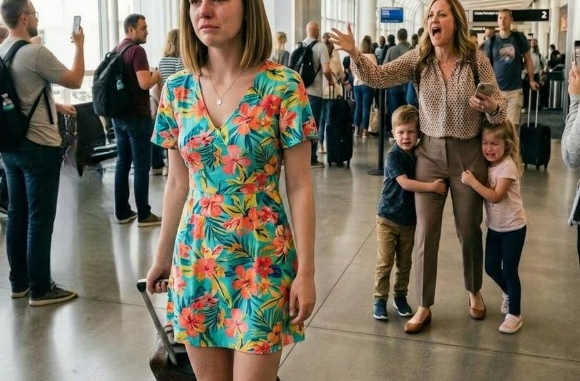
I could tell my sister was gearing up to pull the same stunt the moment she said, almost too casually, “You’re still good for Saturday, right?”
We were standing in Terminal C at O’Hare, surrounded by dragging suitcases, restless kids, and the stale smell of airport coffee. My older sister, Melanie, wore leather leggings and a cropped sweater, already slipping into the familiar role she took on whenever her lack of planning became someone else’s problem. Her ten-year-old twins, Lila and Owen, shared snacks and argued quietly over a charger. A few steps away, her husband Nate hovered near security, half-distracted, half-absent, as if the whole trip were something to be managed rather than enjoyed.
The plan, on paper, was simple: a weekend in Los Angeles for a sold-out reunion concert—what they called their “marriage reset.” The twins were supposedly staying with a sitter back home. That was what Melanie told me when she asked for a ride to the airport because her app wasn’t working and Nate was on a call.
But I knew her too well by now.
Over the years, “small emergencies” in her childcare arrangements had a way of turning into me canceling plans, missing work, or absorbing responsibility I never agreed to. She always framed it as temporary. It never was.
At the check-in kiosk, she leaned in with a practiced softness.
“Tiny hiccup,” she said. “The sitter fell through. It’s just one night—maybe two. You can take them, and we’ll figure out a later flight back.”
I looked at her.
“No,” I said simply.
She blinked like the word didn’t compute. “What?”
“No,” I repeated. “I told you I have mandatory orientation this weekend for my new role. I am not taking your kids because your plans fell apart.”
Her smile tightened. “You’re being dramatic.”
“No,” I said evenly. “I’m being employed.”
Nate wandered back in at the worst possible moment, as usual, and immediately made it worse. “Come on,” he said. “They’re easy. We already paid for everything.”
“And that makes them my responsibility how?” I asked.
Melanie’s voice sharpened. “So that’s it? You don’t care about family?”
The twins went quiet at that. That was always her move—shift the weight so refusal looked like cruelty.
I crouched down so they could hear me. “Hey,” I said gently, “did Mom and Dad tell you anything changed with your plans?”
Confusion. That was all I needed to see.
When I stood again, Melanie snapped, “Don’t do that.”
But I was already done.
“I’m not taking your children,” I said. “You are their parents. You need to either fly with them, postpone the trip, or make actual childcare arrangements—without ambushing me in an airport.”
“You’d really ruin this for us?” she hissed.
I glanced at the twins, then back at her.
“No,” I said quietly. “You did that when you made them your backup plan.”
Then I picked up my bag and walked toward my gate for Denver, where my orientation actually mattered.
The next morning, my phone lit up before I even got out of bed.
Dozens of texts. Calls. Voicemails.
“You ruined everything.”
“You embarrassed us.”
“You left us stranded.”
Nate was angrier. My mother was calmer, which somehow made it worse.
And beneath all of it was the same assumption: that I was supposed to absorb the consequences of their choices.
I didn’t.
Instead, I sent one message:
I did not agree to take the twins. I was told at the airport after saying no multiple times. I left for my scheduled work trip. Please stop contacting me until this is discussed honestly.
Then I put my phone down and went to orientation.
That weekend was supposed to be about a promotion I had worked years for—my first real step into leadership after more than a decade in nursing. But every break, I could feel my phone buzzing like it was trying to pull me back into a role I had never agreed to play.
Later, my mother called. I answered.
“You could have handled this differently,” she said carefully.
“I did,” I replied. “I said no.”
That silence again—the kind that always meant they were re-writing the story.
Because they had.
Melanie hadn’t told them I refused. She told them I disappeared.
And that was when it clicked fully: this wasn’t a misunderstanding. It was a pattern.
At night, I stopped arguing and started documenting. Every “just this once” that turned into days. Every emergency that wasn’t really an emergency—just poor planning redirected onto me.
Eight times in four years.
The same structure every time.
Then my cousin called and mentioned something that made it worse: the twins had been told I “always say yes.”
That was the real fracture.
Not the airport. Not the trip. The expectation.
I called Melanie that evening.
She answered immediately. “Are you done being dramatic?”
“No,” I said. “I’m done being assumed.”
We went back and forth—anger, defensiveness, blame. Then I asked the question that changed the shape of everything:
“Did you tell your kids I agreed before you even asked me?”
Silence.
Then, quietly: “I knew you’d say no if I asked properly.”
That was it.
Not confusion. Not chaos.
A strategy.
I came home from Denver with a job offer and a decision already made.
Within days, I sent a written boundary to the entire family: no unplanned childcare, no last-minute handoffs, no assumptions disguised as emergencies. Anything involving the twins required advance notice and my clear agreement.
The backlash came fast.
“You’re being cold.”
“You’re overreacting.”
“This is just family.”
But nothing about it was accidental anymore.
And then, slowly, things began to shift.
Melanie hired help. Nate took on more responsibility. Plans started getting discussed instead of imposed. I still helped sometimes—but now it was asked, not extracted.
That difference changed everything.
Months later, Lila and Owen stayed with me for a planned weekend. Bags packed. Schedule agreed on. No surprises. Just trust.
And a year after that airport confrontation, we all went to a concert together—properly planned, evenly shared, no one trapped into anything.
On the drive back, Lila said, “Remember when Mom thought you were taking us from the airport?”
I smiled slightly. “I remember that’s when everyone started planning better.”
Melanie met my eyes in the rearview mirror.
This time, neither of us looked away.
They say I ruined a concert trip.
What actually broke was a pattern that had been running on me for years.
And once it broke, something better finally had room to exist.
Leave a Reply