My father taught me to read a map before I ever learned to ride a bike. He would lay topographic charts across the kitchen table, hand me a grease pencil, and say, “A map doesn’t lie. People do—but a map never will.” He was a career Army sergeant major who believed accuracy could save lives, and that lesson never left me.
I grew up on military bases, and in 2004 I became an intelligence officer, deploying to Iraq only weeks after commissioning. One night in Fallujah, while monitoring intercepted communications, I decoded a message that revealed an imminent ambush on a convoy at dawn. I reported it immediately, and the route was changed. One vehicle had already moved ahead and was struck, but the rest of the convoy survived. I was only twenty-two, and after submitting the report, I went back to work—it was simply part of the job.
Years later, I married Derek Fields, a man who valued me without diminishing my service. But his father, Michael, never truly accepted me. To him, I was just his son’s wife with a “desk job,” often the target of subtle dismissals and jokes. For nearly two decades, I stayed quiet, choosing peace over confrontation.
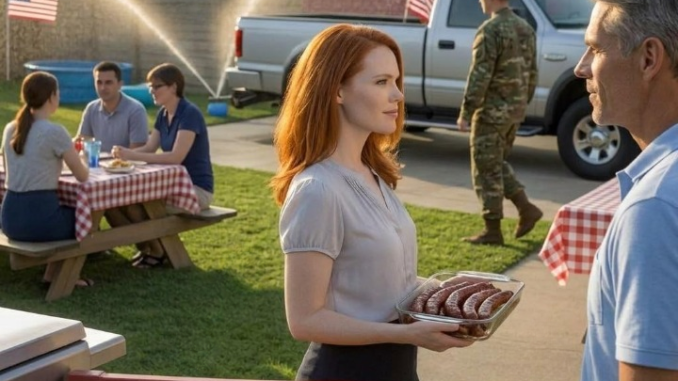
Then, at a Labor Day cookout in 2024, everything shifted. As I arrived carrying food, Michael stopped me at the entrance and said in front of everyone, “You weren’t invited. This is a Fields family event.” I set the dish down and began to leave.
Before I could go, Derek’s brother Brandon arrived. A veteran who rarely attended family gatherings, he immediately stepped in after seeing the situation unfold. “She saved my life,” he said. The yard went silent. He explained that I was the intelligence officer whose work had redirected his convoy in Fallujah, preventing the loss of most of his unit. He had learned my identity years later but had never spoken about it until that moment.
For the first time, Michael had no response.
In the months that followed, he eventually acknowledged the truth. His apology came slowly, but it came sincerely. At Easter, he stood before the family and admitted he had been wrong.
That day, I returned through the same gate, this time welcomed, carrying a pie instead of resentment. Later, Brandon showed me a photo of his platoon—every one of them had come home. And I was reminded that while service isn’t about recognition, sometimes being truly seen still matters.
Leave a Reply