I was twelve when our mother died—an age when life still seems steady and unchanging, until it suddenly isn’t. I can clearly recall the hospital hallway: the sharp scent of antiseptic, the hum of fluorescent lights, and the way adults spoke in low voices, as if quietness could somehow ease the pain.
But more than anything, I remember my sister.
She stood beside me at the funeral—upright, composed, her eyes dry. At nineteen, she was still so young, yet something in her shifted that day. While others broke down, she grew still. Strong. Unshaken.
In that moment, she became everything I needed—a parent, a protector, my entire support system.
She didn’t make a speech or promise anything out loud. There was no dramatic declaration. She simply stepped in and did what had to be done, without drawing attention to herself.
She quietly left college. Took on two jobs. Learned how to stretch a small grocery budget further than it should go. Learned how to hide her exhaustion behind a reassuring smile so convincing that even I believed her when she said, “We’ll be okay.”
And somehow, we were.
Or at least, that’s what I chose to believe.
As I grew up, I focused on school while she focused on survival. I buried myself in my studies, while she figured out how to manage bills, deal with landlords, and make each paycheck last. I hardly ever saw her rest, and when I did, she brushed it off as simple tiredness.
I accepted that—or maybe I just wanted to.
The years passed quickly. I excelled in school. Teachers praised me, mentors encouraged me, and everyone said I had a bright future. One milestone followed another—college acceptance, then medical school, then residency. Each success felt like confirmation that her sacrifices were worth it.
At my graduation, standing in my stiff gown as applause filled the room, I searched the crowd until I spotted her. She sat near the back, clapping softly, her face glowing with pride.
But when she hugged me afterward, something unpleasant surfaced inside me—an arrogance I didn’t recognize at the time.
Caught up in my achievements, I laughed and said words that would later stay with me:
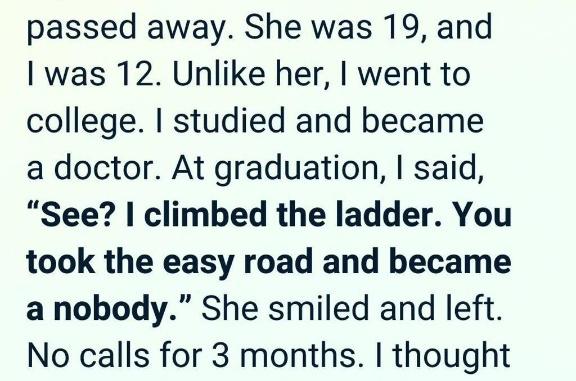
“See? I made it. You chose the easy path and ended up a nobody.”
The words hit between us like something fragile breaking.
For a moment, I thought she might fall apart. But she didn’t. She simply gave a small, tired smile and said, “I’m proud of you.”
Then she walked away.
We didn’t speak for three months.
I convinced myself she just needed time. I moved on with my new job, my new city, my new life. Sometimes guilt crept in, but I pushed it aside. She had always been strong—I assumed she always would be.
When work eventually brought me back for a conference, I decided to visit her without warning. I expected an awkward conversation, maybe tension, maybe forgiveness—nothing I couldn’t handle.
What I found instead shattered me.
The front door was unlocked. That should have been my first clue. The house felt wrong the moment I stepped inside—too quiet, too empty. The furniture was gone. The walls were bare where photos once hung.
I followed a faint sound toward the living room, my heart racing.
She was lying on the floor.
Pale. Shaking. Her breathing uneven and shallow. Pain was written across her face in a way I had never seen before. She looked so small, so fragile—like the strength that once defined her had slowly faded away.
I dropped to my knees, calling her name, my hands trembling as I tried to lift her.
And still, she smiled.
“I didn’t want to worry you,” she whispered.
At the hospital, the truth came out slowly, piece by piece.
A chronic illness she had ignored for years. Symptoms she dismissed. Medication she couldn’t always afford. Doctor visits she skipped because rent and food came first.
And then the words that broke me completely:
“There was never any inheritance,” she said softly. “Mom didn’t leave us anything.”
I stared at her, confused.
“All the money you thought came from savings,” she continued, “was from me. I didn’t want you to feel stuck. I wanted you to focus on your studies.”
The missing furniture. The jewelry. Even our mother’s belongings—sold off one by one.
For years, she had been reducing her own life so mine could grow.
Suddenly, everything made sense—the extra shifts, the exhaustion, the constant insistence that she was fine.
She had been suffering quietly while I built my future on her sacrifices.
That night, after she was stabilized, I stayed by her side. When she fell asleep, I broke down completely—the kind of crying that leaves you empty and aching.
I finally understood how wrong I had been.
I had defined success by achievements and recognition. She had defined it through love, responsibility, and quiet strength.
I carried pride and judgment. She carried both our lives without complaint.
When she woke the next morning, I told her what I should have said long ago—that she was never a nobody, that everything I had become was because of her, and that I was deeply sorry.
“I’m here now,” I said. “You’re not alone anymore. This time, I’ll take care of you.”
She squeezed my hand, tears slipping down her face, and gave me that same tired, familiar smile.
In that moment, I learned something no education could teach.
True greatness doesn’t seek attention.
It shows up early, stays late, sacrifices quietly, and holds everything together while someone else receives the applause.
Her love didn’t just give me a future.
It showed me what real success means—and reminded me what true kindness really is.
Leave a Reply