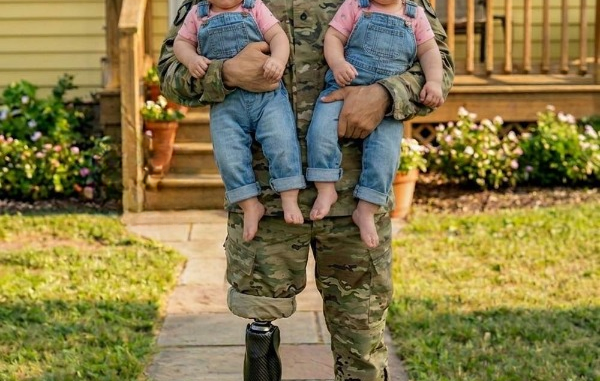
I came home from deployment with a prosthetic leg I’d kept secret, carrying gifts for my wife and our newborn twin daughters. Instead of the reunion I had imagined, I found an empty house, my babies crying upstairs, and a note from my wife saying she had left for a “better life.” Three years later, I found myself standing at her door again—but this time, everything was different.
For months, I had counted down the days until I could finally return home. The only thing that kept me going was the thought of holding my daughters for the first time. My mother had sent me a photo of them, and I must’ve looked at it a hundred times during the flight back.
I never told my wife, Mara, about losing my leg. After everything she’d gone through with past pregnancies, I didn’t want to risk stressing her while she was finally carrying to term. The only person I trusted with the truth was my best friend, Mark.
On my way home, I bought small yellow sweaters for the girls and white flowers for Mara. I wanted to surprise her—to see her face light up when I walked through the door.
But when I arrived, something felt wrong.
The house was dark. Silent. Empty.
When I stepped inside, everything was gone—furniture, decorations, all the life that used to fill those rooms.
Then I heard crying upstairs.
I rushed to the nursery and found my mother holding one baby while the other lay in the crib. She looked at me and broke down in tears.
That’s when I saw the note.
Mark had told Mara about my injury—and my return. In her message, she made it clear: she didn’t want a life with a “broken man” and the burden of raising children. She left with Mark, believing he could give her something better.
I didn’t react right away. I just sat there, holding my daughters for the first time, letting the reality settle in.
That moment changed everything.
I promised them they would never be abandoned again.
The next three years were the hardest of my life—but also the most important. My mother moved in to help, and I slowly rebuilt everything from the ground up.
During rehab, I had ideas about improving prosthetic joints. What I was using wasn’t efficient—it hurt, it slowed me down. So I started designing something better, working late at night after the girls were asleep.
Eventually, I turned those sketches into a patent. Then into a product. Then into a company.
I kept my head down and focused on my daughters and the work. No attention. No announcements. Just progress.
By the time the twins were ready for preschool, my business had grown into something real. We moved to a new city, started fresh, and built a stable life.
Then one day, I came across a property my company had acquired—a foreclosed estate.
When I read the names of the previous owners, I had to look twice.
Mara and Mark.
Of all the places, it was theirs.
I drove out to see it. Movers were already there, clearing things out.
Mara stood on the porch, arguing. Mark looked worn down, nothing like the confident man I once knew.
When I walked up and knocked, Mara opened the door—and froze.
I calmly told them the truth: the house now belonged to me.
They struggled to process it. Mara’s voice shook as she asked about our daughters, saying she had made a mistake and wanted to see them.
But I didn’t hesitate.
“They stopped waiting for you a long time ago,” I told her.
Mark tried to explain, but there was nothing left to say. Their choices had already shaped their outcome.
I left them there, with nothing but the consequences of what they’d built.
A month later, that same house became something else entirely—a retreat for injured veterans, complete with therapy spaces, a garden, and a workshop for developing better prosthetics.
I didn’t put my name on it.
It wasn’t about me.
It was about giving others a second chance—just like I had taken mine.
As for Mara and Mark, I didn’t need revenge.
Time had already done the work.
Leave a Reply