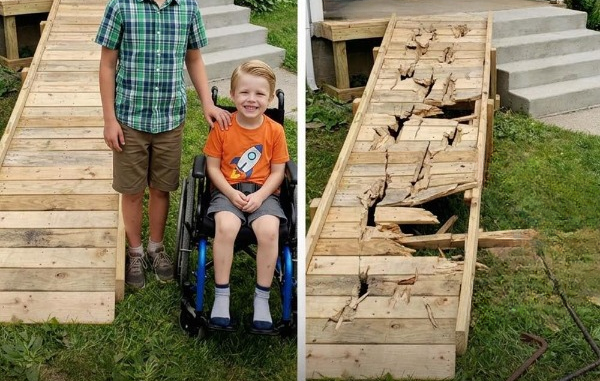
I assumed it was just another normal afternoon—until my son noticed something no one else had. By the next day, our entire street would be different.
My son, Ethan, is twelve. He’s the kind of kid who won’t ignore something that feels wrong, even if it’s not his problem to fix.
Across the street lives Caleb, a quiet nine-year-old who spends most of his time sitting on the front porch in his wheelchair, watching other kids play like he’s stuck on the outside looking in.
At first, I didn’t think much of it. Kids adapt. They find their space. But Ethan saw more.
One afternoon, as we carried groceries inside, he paused and looked across the street. Caleb was there again, hands resting on his wheels, watching a group of kids ride by on their bikes.
Ethan frowned. “Mom… why doesn’t Caleb ever come down?”
I noticed the sadness in Caleb’s eyes.
“I’m not sure,” I told him. “But we can go ask later if you want.”
That was all Ethan needed.
That evening, we walked over—and the problem became obvious immediately.
Four steep steps.
No railing. No ramp. No way for Caleb to get down on his own.
We knocked, and his mom, Renee, answered. She looked worn out, like life had been heavy for a long time.
When I gently asked, she gave a small, apologetic smile. “He wants to play more than anything… but without a ramp, someone has to carry him every time.”
Ethan’s expression changed instantly.
“We’ve been trying to save for one,” she added. “But it’s been slow. Insurance won’t cover it.”
We went home quietly—but Ethan wasn’t done thinking about it.
That night, instead of games or TV, he sat at the kitchen table sketching ideas. His dad had taught him how to build before he passed away three months earlier, and it had become something Ethan loved.
I watched him work, focused.
“What are you doing?” I asked.
Without looking up, he said, “I think I can build a ramp.”
The next day, he poured out all his savings—every coin and bill.
“That was for your bike,” I reminded him.
“I know.”
“Are you sure?”
“Mom… he can’t even leave his porch.”
That was the end of the discussion.
We went to the hardware store together. Ethan carefully chose materials, asked questions, and checked measurements like he knew exactly what he was doing.
For three days, he worked nonstop after school—measuring, cutting, sanding, adjusting. I helped where I could, but he led the entire project.
By the end, his hands were scraped and tired—but he stepped back, smiling.
“It’s not perfect,” he said, “but it’ll work.”
Together, we carried it across the street.
Renee looked confused at first—then overwhelmed when she realized.
“You built this?” she asked.
Ethan nodded, suddenly shy.
We set it up, and then she turned to Caleb. “Do you want to try?”
He hesitated… then slowly rolled forward.
For the first time, he made it down to the sidewalk on his own.
The look on his face wasn’t just happiness—it was freedom.
Within minutes, other kids gathered. Someone asked him to race. He laughed and joined them, finally included.
Ethan stood beside me, quiet but proud.
But the next morning, everything changed.
I woke up to shouting and ran outside barefoot.
Mrs. Harlow stood in front of Caleb’s house, furious.
“This thing is an eyesore!” she snapped.
Before anyone could react, she grabbed a metal bar and swung it.
The ramp cracked.
Caleb cried out.
Ethan froze.
She kept hitting it until it collapsed completely.
“Clean up your mess,” she said coldly—and walked away like nothing happened.
Silence fell over the street.
Caleb was back at the top of the steps.
Watching again.
Later, Ethan sat quietly on his bed, staring at his hands.
“I should’ve built it better,” he whispered.
“You did something kind,” I told him. “That matters.”
“But it didn’t last.”
I didn’t have an answer.
I thought that was the worst of it.
I was wrong.
The next morning, several black SUVs pulled up outside Mrs. Harlow’s house. Men in suits stepped out—serious, purposeful.
They weren’t neighbors. And they weren’t police.
One of them knocked on her door.
At first, she smiled confidently—then something changed. Her expression dropped. Her hands started to shake.
I didn’t know why yet.
But I knew it wasn’t good.
The man spoke clearly this time. “We need to discuss your application.”
Application?
It turned out she had been in the final stages of becoming CEO of a major charity—the Foundation for Global Kindness.
What she didn’t know was that part of their process involved observing candidates in real life.
Unfiltered.
Unscripted.
Real.
The man showed her a video.
The sound of wood breaking.
Caleb’s scream.
Her own voice: “This is an eyesore!”
Her face went pale.
“You destroyed a wheelchair ramp built for a child,” the man said.
Moments later, they withdrew her job offer.
Just like that.
But they didn’t stop there.
They announced plans to build a fully accessible community park behind her house—complete with ramps, adaptive equipment, and safe spaces for kids like Caleb.
Then they called for Ethan.
He stepped forward nervously.
“In honor of your father,” the man said, “we’ll also be creating a permanent dedication—and building a new, proper ramp.”
Tears filled my eyes.
Mrs. Harlow sank to the ground as everything unraveled around her.
And across the street, Caleb sat on his porch—
still waiting.
But this time, he was smiling.
Because now, everyone knew:
what one small act of kindness had started…
was about to become something much bigger.
Leave a Reply