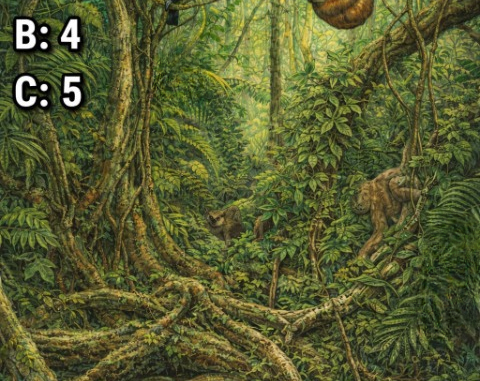
At first glance, this jungle illustration looks like an ordinary sketch—something you might glance at and quickly move on from.
But the longer you study it, the more it transforms. Shapes shift subtly: what seems like tree bark may become a face, shadows hint at hidden bodies, and leaves and branches reveal creatures carefully camouflaged. Spotting the first hidden animal makes it nearly impossible to stop searching for the others.
This is what makes the illusion so captivating. A simple drawing turns into a quiet challenge, testing patience, perception, and attention to detail. Initially, the scene appears calm and familiar: twisted roots snake across the forest floor, vines hang from the canopy, and layers of foliage filter the sunlight. Yet within this stillness, animals lurk, often so well hidden that viewers miss them on their first pass.
The subtlety of the puzzle is part of its appeal. It doesn’t immediately present itself as a challenge; instead, it draws you in, encouraging you to distinguish between ordinary forest elements and living creatures blended into the scene. One moment you’re seeing only leaves and shadows, and the next, a beak, a tail, or a face emerges. Once that shift occurs, the jungle becomes layered with hidden possibilities.
Online, this puzzle is often paired with bold claims. Some versions suggest the number of animals you find reveals aspects of your personality—intelligence, intuition, or self-interest—while others turn it into a friendly challenge, asking viewers to count the animals and compare results.
Hidden-image puzzles are satisfying because they reward careful observation with small discoveries. In this scene, the first figures noticed are often the obvious ones: a bird, a sloth hanging from a branch, or a snake winding along the ground. Others spot a monkey tucked in the foliage or a larger creature blending into darker areas. But not everyone sees the same animals, or at the same speed, and that’s part of what makes such illusions fascinating. Differences usually reflect how people process visual information rather than intelligence—some focus naturally on fine details, others see the big picture first.
Claims linking the number of animals to personality traits are misleading. While the puzzle may reveal cognitive tendencies like attention to detail or pattern recognition, it is not a reliable measure of personality. Its popularity comes from the mix of mystery and self-discovery: people are drawn to anything that promises insight into themselves, and sharing the experience adds a social, competitive element.
Ultimately, the true appeal of this jungle illusion lies in its ability to make us slow down. Optical illusions interrupt the rapid pace of daily life, inviting us to pause, observe closely, and question our initial perceptions. Children approach it with curiosity and excitement; adults often experience a mix of challenge, satisfaction, and even frustration as they seek elusive shapes.
The real value of the puzzle isn’t in the number of animals you find or what it supposedly reveals about you—it’s in how it teaches patience, focus, and careful observation. By taking a closer look, hidden details emerge, reminding us that perception is flexible and that the world often holds more than we notice at first glance.
In short, this jungle puzzle is a clever visual challenge that rewards curiosity and attention. It doesn’t define your personality or intelligence—only your willingness to slow down and really see what’s in front of you.
Leave a Reply