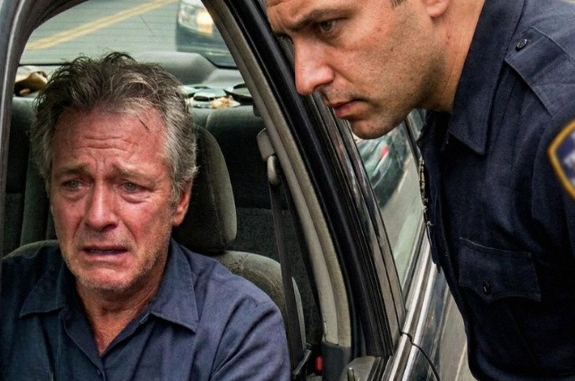
I clocked a car speeding and approached it expecting the usual excuses—but what I encountered turned a routine stop into a moment that would stay with me long after the siren faded.
I pulled over a man going 88 in a 55, thinking I knew exactly how it would go. I didn’t.
I caught him just past the overpass, where most drivers hit the brakes as soon as they spot a cruiser. He didn’t. He kept going until I lit him up, and even then he hesitated before pulling over, like he was wrestling with something.
When I got out, I was already irritated. I tapped the back of his car.
“Engine off. Now.”
He complied immediately.
“You know how fast you were going?”
He was older than I expected—late 50s, gray beard, worn face, dressed in a faded delivery shirt. But he didn’t reach for his license. Instead, he gripped the wheel so tightly his knuckles turned white.
“Sir, license and registration.”
“My girl…” he said quietly.
I paused. “What?”
“The hospital called. Something’s wrong. They said I need to get there now.”
I asked where. “County Memorial.”
“What’s her name?”
“Emily.”
He explained she was in labor and there were complications. He’d missed the first calls while driving, and when he called back, the nurse told him she kept asking for him.
He looked at me then—pure panic in his eyes.
Traffic ahead was building, every light against us. Even speeding, he might not make it in time.
I asked about family. There wasn’t anyone else. Just him.
For a moment, I weighed it: one wrong move could cost lives—but a normal stop might mean his daughter faced surgery alone.
So I made a call.
“Stay right behind me. Do exactly what I do.”
I got back in my cruiser, called it in as a medical urgency, and took off. He stayed glued to my bumper as I cleared intersections, weaving through traffic, ignoring the complaints I knew were coming.
We made it fast.
At the hospital, he jumped out and ran before the car even stopped.
I should’ve left then—but I didn’t.
A nurse came out and told me we’d arrived just in time. His daughter had been refusing an emergency procedure until he got there. He made it before they took her in. He talked her through it.
I followed her inside.
In the recovery room, I saw him beside the bed, shaken, relieved. His daughter was pale but alive, holding a newborn wrapped in a blanket.
“Dad,” she whispered.
“I’m here,” he said.
She noticed me and thanked me. I told her she didn’t have to—but she insisted.
The baby stirred.
“What’s her name?” I asked.
“Hope,” they said.
Then reality caught up.
Complaints had been filed. Supervisors and troopers were waiting downstairs.
I admitted what I’d done. It wasn’t by the book. It could’ve gone wrong.
But the father came down too. He told them plainly: his daughter and granddaughter were alive because I chose to help.
A note from Emily said it best: I hadn’t just enforced the law—I’d kept a family together.
The next day, I got a formal reprimand. No suspension.
A week later, a photo arrived: Emily, her father, and baby Hope.
I still stop speeders. I still write tickets.
But sometimes I think about that day—the man gripping the wheel, the urgency in his voice—and how, for a brief stretch of road, everything really did hang in the balance.
Because he made it.
Because she heard his voice.
Because Hope got her name—with her grandfather right there.
Leave a Reply