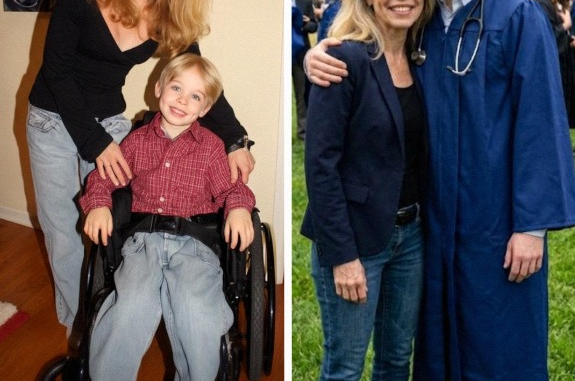
I went into labor believing my marriage had already weathered everything. I was wrong. The day our son was born, my husband walked away—and I spent the next 25 years raising him on my own through every challenge. Decades later, one public moment made that man regret ever leaving.
The day he left wasn’t loud. There was no shouting, no slammed doors.
In a way, that might have been easier. My mother always said a slammed door means anger—and anger is something you can confront, something you can understand.
But what Warren gave me wasn’t anger. It was a single look at our newborn son, a glance at the neurologist, and a silence so sharp it felt deliberate.
Henry was less than three hours old. I still had an IV in my arm, my body aching, my son curled against me with his tiny fist gripping my hospital gown.
The neurologist spoke gently—the kind of tone that quietly signals your life is about to change.
“There are motor impairments,” she said. “We won’t know everything yet, but he’ll need therapy, support, and close monitoring in the coming months.”
I nodded as if she were giving simple directions.
She reassured me it wasn’t my fault, that pregnancy is unpredictable, and that with care, my son could still live a full life.
I thanked her.
And then Warren reached for his keys.
At first, I thought he just needed a moment to process everything. That was his way—stepping away to think.
“Can you pass me some water?” I asked.
He didn’t move.
Instead, he looked at Henry—not with fear or sadness, but with cold assessment.
“I can’t do this,” he said. “This isn’t the life I wanted. I wanted a son I could play sports with… and he won’t be able to.”
I waited for him to take it back. To show emotion. To say anything a father should.
Instead, he grabbed his jacket and walked out of the delivery room like it meant nothing.
I looked down at my baby.
“Well,” I whispered, “it’s just us now.”
Two days later, I left the hospital alone. No flowers, no balloons, no partner beside me—just a sleeping baby and a stack of paperwork thicker than I could manage.
The years that followed weren’t inspiring. They were exhausting.
My apartment smelled of formula and cleaning supplies. I spent nights stretching Henry’s legs while he cried and I fought sleep. I learned how to navigate insurance, therapy schedules, and constant uncertainty.
People spoke softly around us, as if we were something fragile.
I learned to ignore them.
As Henry grew, he became sharper than anyone expected.
At school, when someone underestimated him, he called it out directly. At doctor visits, he corrected professionals who spoke about him instead of to him.
By ten, he understood his condition better than most adults. By fifteen, he was reading medical journals at the kitchen table.
Therapy turned into progress. Step by step, things changed. The wheelchair became a cane—and eventually, even that faded.
At sixteen, he told me what he wanted.
“I don’t want to be the patient people talk around,” he said. “I want to be the one who listens.”
And he meant it.
He got into medical school—and graduated at the top of his class.
A few days before graduation, I found him unusually quiet.
“What’s wrong?” I asked.
“Dad called.”
Just hearing that pulled me back years.
“He found me online,” Henry said. “He wants to come to graduation.”
I didn’t hesitate. “No.”
But Henry had already decided.
“I invited him.”
Graduation day arrived in a blur of proud families and flashing cameras.
Then Warren walked in—older, confident, smiling as if he belonged.
He looked at Henry, noticing what he had once rejected: strength, independence, success.
“Son,” he said, almost casually.
Henry stayed calm.
When his name was called, Henry walked onto the stage—steady, composed.
The room filled with applause.
He stepped up to the microphone.
“People like stories like this,” he began. “They see success and assume it’s about personal strength.”
Then he looked at me.
“But I’m here because of my mother.”
The room fell silent.
“When I was born, my father left the hospital. My mother didn’t. She stayed—for every appointment, every setback, every moment when things were hard.”
Warren went completely still.
Henry met his eyes.
“This isn’t a proud moment for both my parents. It belongs to the one who never left.”
Then his voice softened.
“Mom… everything good in me started with you.”
The applause was overwhelming.
I stood there in tears, surrounded by strangers—and the man who had once abandoned us.
I never looked at him.
Afterward, Warren confronted Henry.
“You invited me for that?” he asked.
“I didn’t embarrass you,” Henry replied calmly. “I told the truth. You left at the beginning. My mother stayed for everything after.”
And just like that, the man who had walked away all those years ago was left standing alone—finally understanding exactly what he had given up.
Leave a Reply