For years, I watched someone I trusted treat my little girl as though she barely existed. I thought I understood why, but one unexpected moment forced me to question everything I had believed.
When my husband, Joey, and I discovered I was pregnant, one of the first people I wanted to tell was my mother-in-law, Diane.
At the time, we were quite close.
Diane could be dramatic and opinionated, but I honestly believed she would become the kind of grandmother who spoiled her grandchild endlessly.
When I showed her the pregnancy test, she stared at the two pink lines for a few seconds before jumping out of her chair.
“You’re pregnant?!”
She hugged me so tightly I could hardly breathe, tears filling her eyes.
“I’m going to be a grandmother!” she repeated excitedly.
Almost immediately, she began talking about baby clothes, birthdays, Christmas mornings, and all the things she planned to do with her first grandchild.
“We don’t even know if it’s a girl yet,” Joey reminded her with a laugh.
“I know,” Diane said. “But I have a feeling.”
She was right.
When we found out we were having a daughter, Diane was overjoyed. She bought tiny dresses, stuffed animals, blankets, and enough pink socks to last for years.
Everything seemed wonderful.
Nine months later, our daughter, Lily, was born.
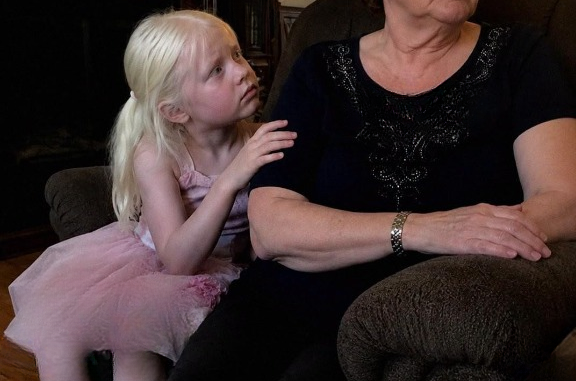
The moment I held her, I noticed something unexpected. Her skin was extremely pale, her eyelashes and eyebrows were almost white, and she had beautiful white-blond hair.
After several examinations, the doctors explained that Lily had albinism.
Naturally, I was frightened at first—not because there was anything wrong with my daughter, but because we suddenly had challenges we hadn’t anticipated. Her eyesight would need regular monitoring, and her skin would be especially sensitive to sunlight.
We had plenty to learn.
But none of that changed how I felt when I looked at her.
She was my baby.
She was perfect to me.
Then Diane entered the hospital room.
I will never forget her reaction.
She arrived smiling, carrying a pink gift bag and a ridiculous collection of balloons. She hurried toward the bed, clearly eager to meet her granddaughter.
Then she saw Lily.
Her smile vanished.
She stopped in her tracks.
The gift bag slipped in her hand, and the color drained from her face.
“Mom, come meet your granddaughter,” Joey said nervously.
Diane simply stared at Lily.
Then she whispered, “No.”
I frowned.
“Diane?”
She turned around and walked straight out of the room.
She didn’t say goodbye to me. She didn’t congratulate Joey. She didn’t even touch Lily.
At first, I couldn’t comprehend what had happened.
I asked Joey what was wrong, but he had no explanation.
I wish I could say Diane came back later and explained herself.
She never did.
For the next six years, she behaved as though Lily barely existed.
Diane posted pictures online constantly—birthdays, family dinners, flowers in her garden, even neighborhood pets—but there were never any pictures of Lily.
If someone asked her about her grandchildren, she would quickly change the subject.
Whenever she and Lily were in the same room, Diane barely acknowledged her.
At first, I convinced myself that she simply needed time.
But months became years.
Eventually, I stopped making excuses.
Joey and I argued about it constantly.
“Mom is uncomfortable,” he would say. “Just give her time.”
“She’s had four years,” I would reply.
Then five.
Then six.
The worst part was that Diane was never openly cruel. Instead, she rejected Lily through small actions that were impossible to ignore.
Once, while we were crossing a parking lot, Lily reached for Diane’s hand.
Diane pulled away so quickly that Lily stopped moving.
I saw it.
Joey saw it too.
That evening, I confronted him.
“Did you see what your mother did?”
He sighed.
“She pulled her hand away from our daughter like Lily had burned her.”
“I’ll talk to her,” he promised.
“You always say that.”
He had no answer.
Diane wouldn’t explain herself to him either.
By the time Lily was six, she had begun noticing.
One night, while I was putting her to bed, she looked up at me.
“Mommy, why doesn’t Grandma like me?”
My heart shattered.
“Oh, sweetheart,” I told her, brushing her pale hair away from her face. “Grandma is difficult sometimes. But deep down, she loves you very much.”
Lily stared at me.
Then she quietly replied, “I don’t think so.”
She rolled over and went to sleep.
I went into the bathroom and cried.
That night, something changed.
For six years, I had tried to keep the peace, but Lily was now old enough to understand that she was being rejected.
I refused to let my daughter grow up believing she had to earn someone’s love.
From then on, I stopped bringing Lily around Diane unless absolutely necessary.
Joey wasn’t happy about it at first, but eventually he understood.
I thought this was simply how our family would remain.
Then one afternoon, everything changed.
We were at Diane’s house. Joey was helping his father in the garage, while Diane had gone outside to work in her garden.
Lily was staying with my sister, so I was alone in the kitchen.
I was pouring myself some water when Diane’s phone buzzed on the counter.
I normally would have ignored it, but a message preview appeared on the screen.
It was from Diane’s sister, Claire.
The message began with condolences and said that she missed “her” too.
There was a photograph underneath.
Even in the tiny preview, I could see a little girl who looked remarkably familiar.
She appeared to be around six or seven years old. Her skin was very pale, her eyebrows were nearly white, and she had long, white-blond hair.
For a moment, I thought I was looking at Lily.
Then I realized the photograph was clearly much older.
Underneath it, I could make out part of a sentence:
“She looks so much like…”
Before I could read more, I heard the back door open.
I turned around.
Diane stood there in her gardening gloves.
Her eyes moved from me to her phone.
Then she saw the message.
The gloves slipped from her hands.
“Judy,” she whispered.
For the first time in six years, I didn’t see indifference on her face.
I saw fear.
And suddenly, I wondered whether I had misunderstood everything.
I pointed toward the phone.
“Who is that little girl?”
Diane stiffened.
“You shouldn’t be looking at my messages.”
“I didn’t touch your phone. The message appeared on the screen.”
She grabbed the phone.
“Then forget what you saw.”
“Forget it? She looks like Lily.”
Diane flinched.
“Who is she?” I asked again.
“Judy, please.”
“No. Not anymore.”
My voice rose.
“For six years, I’ve watched you treat my daughter like she doesn’t exist. Two weeks ago, Lily asked me why you don’t like her.”
Diane’s eyes filled with tears.
“I’ve defended you to her. I’ve told her that you love her deep down. Do you know what she said? She said she didn’t believe me. She’s six years old, Diane.”
“Stop,” Diane whispered.
“No. Tell me who that girl is.”
Diane’s hands trembled around the phone.
Finally, she sat down.
“Her name was Rose.”
The word “was” immediately changed everything.
“Who was Rose?”
Diane stared toward the window.
“My daughter.”
I stared at her in disbelief.
“What?”
“My daughter,” she repeated. “Before Joey was born.”
I had known Diane for years, and I had never heard about another child.
She unlocked her phone, enlarged the photograph, and handed it to me.
The resemblance was startling.
Rose wasn’t an exact copy of Lily, but there were enough similarities to make my stomach twist.
“She had albinism,” Diane said quietly.
“You had a daughter with albinism?”
Diane nodded.
“Why doesn’t Joey know about her?”
“Because I couldn’t talk about her,” she admitted.
After Rose died, Diane had hidden every photograph and instructed the family never to mention her. By the time Joey was old enough to ask questions, everyone had learned to remain silent.
Then Diane told me the story.
She had become pregnant with Rose when she was very young. Her strict parents considered the pregnancy a family scandal. After Rose was born, Diane married Rose’s father, but the marriage eventually became deeply unhappy.
Despite everything, Diane adored her daughter.
“She was fearless,” Diane said softly. “She loved being outside. She loved flowers. That’s why I started gardening.”
I thought about the enormous garden Diane tended every summer.
“What happened to her?”
Diane’s lips trembled.
“When Rose was six, her father took her out for the day. We were fighting constantly by then. I always worried because he knew about all the precautions she needed. I packed her sunscreen and hat, just like I always did.”
She paused.
“On the way home, they were in an accident.”
My chest tightened.
“Rose died.”
I felt my anger give way to shock and sadness.
“Today is the anniversary,” Diane added.
Suddenly, Claire’s message made sense.
I looked at the photograph again.
“Rose was six?”
Diane nodded.
“The same age Lily is now.”
Then I remembered the hospital.
“When you saw Lily…”
“I saw Rose.”
Diane covered her face.
“I walked into that room expecting to meet my granddaughter. Then I saw her—white hair, pale eyelashes, that little face. For a moment, I thought I was losing my mind.”
She explained that she’d whispered “No” because she couldn’t breathe. She had run into the hallway and become physically ill.
I had never known any of that.
Neither had Joey.
“But you stayed away for six years,” I said.
“I know.”
“She thinks you hate her.”
“I know.”
“If you understood that, why didn’t you do something?”
Diane lowered her head.
“I was afraid.”
“Of Lily?”
“Of loving her.”
Her answer silenced me.
“Every time I looked at her, I saw Rose,” she continued. “As Lily grew older, it became harder. Her smile, the way she tilted her head, little expressions—they reminded me of Rose.”
She wiped away a tear.
“And every year Lily got closer to the age Rose was when she died, my fear became stronger. I knew it wasn’t rational. Lily wasn’t Rose. But part of me believed that if I loved her, I would lose her too.”
“So you rejected her first.”
Diane nodded.
“Yes.”
“And you made a child suffer for something she had nothing to do with.”
“Yes.”
There was no attempt to defend herself.
That mattered.
But it didn’t erase six years of hurt.
“I wish you’d told us,” I said.
“I was ashamed.”
“You should be ashamed of how you treated Lily,” I told her. “Not ashamed of grieving your daughter.”
Just then, Joey walked into the kitchen.
“What’s going on?”
Diane looked at him.
“Sit down. There’s something I should have told you a long time ago.”
I left them alone.
Later that night, Joey sat beside me on the couch with red eyes.
“I had a sister,” he whispered.
“I know.”
“All these years, I had a sister.”
I held his hand while he cried.
Nothing was magically fixed after that conversation.
Joey was furious that Diane had hidden Rose from him.
I was still angry about how she had treated Lily.
Diane began seeing a therapist.
For several months, Lily didn’t visit her.
I told Diane that if she ever built a relationship with Lily, it would happen at Lily’s pace—not hers.
She agreed.
Eventually, Diane asked if she could come to our house.
She arrived without presents, balloons, or any attempt to buy forgiveness.
She sat on the couch while Lily watched her cautiously.
Finally, Diane spoke.
“Lily, I owe you an apology.”
Lily looked at me before turning back toward her grandmother.
“I haven’t been a good grandmother to you,” Diane continued. “You didn’t do anything wrong. I was carrying pain from something that happened a long time ago, and instead of getting help, I allowed that pain to make me treat you badly.”
Lily was quiet.
Then she asked, “Do you not like my hair?”
Diane’s face crumpled.
“Oh, sweetheart. I do.”
She reached into her purse and pulled out Rose’s photograph.
“Your hair actually reminds me of someone I loved very much.”
Lily looked at the picture.
“She looks like me.”
“She does,” Diane said through a smile and tears.
“Who is she?”
“Her name was Rose. She was my daughter. That means she was your daddy’s sister.”
Lily’s eyes widened.
“My aunt?”
“Yes.”
“What happened to her?”
“She died when she was little.”
Lily looked at the photograph again.
“Is that why you didn’t look at me?”
Diane nodded.
“Yes. But I was wrong. You are Lily. You aren’t Rose, and I should have seen you for who you are.”
Lily thought for a moment.
Then she handed the photograph back.
“You can come to my school thing on Friday if you want.”
Diane covered her mouth.
“I would love that.”
Lily didn’t hug her that day.
And that was okay.
Diane came to the school event on Friday.
Then she attended Lily’s birthday.
Slowly, cautiously, they began building the relationship that should have existed from the beginning.
Several months later, I walked into the living room and found Lily showing Diane one of her drawings.
Instead of making an excuse to leave, Diane sat beside her for nearly twenty minutes, asking questions about every little detail.
Before Diane left, Lily hugged her.
Diane closed her eyes, held her gently, and whispered, “I love you.”
“I love you too, Grandma,” Lily replied.
I turned away because I was already crying.
I still don’t excuse what Diane did.
Grief can explain someone’s behavior, but it doesn’t erase the damage that behavior causes.
For six years, my daughter believed there was something about her that made her grandmother unable to love her.
But now I understand that when Diane entered that hospital room, looked at my newborn daughter, and whispered “No,” she wasn’t rejecting Lily because of her appearance.
She was seeing the face of a child she thought she’d lost forever.
Six years later, a message on her phone finally forced her to confront the grief she had been running from.
Leave a Reply