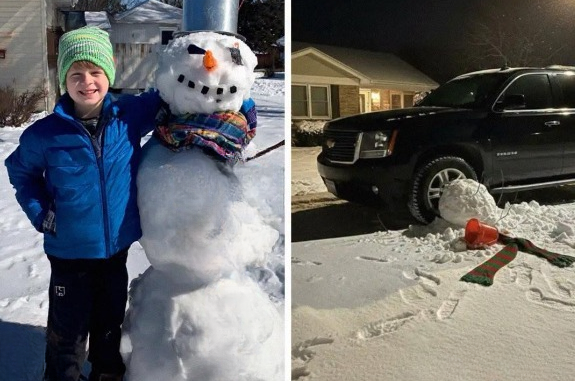
This winter, my eight-year-old son Nick developed a passion for building snowmen in the same corner of our front yard. Day after day, he would come home from school, rush outside, and create a new snowy character, complete with names, personalities, and his favorite red scarf. Our yard became his little world, and watching him through the window always brought a smile to my face.
Unfortunately, our neighbor, Mr. Streeter, kept ruining it.
For years, he had taken a shortcut across the edge of our lawn whenever he pulled into his driveway. It saved him almost no time, but he did it anyway. The problem became much worse once winter arrived because his tires repeatedly crushed Nick’s snowmen.
The first time it happened, Nick came inside devastated. He told me he had watched Mr. Streeter drive straight through his creation without even slowing down. I tried speaking with our neighbor and politely asked him to stop driving over that part of our property.
His response was dismissive.
“It’s just snow,” he said.
I explained how much effort Nick put into each snowman and how upset he became when they were destroyed. Mr. Streeter simply shrugged and insisted that children would get over it.
Despite multiple conversations, nothing changed.
One snowman after another was flattened. Nick became increasingly frustrated, but he refused to move his projects elsewhere.
“That’s my spot,” he insisted. “He’s the one doing the wrong thing.”
Eventually, after yet another snowman was destroyed, Nick told me he had a plan. He promised he wasn’t trying to hurt anyone or damage anything. Since he was only eight years old, I assumed he meant something harmless, like putting up a sign or writing a message in the snow.
I was wrong.
The next afternoon, Nick built a large snowman around the fire hydrant located at the edge of our property. Enough of the hydrant remained visible that anyone paying attention could still see it, but from a distance it looked like an ordinary snowman.
That evening, while I was preparing dinner, I heard a loud crash followed by the sound of twisting metal and someone shouting outside.
I rushed to the window.
Mr. Streeter’s car had struck the fire hydrant.
Water was shooting high into the air, soaking the street, the yard, and his vehicle. At the base of the damaged hydrant sat the remains of Nick’s “special” snowman.
When I asked Nick what happened, he calmly explained that he had placed the snowman where cars weren’t supposed to be driving.
“I knew he’d go for it,” he admitted.
Moments later, an angry and drenched Mr. Streeter stormed to our front door, blaming us for the accident. However, the situation quickly became obvious: the hydrant could only have been hit if he had driven off the road and onto our lawn—the very thing I had repeatedly asked him not to do.
I contacted the city and the non-emergency police line to report the damaged hydrant and the flooding. When officers arrived, they documented the situation and confirmed that Mr. Streeter would be responsible for the consequences of hitting city property.
Later, Nick worried that he had done something wrong.
I explained that while his idea had been clever, it had also been risky. Thankfully, no one was injured.
When my husband Mark came home and heard the full story, he struggled to hide his amusement. He pointed out that the only person truly at fault was the adult who repeatedly ignored property boundaries and intentionally destroyed a child’s snowmen.
After that day, everything changed.
Mr. Streeter never drove across our lawn again. He carefully stayed on his own driveway whenever he came and went.
Nick continued building snowmen for the rest of the winter. Some melted, some leaned sideways, and some lost parts during storms.
But none of them were ever crushed by a car again.
And whenever I look at that corner of our yard, I remember how my son stood up for himself with nothing more than a pile of snow, a red scarf, and a surprisingly strong understanding of personal boundaries.
Leave a Reply