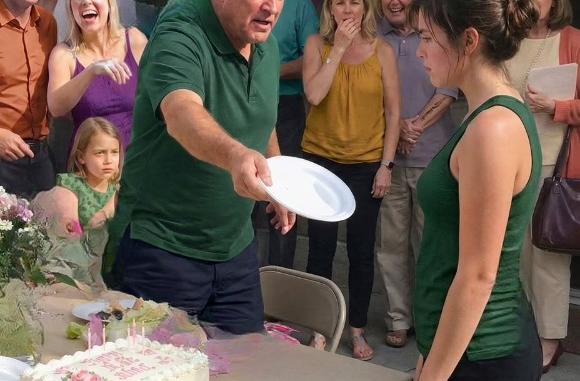
At My Mom’s Birthday Party, My Stepfather Handed Me a Paper Plate and Said, “The Staff Eats Outside.”
The room erupted with laughter.
My mother stayed silent.
I turned and started toward the door.
Then my aunt walked in, scanned the room, and asked, “Wait… nobody’s told them yet?”
The laughter died instantly.
On my mother’s sixtieth birthday, my stepfather, Gary, handed me a paper plate and smirked.
“The staff eats outside.”
For a moment, the room froze.
Then came the chuckles. My stepbrother laughed into his drink, a few relatives grinned, and my mother stood beside her birthday cake without saying a word.
I stared at the plate.
Just hours earlier, I had been the one hauling tables, arranging decorations, carrying catering supplies, and fixing last-minute problems because Mom had called me before sunrise, overwhelmed and needing help.
That had always been my role.
In my family, being dependable eventually became your entire identity.
Gary spent years introducing me as “the practical one,” a polite way of suggesting I was less successful than everyone else. Never mind that I owned a thriving maintenance company with more than twenty employees. Because I still wore work boots and knew how to fix things, he treated me like hired help.
“Come on, Claire,” he said, nodding toward the patio. “Don’t make it uncomfortable.”
The laughter returned.
I looked at Mom, waiting for her to say, She’s my daughter.
Instead, she lowered her eyes.
Something inside me went still.
“Happy birthday, Mom,” I said quietly.
I set the plate down and grabbed my purse.
I was almost at the door when a voice interrupted.
“So… nobody’s told them?”
My Aunt Rebecca stood in the entryway carrying a leather folder.
As executor of my late grandmother’s estate, she had spent the past eighteen months dealing with probate and legal challenges—most of them caused by Gary.
The room fell silent.
Rebecca looked at my mother, then Gary, and finally at me.
“The judge signed the final order this afternoon,” she announced. “Claire, the lake house and Rosewood Holdings officially belong to you.”
Gary’s smile disappeared.
Mom grabbed the edge of the table.
Rosewood Holdings owned not only the lake house but several valuable properties connected to it.
“That can’t be right,” Gary said.
Rebecca opened her folder.
“What can’t be right,” she replied, “is the sales contract you signed yesterday for property you never owned.”
She placed a stack of papers beside the birthday cake.
Gary had secretly agreed to sell the lake house, surrounding land, and a commercial property for $1.46 million. He had even accepted a $75,000 deposit and promised the buyer vacant possession.
The problem?
None of it belonged to him.
In fact, none of it belonged to my mother either.
My grandmother had changed her will years earlier.
During the final months of her life, I was the one driving her to appointments, helping with repairs, and spending time with her. I never expected anything in return, but Grandma noticed.
In a notarized letter, she explained why she left Rosewood Holdings to me:
“Claire protects what everyone else assumes will protect itself.”
Mom received a substantial cash inheritance and investment income.
The properties came to me.
Gary had spent years insisting I manipulated Grandma and telling relatives I was trying to steal my mother’s inheritance. That rumor had followed me ever since.
Now the truth sat on the table for everyone to see.
Mom began crying.
Gary didn’t even look at her.
Instead, he pointed out that she had signed the sales contract too.
I turned toward my mother.
Suddenly, her silence about the paper plate felt insignificant compared to what she had done.
“He said the court would rule in our favor,” she whispered.
Rebecca’s expression hardened.
“You signed documents to sell estate property before probate was complete.”
Mom looked away.
Then Gary shrugged.
“Fine. Claire owns it. She can sign now and everyone gets paid.”
I stared at him in disbelief.
“You tried to sell my grandmother’s property, humiliated me in front of everyone, and now you expect my help?”
His face darkened.
“This family has supported you long enough.”
That was when Rebecca revealed the final surprise.
The deposit from the sale had already arrived.
And most of it was gone.
Bank records showed that over $60,000 had been transferred to a failing car dealership owned by Gary’s son.
The room went silent.
Then Rebecca looked at my mother.
“Tell Claire whose signature authorized that transfer.”
Mom’s face went pale.
“Yours.”
I didn’t recognize the signature.
Because it wasn’t mine.
Gary had copied it from an old maintenance contract and attached it to documents claiming I approved both the sale and the transfer of funds.
The signature was forged.
For the first time all day, nobody in the room was laughing.
Gary tried explaining that the dealership needed emergency money and that the sale would have happened eventually anyway.
No one was buying it.
The celebration ended shortly afterward.
The buyer canceled the deal and demanded the deposit back. Gary was forced to liquidate assets and borrow against retirement savings to repay the money. The forged documents were reported to authorities.
Months later, Gary pleaded guilty to forgery and attempted property fraud.
He avoided prison but received probation, restitution orders, and community service.
My mother wasn’t criminally charged, but she admitted she knowingly signed documents tied to property she didn’t legally own.
That confession hurt more than Gary’s insult ever had.
She hadn’t defended me because she hoped I would eventually give in and sign whatever they wanted.
After the court case, I gave Gary thirty days to leave the lake house.
I gave my mother a choice.
She could move out with him or stay temporarily while finding another place to live.
She chose to stay.
For four awkward months, we shared the house.
At first, conversations were polite.
Eventually, they became honest.
One evening, she finally looked at me and said, “I should have defended you before I knew what your grandmother left you.”
I nodded.
“That’s exactly what hurt.”
It was the first apology that truly mattered.
The following year, I sold the commercial property, kept the land, and transformed the lake house into a retreat center for families caring for elderly loved ones.
My grandmother had always worried about becoming a burden.
I wanted her legacy to become something meaningful.
Mom eventually moved into a nearby condo.
We still speak, though carefully.
Gary and I never spoke again.
And on my next birthday, nobody handed me a paper plate. They handed me something far more valuable:
Respect.
Leave a Reply