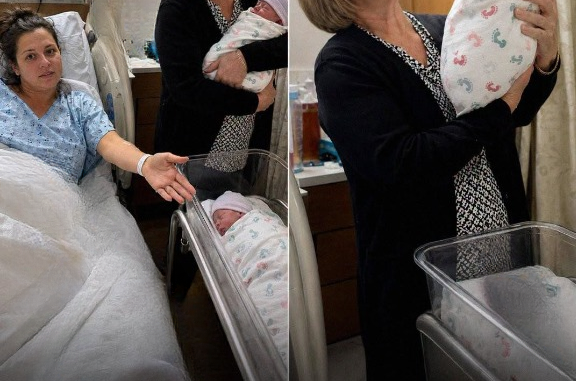
My mother-in-law insisted that only my son mattered. Moments later, a nurse rushed to my daughter’s bassinet and revealed something everyone else had completely missed.
Nurse Sarah suddenly grabbed my daughter from her bassinet, moving so quickly that her blanket slipped onto the floor.
“Call neonatal!”
Her voice immediately filled the room with urgency.
My husband, Tom, stood frozen while holding our son. My mother-in-law, Margot, stepped back as Sarah placed two fingers against my daughter’s chest.
“What’s wrong?” I asked.
Sarah gently tilted my baby’s head, covered her face with a tiny oxygen mask, and shouted toward the hallway.
“I need oxygen now!”
Within seconds, the recovery room became chaotic.
Another nurse rushed in with a medical cart, followed by a doctor. A curtain was pulled around the bassinet, but I could still see my daughter’s tiny feet.
They were blue.
I tried to sit up, but the pain in my abdomen was overwhelming.
“What’s happening to her?”
Tom placed our son in a nearby crib and moved toward the medical team.
“Give us some space,” Sarah told him.
“Is she breathing?”
“Not enough.”
The doctor listened to our daughter’s chest.
“She’s in respiratory distress. Her heart rate is dropping.”
My vision blurred. After 36 exhausting hours of labor, both babies had cried when they were placed against my chest.
I knew they had.
But now I couldn’t hear my daughter at all. The only sound was the steady hiss of oxygen.
“We need to move her,” the doctor said.
Sarah raised the bassinet rails.
“Please,” I begged. “Let me see her.”
She brought my daughter close enough for me to touch her.
Her fingers were ice-cold.
“Stay with me, Ivy,” I whispered.
We had chosen her name months before.
Margot had hated it, saying it sounded too weak.
Sarah squeezed my shoulder.
“We’re taking her to the NICU.”
Then my daughter was rushed through the doors.
I tried to follow, but my body wouldn’t cooperate. I had lost too much blood during delivery, and my legs gave out before I could reach the floor.
Tom caught me.
“Sit down.”
“Go with her.”
“Kris—”
“Go with our daughter.”
He glanced toward the hallway and then at his mother.
Margot was still standing beside our son’s crib, her hands resting against the clear plastic sides.
She looked protective.
Almost possessive.
And somehow completely detached from what was happening.
Tom noticed where I was looking.
“Mom.”
Margot looked up.
“You should stay with the boy.”
Tom stared at her.
“My daughter can’t breathe.”
“The doctors have her.”
“Her name is Ivy.”
Margot’s expression hardened.
“This isn’t the time.”
“No,” Tom replied. “This is exactly the time.”
He headed for the door.
Margot grabbed his sleeve.
“The family is here to meet your son.”
Tom looked at her hand before pulling away.
“Get out.”
She stared at him.
“What?”
“Leave the hospital.”
“You’re emotional.”
“My daughter nearly died while you were pushing her bassinet aside.”
“I did nothing of the sort.”
“You moved her.”
“She was in the way.”
Those words hit the room like shattered glass.
Tom pointed toward the exit.
“Get out.”
Margot gave a quiet laugh—the same laugh she used whenever someone challenged her authority.
“You don’t mean that.”
Tom opened the door.
“I do.”
“Your grandfather is downstairs.”
“He can leave too.”
“Thomas.”
“Don’t call me that.”
Her face became cold.
“If I leave now, don’t expect me to come back.”
“Then don’t.”
For the first time in twelve years, Margot had nothing to say.
She picked up her handbag and looked toward our son.
She didn’t look at me.
She didn’t look at Ivy’s empty bassinet.
Only him.
“This family will remember what you did today.”
Tom held the door open.
“So will I.”
Margot walked out.
Tom leaned against the wall and started crying.
“I didn’t notice,” he whispered.
I stared at the empty bassinet.
“Neither did I.”
“You were barely conscious.”
“I was her mother.”
“You had just given birth.”
“I should have seen her.”
Tom shook his head.
“No. I should have.”
He sat beside me.
“I was taking pictures of Mason.”
Our son’s name sounded strangely unfamiliar in that moment—not because I loved him any less, but because everyone had spent the entire afternoon talking about him.
Mason this.
Mason that.
The Waverly heir.
The future of the family.
Nobody had noticed whether Ivy was warm.
Nobody noticed she had stopped moving.
Except Sarah.
Forty minutes later, Dr. Patel came into the room.
“Ivy is stable.”
The words nearly knocked the air from my lungs.
Tom grabbed my hand.
“What does stable mean?”
“She’s breathing with support. Her oxygen levels have improved.”
“Why did this happen?”
“She has a congenital heart defect. A narrowing near the pulmonary valve restricted blood flow to her lungs.”
I stared at him.
“Will she need surgery?”
“Yes. Within the next 24 hours.”
I closed my eyes.
I had known my daughter for less than a day, and already she needed open-heart surgery.
Tom asked about the risks, recovery, and chances of success.
Dr. Patel answered carefully before looking at me.
“Nurse Sarah noticed her distress very early. That was extremely important.”
“Would she have died?”
He paused.
“If her oxygen levels had continued dropping unnoticed, the outcome could have been very different.”
Very different.
Five minutes?
Ten?
However long Margot had been standing there focused on Mason while Ivy lay silently beside her?
After the doctor left, Tom pushed my wheelchair toward the NICU.
Ivy looked impossibly tiny beneath the tubes and wires.
A machine helped her breathe.
I reached into the incubator and touched her palm.
Her tiny hand closed around my finger.
I broke down.
“I’m sorry.”
Tom crouched beside me.
“Stop.”
“I was right there.”
“So was I.”
“Everyone was looking at Mason.”
“I know.”
His voice cracked.
“I let her make me believe that was normal.”
He didn’t need to say Margot’s name.
Her influence had been part of our marriage long before our children were born.
When we discovered we were expecting twins, Margot asked whether they were boys or girls before asking whether they were healthy.
At the reveal dinner, blue confetti appeared first.
She screamed with excitement.
When the pink confetti followed, she clapped twice and declared that the family name was safe.
Tom rolled his eyes.
I laughed awkwardly.
That was how we always handled Margot.
We turned cruelty into eccentricity.
Control into tradition.
Threats into jokes.
The Waverly family owned farmland, rental properties, and a packaging company started by Tom’s grandfather.
Margot controlled the family trust.
She had paid for our wedding.
She had helped with the down payment on our house.
She had promised Tom that the company would eventually be his.
Every gift came with conditions.
Some were easy to ignore.
Others felt like chains around his neck.
That evening, Margot called seventeen times.
Tom finally answered the eighteenth call and put it on speaker.
“Has the girl stabilized?” she asked.
The girl.
Tom’s expression immediately changed.
“Her name is Ivy.”
“I know her name.”
“Then use it.”
Margot sighed.
“I’m trying to discuss the future.”
“Our daughter is having heart surgery.”
“Which is exactly why you need to be practical.”
I stared at the phone.
“What does practical mean?”
Margot paused when she realized I was listening.
“Kris, you need to rest.”
“What does practical mean?”
“It means Mason must be protected from instability.”
Tom stood.
“What instability?”
“The hospital bills. Long-term care. Whatever limitations the girl may have.”
The girl again.
Margot continued.
“The trust exists to preserve the family line. We cannot allow emotional decisions to drain resources intended for the heir.”
Tom’s face went blank.
“Are you saying the trust should cover Mason but not Ivy?”
“I’m saying exceptional expenses need to be evaluated.”
“She’s your granddaughter.”
“And Mason is the future of the estate.”
Tom ended the call and shut off his phone.
After a long silence, he finally spoke.
“My mother reviewed the trust with me last month.”
I looked at him.
“What did you sign?”
“An acknowledgment.”
“Of what?”
“That Mason would become the primary beneficiary after me.”
“And Ivy?”
He looked toward the NICU doors.
“She wasn’t included.”
I felt sick.
“You signed something that excluded our daughter?”
“I thought it was ceremonial.”
“She’s been telling you for months that only the boy mattered.”
“I thought she was just talking.”
“Because her words never cost you anything.”
He flinched.
I hated saying it.
But I meant it.
Tom had grown up as the only boy in his generation. Margot had praised him simply for being born male.
His female cousins were expected to smile while he received opportunities they never did.
Private school.
Summer internships.
Company shares.
Tom knew it was unfair.
But he never turned those advantages down.
Discrimination feels easier to ignore when you’re the one receiving the benefits.
“I’ll fix it,” he said.
“How?”
“I’ll call the attorney.”
“Your mother’s attorney?”
He looked down.
That told me everything.
Ivy’s surgery lasted four hours.
During the second hour, Margot showed up with a lawyer.
Nurse Sarah found us in the waiting room.
“Your mother-in-law is at reception.”
“Tell her to leave,” I said.
“She says she has documents for your husband.”
Tom stood.
“I’ll handle it.”
I grabbed his hand.
“Don’t sign anything.”
“I won’t.”
He kissed my forehead and left.
Twenty minutes passed.
Then forty.
I imagined Margot pressuring him again—reminding him about the company, the house, the trust, and everything she had supposedly given him.
Then Tom returned carrying a cardboard box.
Inside were framed photographs, a laptop, and the bronze nameplate from his office.
“What happened?”
“My mother gave me a choice.”
“The company or us?”
He shook his head.
“The company or Ivy.”
My stomach dropped.
“She said she would protect Mason’s inheritance if I signed an agreement limiting what could be spent on Ivy’s medical care.”
“What did you do?”
“I resigned.”
I stared at the box.
His entire career fit inside it.
“She fired you?”
“No. I quit before she could.”
Then he pulled an envelope from his coat.
“I also gave up my interest in the trust.”
“Tom, what about the mortgage?”
“We can pay it.”
“Your salary?”
“I’ll find another job.”
“The twins?”
“Have two parents.”
His eyes filled with tears.
“My mother spent my entire life teaching me that family meant protecting whatever carried our name.”
He looked toward the operating-room doors.
“I almost let that lesson cost my daughter her life.”
“You didn’t cause her condition.”
“No. But I helped create a situation where nobody noticed her.”
There was nothing I could say to make that easier.
Dr. Patel finally came out just before midnight.
He was smiling.
“The procedure went well.”
Tom collapsed into a chair, and I covered my face.
Our daughter had survived.
Three days later, I held Ivy again.
She weighed six pounds.
Mason was nearly seven.
Margot would have called that proof that he was stronger.
But Ivy had survived heart surgery before she was even 72 hours old.
When I placed her beside Mason, he turned toward her.
His tiny hand opened.
Ivy’s fingers curled around his.
Tom took a picture.
Not of Mason.
Not of Ivy.
Both of them.
Equal in the frame.
Margot never came back.
She sent flowers addressed to “Thomas and Son.”
Sarah threw them away before I could see them.
I loved her for that.
Two months later, Margot sued us for repayment of the house deposit.
She claimed the money had been a loan.
It wasn’t.
Tom’s grandfather offered to make the lawsuit disappear if Tom apologized.
“For what?” I asked.
“For embarrassing the family.”
Tom looked at Ivy sleeping against my chest and Mason resting in his carrier.
“My daughter nearly died.”
“And she survived,” his grandfather replied.
“That doesn’t erase what happened.”
The old man sighed.
“You’re sacrificing generations of family work over an emotional misunderstanding.”
Tom shook his head.
“No. I’m ending one.”
We sold the house before the case reached court.
Not because Margot won.
Because I no longer wanted to raise our children in a home she believed gave her control over us.
We bought a smaller house across town.
Three bedrooms.
A narrow kitchen.
A backyard with one dying apple tree.
Tom found another job.
The salary was lower, but the hours were better.
The lawsuit was eventually dismissed.
Then one of Tom’s cousins testified that Margot had given her a similar “gift” and later demanded repayment after she married someone the family disliked.
Once one daughter spoke, two others followed.
Suddenly, years of family secrets began falling apart.
Scholarships that had been promised and then withdrawn.
Women being paid less.
Property being placed only in men’s names.
Margot called it tradition.
The court saw a pattern.
Ivy is eleven months old now.
She has a thin scar running down the middle of her chest.
Mason has learned to crawl.
Ivy hasn’t yet.
Her cardiologist says she simply needs more time.
Margot once sent Mason a silver rattle for Christmas.
Nothing for Ivy.
Tom returned it unopened.
A week later, another package arrived.
Inside were two wooden boxes.
One had MASON engraved on it.
The other said IVY.
They were from Tom’s grandfather.
There was no apology.
Only a short note:
“I should have noticed sooner.”
Tom placed the boxes in the closet.
Healing hasn’t made everything easy.
He still mourns the mother he thought he had.
And I still get angry when I remember him standing silently in that hospital room.
Sometimes love survives because people forgive.
Sometimes it survives because the person who failed you finally stops defending what they did.
Last Sunday, Sarah came to Ivy’s first birthday party.
We celebrated early because the anniversary of her surgery means more to us than the date she was born.
The cake had two figures on top.
A boy holding a blue balloon.
A girl holding a red heart.
Sarah picked up Ivy.
My daughter grabbed Sarah’s name badge and immediately tried to chew it.
“Still causing trouble?” Sarah asked.
“Constantly,” I laughed.
Across the room, Tom was helping Mason open a gift.
Then he noticed Sarah holding Ivy.
He put the toy down and walked over.
“Can I have her?”
Sarah smiled.
“Of course.”
Tom carefully took his daughter into his arms.
Ivy rested her head against his chest.
For months after the hospital, Tom asked permission every time he held her.
Not because I demanded it.
Because he wanted to.
He wanted every touch to be a choice.
Every moment to be something he had earned.
Margot believed only the boy mattered because he carried the family name.
She was wrong.
A name is simply something people repeat.
A family is what people protect.
That day in the hospital, Mason was surrounded by people celebrating what he represented.
Ivy was lying nearby, struggling to breathe.
The person who saved her wasn’t the richest person in the room.
Not the heir.
Not the woman controlling the estate.
It was a nurse who looked beyond the boy everyone was celebrating and noticed the little girl nobody was watching.
And once we finally understood what our silence had nearly cost us, we promised that no one would ever overlook her again.
Leave a Reply