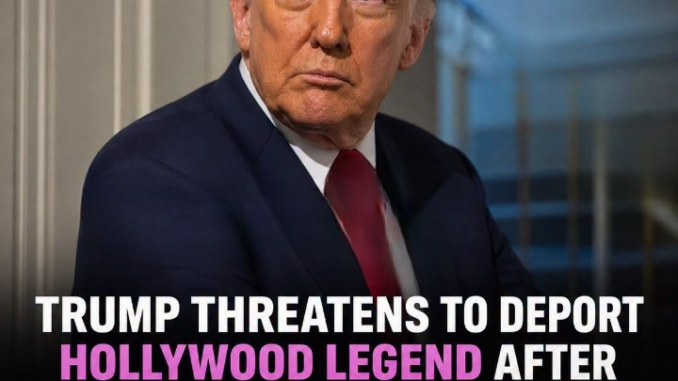
Donald Trump and Robert De Niro have been exchanging harsh public criticism for years, but their latest clash has reportedly taken the feud to a much more serious level. According to the source material, Trump posted on Truth Social suggesting that the Hollywood star could face deportation after De Niro launched another strong criticism of him. The remark immediately attracted attention because De Niro was born in the United States and is a well-known American citizen and actor.
At 83, De Niro has never been shy about expressing his opinion of Trump. Over the years, he has described Trump in deeply negative terms and repeatedly warned that his political influence could harm the country. His criticism goes beyond individual policies. De Niro has framed the conflict as a larger struggle over the direction of America and the protection of democratic institutions.
The actor’s comments have often been passionate and aggressive. His supporters view that intensity as a reflection of genuine concern, while his opponents consider his rhetoric unnecessarily extreme. According to the source, De Niro’s criticism comes from a fear that the country he grew up in is changing in ways he finds deeply troubling. He argues that loving America does not mean remaining silent or blindly supporting whoever holds political power. Instead, he believes citizens demonstrate patriotism by defending democratic institutions, a free press, and equal treatment under the law.
Trump reportedly rejected that argument entirely. Rather than responding to De Niro’s comments as ordinary political disagreement, he mocked the actor and portrayed his criticism in much harsher terms. The source also connects Trump’s remarks to previous comments about political opponents whose loyalty he questioned, including suggestions that certain critics could simply be sent away.
That is what makes this exchange more significant than another celebrity-versus-politician argument. Public figures frequently trade insults, and De Niro has been among Trump’s most outspoken Hollywood critics for years. But bringing deportation into the conversation changes the nature of the rhetoric. Deportation represents government authority rather than simply another insult, which raises broader questions about how political leaders respond to people who strongly disagree with them.
There is also an important legal issue involved. A person who is a natural-born American citizen cannot simply be deported because a president dislikes what they say. Whatever people think of De Niro’s statements, strong criticism of government officials is generally protected political expression under the First Amendment.
That protection doesn’t prevent Trump or his supporters from criticizing De Niro in return. They can challenge his arguments, question his opinions, or respond to his comments just as forcefully. The controversy centers instead on rhetoric suggesting that a citizen could be removed from his own country because of political criticism. Critics argue that this risks treating disagreement as disloyalty rather than recognizing it as part of democratic debate.
De Niro’s celebrity also makes the dispute especially visible. With decades of acting experience and two Academy Awards, he has a platform that most Americans do not have. But his fame doesn’t make his political opinions automatically correct. People are free to agree with him, reject his arguments, or criticize the dramatic language he uses.
Trump’s social-media statements also invite different interpretations. His posts frequently mix political messaging with sarcasm, insults, humor, and provocation. Supporters may view his response as another example of Trump refusing to back down when attacked by a prominent celebrity. Critics, however, may see the language as troubling because it raises questions about how political power could be used against outspoken opponents.
Ultimately, the deeper issue isn’t simply the personal feud between Trump and De Niro. It is the very different ideas each side represents. De Niro presents outspoken criticism of political leaders as part of defending the country and its democratic principles. Trump’s reported response frames the actor’s attacks as deserving an unusually severe reaction.
The dispute therefore extends beyond Hollywood drama. It touches on citizenship, free speech, political disagreement, and the limits of government power.
Whatever people think about De Niro’s rhetoric or Trump’s response, the controversy highlights a fundamental democratic principle: citizens must be able to criticize those in power without fearing that political disagreement alone will cost them their rights or their place in their own country.
Leave a Reply