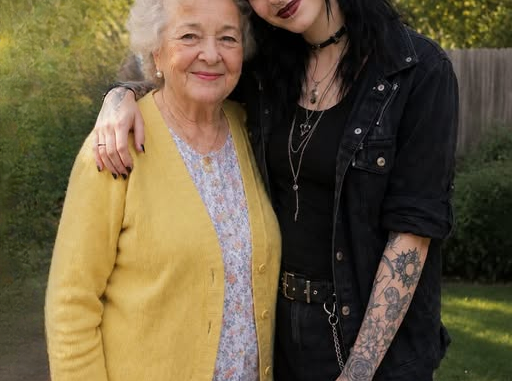
Raven waited until almost everyone had left the funeral home before approaching me. For months, this young woman—always dressed in black, wearing silver rings and perfectly drawn eyeliner—had spent nearly every Saturday sitting at my 73-year-old mother Doris’s kitchen table. She often took the chair that had once belonged to my father.
I never knew exactly what they discussed, and if I’m honest, I resented how close they had become so quickly. Sometimes Mom would even ask me to leave because their conversations were private, which only fueled my curiosity.
Now Raven stood in front of me with tear-filled eyes. She opened her palm and showed me a small brass key.
“Your mother told me to give this to you after she passed,” she said.
I asked what the key unlocked.
Raven only answered, “She said you would know once you found it.”
That night, my husband Tom watched as I almost tossed the key into a desk drawer. Instead, we went back to Mom’s house and started searching.
Eventually, in the back of her bedroom closet, hidden beneath some folded blankets, I found a small wooden box with a tiny lock.
The key fit.
Inside were stacks of unopened letters, birthday cards, and Christmas messages—all addressed to my aunt Elaine, Mom’s younger sister.
They hadn’t spoken in eleven years.
Suddenly, I remembered Raven encouraging Mom to contact Elaine just a few weeks earlier. For the first time, I began to understand what those mysterious Saturday meetings had really been about.
But when I called Elaine and told her about the box, she revealed something I never expected.
She came over the following afternoon and stared silently at the letters spread across Mom’s bed.
Then she confessed that she had a box of her own at home—eleven years’ worth of letters she had written to Doris but never sent.
Their falling-out had begun while they were caring for my grandmother. Afterward, stubbornness and hurt had kept them apart.
Five years earlier, Elaine had even called me to ask whether Mom ever talked about her.
I had been exhausted from constantly being stuck between them, so I told her, “Not really.”
I had been wrong.
Mom talked about Elaine often.
Standing in that room, I realized that no lawyer, insurance policy, mortgage, investment, estate document, or court ruling could restore the years these two sisters had lost because neither was willing to speak first.
Then, among Mom’s belongings, I discovered one final sealed card addressed to Elaine.
It was worth more to our family than anything written in her estate papers because it contained the words the sisters had never managed to say to each other.
I took the unopened card to Elaine’s home and finally admitted my own mistake. I told her I had known how much Mom missed her, and that my careless response years earlier had helped keep their misunderstanding alive.
Elaine was angry, and I couldn’t blame her.
But I left the letter with her and didn’t ask her to forgive me.
Three weeks later, she came back to Mom’s kitchen and told me she had finally opened it.
Doris had written that she had spent years waiting for the perfect moment and the perfect words, only to realize that waiting had become the biggest mistake of all.
The message was simple.
She missed her sister.
That same evening, Raven sent me a text saying she had finally reached out to her own mother, too.
Elaine and I still had years of hurt and distance to work through. But before she left Mom’s kitchen, she looked across the old table and said:
“Call me next week.”
For the first time, I understood that loving someone doesn’t always mean solving their problems for them.
Sometimes, it simply means making sure an important conversation doesn’t disappear forever into silence.
Leave a Reply