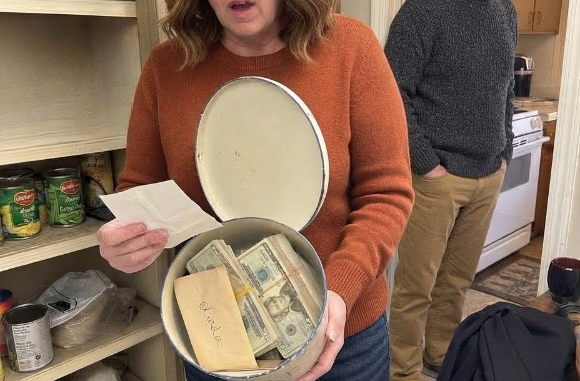
Mama had banked at First County for four decades.
I had been with the same bank for thirty years.
It was the kind of small-town branch where the employees knew customers by name and remembered their families.
I arrived a little after five.
A teller named Dana greeted me. I explained that my mother had passed away and that I had found documents relating to her accounts.
Dana typed Mama’s name into the computer.
Her expression changed immediately.
She excused herself and returned with the branch manager, Gerald Watts.
He looked at me, then glanced at the flour tin I was carrying.
“Mrs. Parrish, would you please come into my office?”
Once we were seated, Gerald folded his hands on the desk.
“Your mother came to see me.”
“When?”
“About fourteen months ago.”
He opened a drawer and placed a folder in front of me.
Mama had known her time was running short.
Apparently, she had spent more than a year preparing for the day I would eventually walk into that bank.
Inside the folder were copies of the original settlement agreement.
The actual amount was printed clearly:
$63,000.
There was also the false disbursement paperwork Wayne had shown us.
Bank records revealed that an account had been opened in my name and later drained.
Then I found something even more important.
A legal memorandum.
Mama had hired an attorney to investigate.
The document detailed what Wayne had done:
Fraud.
Misuse of a minor’s funds.
Document falsification.
Theft.
Mama had instructed Gerald to keep everything confidential until after her death.
She believed that if I ever discovered the flour tin, I would understand where the trail led next.
I stared at him.
“What can we do now? Wayne is dead.”
Gerald told me Mama had asked him the same question.
According to the attorney, there might still be legal avenues because a corporate insurer had been involved in the original settlement.
The insurance company had paid the entire $63,000.
And the records proving it still existed.
Wayne was gone.
But the evidence wasn’t.
I couldn’t believe how much preparation Mama had done.
“She really arranged all of this?”
Gerald nodded.
“Your mother was extremely thorough.”
Then he opened another drawer.
Inside was one final envelope.
Written across the front were the words:
For Linda, when she is sitting across from Mr. Watts.
He had kept it there for fourteen months.
I opened it.
This letter was much shorter.
Mama wrote that she knew money could never give me back the years I’d lost.
She couldn’t restore the opportunities I might have had if I’d received the settlement when I was eighteen.
She couldn’t erase the years she had spent keeping the truth from me.
But she could leave me the money she had managed to save.
She could give me the evidence she had gathered.
And she could make sure someone helped me pursue whatever could still be recovered.
Her final words were simple.
She hoped, someday, I could forgive her.
I didn’t cry.
Instead, I felt something I couldn’t quite put into words.
For the first time, I saw my mother as more than simply “Mama.”
She had carried that shame for thirty years.
It had followed her through Sunday dinners, birthdays, phone calls, and ordinary days when she could have told me the truth but couldn’t make herself speak.
So eventually, she created a system that could speak for her after she was gone.
The flour tin.
The letters.
The bank manager.
The attorney.
The documents.
Fourteen months of careful preparation.
Mama had created a path and trusted that I would eventually find it.
I left the bank with the folder and the attorney’s contact information.
When I returned to Mama’s house, Russell was waiting in the kitchen.
He had made coffee.
That was Russell’s way of offering an apology before he was ready to say the words.
I told him everything.
The true settlement amount.
The documents.
The lawyer.
Mama’s secret effort to recover what had been stolen.
When I finished, Russell said nothing for a long time.
Finally, he whispered, “I didn’t know how much he took.”
“But you knew something.”
Russell admitted that Wayne had once told him there had been problems with the settlement.
At the time, Russell was young and had accepted Wayne’s explanation.
“Did you always believe him?”
Russell stared down at his coffee.
“I stopped thinking about it.”
That wasn’t the same as believing him.
We both knew that.
Then I said what had been bothering me.
“Mama left the money to me. Not to both of us.”
Russell nodded.
“Do you know why?”
He finally met my eyes.
“Because it belonged to you,” he said. “It was always yours.”
The following Monday, I contacted the attorney Mama had hired.
His name was Philip Crenshaw.
He wasn’t surprised to hear from me.
In fact, he had been expecting my call.
Mama had told him that one day I would discover the evidence.
The legal process was anything but simple.
The original trucking company had merged with another corporation.
The insurer had gone through structural changes.
Old records had to be located.
Financial documents needed to be reviewed.
A forensic accountant compared the legitimate settlement records with Wayne’s fraudulent paperwork.
The process took eleven months.
Eleven months of documents, phone calls, statements, old files, and legal negotiations.
Eventually, the insurer agreed to settle for $41,000.
They never formally admitted complete responsibility for Wayne’s actions.
But the evidence of fraud was strong enough that they agreed to resolve the claim.
When I combined that money with the $18,940 Mama had hidden in the flour tin, I ended up with almost exactly $60,000.
It wasn’t the original $63,000.
It didn’t account for decades of interest.
And receiving $60,000 in my late forties was nothing like receiving that money at eighteen.
At eighteen, it could have paid for college.
A house.
A business.
A completely different beginning.
That version of my life was gone.
But something unexpected happened during those eleven months.
I began to understand what Mama had been trying to do all those years.
She couldn’t undo the mistake she had made.
So instead, she spent the rest of her life trying to repair the damage piece by piece.
Five dollars at a time.
One document at a time.
One letter at a time.
She had failed me when I needed her most.
That would always be true.
But it was also true that she never stopped trying to make things right.
Both things could be true at once.
PART 3 — What We Carry Forward
I kept the flour tin.
When everything was finally settled, I washed it carefully and placed it on my own kitchen counter.
It remains empty.
I thought about using it as a planter for herbs.
In the end, I decided not to.
It didn’t need to become anything else.
The tin already carried enough meaning.
Some mornings, while making coffee, I look at the chipped blue pattern around its rim and remember myself at twelve years old.
I remember Mama pushing my hand away.
Then making me cocoa.
Then sitting beside me with her hand resting gently on my hair.
Back then, I didn’t understand why her apology felt so much bigger than the incident itself.
Now I do.
Mama wasn’t perfect.
She had made a terrible mistake.
When she discovered what Wayne had done, she chose silence.
She chose stability instead of justice.
But for thirty years, she tried to undo that decision using whatever resources she had.
Russell and I also started talking more.
One afternoon, several months after the funeral, he drove down from Memphis without any particular reason.
He sat at my kitchen table and stared at the flour tin.
Eventually, he said, “I should have done more when we were younger.”
“You were twenty-two.”
“Still.”
I looked at him.
“Still,” I agreed.
But even that wasn’t the entire story.
Six months after Mama’s funeral, Russell called me on a Tuesday night.
He almost never called without a birthday, holiday, or emergency as a reason.
“I need to tell you everything,” he said.
Then he confessed that Wayne had talked to him about the settlement before it was finalized.
Russell had only been twenty-one.
Wayne told him the settlement would be much smaller than expected because of supposed legal complications.
He used terms like “tax strategy” and “financial restructuring.”
He also told Russell not to mention anything to Mama or me because it would only cause unnecessary worry.
Russell believed him.
Wayne was the authority figure in our home.
Russell was barely an adult.
But when I turned eighteen and Wayne announced that the money had disappeared, Russell immediately knew something wasn’t right.
By then, however, admitting his suspicions would have meant revealing that he had kept Wayne’s earlier conversation secret.
He felt ashamed.
So he stayed silent.
Eventually, he moved to Memphis.
Distance made it easier to avoid thinking about everything.
“I thought about it every year,” he told me.
“My birthday?”
“Your birthday. Christmas. All of it. I kept telling myself you were doing okay. You’d built a good life.”
“I did build a good life.”
“I know,” he said. “But that doesn’t make what I did right.”
Then, without trying to defend himself, he finally said:
“I’m sorry, Linda.”
We talked for an hour.
About Mama.
About Wayne.
About ourselves.
And about the kind of family we had become.
We loved each other.
But we had also learned to hide the hardest things from one another.
Instead of facing painful subjects, we simply avoided them.
Nobody had taught us another way.
The problem with silence is that it doesn’t disappear when one generation refuses to talk.
It gets passed down.
It becomes a habit.
Avoidance.
Distance.
Secrets.
Eventually, those things can look like personality traits when they’re actually inherited wounds.
Mama, in her own imperfect way, finally broke that pattern.
She put everything in writing.
She sealed the truth inside envelopes.
She trusted a bank manager.
She contacted an attorney.
She created a system that would force the truth into the open even if she wasn’t alive to tell me herself.
It was decades too late.
But it was still something.
I decided I wanted to handle things differently with my own daughter.
She’s twenty-six and lives in Atlanta.
She calls me every Sunday.
I told her the entire story.
After listening, she asked me something I wasn’t expecting.
“Do you forgive Grandma?”
I thought about the question.
“I think I understand her more than I forgive her.”
My daughter waited.
“Maybe understanding is where forgiveness starts,” I added. “So I suppose I’m just beginning.”
Then she asked:
“What do you think Grandma was most afraid of?”
I looked at the flour tin.
“That I would believe she chose Wayne instead of me.”
“Did she?”
I had to answer honestly.
“In that moment, yes.”
My daughter stayed quiet.
Then I continued.
“But everything she did afterward was her attempt to choose me.”
That’s the tragedy of it.
Mama loved me.
And Mama failed me.
Those truths don’t cancel each other out.
For years, I believed they had to.
Now I know they can exist inside the same person.
Inside the same family.
Even inside the same flour tin.
Eventually, I started making Mama’s biscuits again.
I found her old recipe card among the kitchen things I had brought home.
Two cups of flour.
Baking powder.
Cold butter cut into little pieces.
Simple ingredients.
I hadn’t made those biscuits since childhood because somewhere inside me, I had connected them to that morning when Mama slapped my hand away from the tin.
But one Sunday, I decided to try again.
I didn’t use Mama’s flour tin.
That one stays empty.
Instead, I bought a new container.
A fresh one.
No secrets.
No history.
I followed Mama’s handwritten recipe.
When the biscuits came out of the oven, the smell was exactly as I remembered.
Warm.
Buttery.
Familiar.
I stood in the kitchen eating one straight from the pan.
And suddenly, I could picture Mama again.
Standing in her kitchen.
Guarding the flour tin.
Making cocoa afterward.
Running her fingers through my hair.
Carrying a secret she hadn’t been strong enough to tell me.
The flour tin had become a place where two versions of my mother could exist at the same time.
The woman who had failed me.
And the woman who had spent thirty years trying to repair that failure.
Some of the recovered money is now invested.
I used part of it to repair my roof.
I took a trip to the Georgia coast with my daughter.
I donated money to a scholarship fund at my old high school in Mama’s name.
None of those things were extravagant.
They felt more like permission.
A small restoration of choices that should have been mine decades ago.
Later, Philip Crenshaw sent me a card.
It simply said that Mama had done careful work and that he was glad her efforts had finally reached me.
I placed the card beside Mama’s recipe box.
That’s where I keep the things I want to find again.
The flour tin still sits on my counter.
Some mornings, it makes me sad.
Other mornings, it brings something close to peace.
Not because the past vanished.
It didn’t.
Not because Mama’s decisions suddenly became acceptable.
They didn’t.
But understanding has made the memories less painful.
Now I know what that tin truly held.
Not merely $18,940.
It contained eleven years of Mama quietly setting aside five- and ten-dollar bills from the man who had stolen from me.
It contained decades of regret.
Fourteen months of careful planning.
Legal paperwork.
Letters written with an aging hand.
And one mother’s desperate attempt to leave behind a truth she hadn’t been brave enough to speak.
Mama protected it until she could finally give it to me.
Now I protect it.
Maybe someday, my daughter will have it.
But I hope she never has to uncover my truth hidden inside.
I want to tell her the important things while I’m still here.
I want Russell and me to have the conversations our family spent years avoiding.
I want to be part of the generation that learns to speak difficult truths before they turn into lifelong secrets.
I don’t always succeed.
But I’m trying.
Sunday after Sunday, I keep making Mama’s biscuits.
I’m getting better at them.
Maybe that’s what all of this taught me.
Honesty takes practice.
Forgiveness takes practice.
Families take practice.
Everything does.
And for now, that’s enough.
Leave a Reply