PART 2 — The Truth Behind the “Poor Old Woman”
Two weeks went by.
During that time, I began seeing my family through different eyes.
Every order they gave me.
Every cruel remark.
Every assumption they made.
Instead of breaking my heart, each one reassured me that I was making the right choice.
Then, precisely at ten o’clock one morning, there was a knock at the door.
Sarah Mitchell stood on the porch with a leather briefcase. Next to her was James Morrison, Bill’s son and the attorney responsible for handling the company’s legal affairs.
Meadow appeared behind me almost instantly.
“Who are these people?”
“My attorneys.”
Her expression immediately changed.
Sarah handed me a thick envelope.
“Everything has been finalized and officially filed.”
Meadow stared at the envelope.
“What did you file?”
“I think everyone should sit down.”
Blaine came in from the kitchen, clearly confused by the two sharply dressed strangers. Meadow and Blaine sat beside each other while I remained standing.
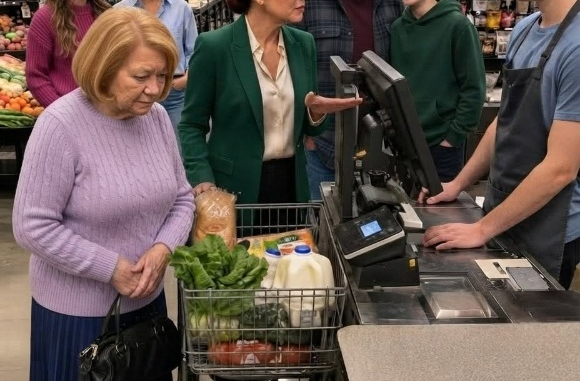
“Three weeks ago,” I said, “Meadow called me a maid inside a grocery store.”
Blaine looked uncomfortable.
“You laughed.”
“Mom—”
I stopped him with a raised hand.
“And last week, Meadow, I overheard you discussing how much longer I might live and how much money you expected to receive when I died.”
Her face turned red.
“You were listening to our private conversation?”
“In my own house.”
I opened the envelope.
“I’ve removed both of you from my will.”
Blaine looked stunned.
“You can’t be serious.”
“I am.”
I paused before continuing.
“Jud will receive a trust when he turns twenty-five, provided he learns the value of respect. Most of the remaining estate will eventually be donated to charity.”
Blaine looked devastated.
“But we’re your family.”
“Family doesn’t treat someone the way you’ve treated me.”
Then I looked at James.
“Tell them about Morrison’s.”
James opened his briefcase.
“Mrs. Harrison owns forty percent of Morrison’s Market. She has been a silent partner for fifteen years and recently took an active role in managing the business.”
Meadow’s eyes widened.
“That isn’t possible.”
James continued.
“She also owns substantial interests in several other grocery operations, multiple rental properties, and a property-management company that oversees commercial real estate.”
No one spoke.
Finally, Blaine whispered, “How much money do you have?”
Sarah answered calmly.
“Based on the current valuation of her businesses, investments, properties, and liquid assets, approximately forty-seven million dollars.”
Meadow tightened her grip on the couch.
“Forty-seven million?”
I met her eyes.
“Yes. Forty-seven million.”
“While you made me sleep in the smallest bedroom.”
Neither of them responded.
“While you shut down the business I loved because you were embarrassed by me.”
Blaine suddenly stood.
“Why didn’t you tell us?”
I nearly laughed.
“Why would I?”
“We would have treated you differently if we’d known!”
Meadow blurted out the truth before realizing what she had said.
The room fell silent.
“Exactly.”
She immediately understood her mistake.
“You would have treated me better because I had money—not because I deserved to be treated with basic human respect.”
Sarah cleared her throat.
“There is one more matter.”
She placed another document on the table.
“Mrs. Harrison’s company has acquired the mortgage on this property. She now has control of the house.”
Meadow’s face went white.
“You mean this house?”
“Yes.”
I looked at both of them.
“You have thirty days to find another place to live.”
“This is our home!” Meadow shouted. “Jud lives here!”
“This was my home for twenty-two years before either of you came into it.”
She stared at me as though she couldn’t believe what she was hearing.
“You can’t just throw us out!”
“You spent five years telling me I was in your way. Consider this my answer.”
I told them I would stay in a hotel downtown while everything was being finalized.
As I walked upstairs to pack, Blaine followed.
“Mom, please. We can fix this. We’ll change.”
I stopped halfway up the staircase.
A part of me wanted to turn around.
But I knew exactly what I’d see if I looked at him—the little boy whose scraped knees I had bandaged and whose college applications I had proofread after working double shifts.
That boy had disappeared somewhere along the way.
The man standing behind me was the same man who had laughed while his wife treated his mother like a servant.
So I kept walking.
“I’m seventy years old, Blaine. I don’t have enough years left to wait for you to learn how to love me properly.”
Then I continued upstairs.
One suitcase.
That was all it took to gather my belongings from a home where I had spent decades.
And strangely enough, carrying that suitcase away felt lighter than remaining there ever had.
PART 3 — A Life Worth Living
Six months later, I sat on the terrace of my villa overlooking Lake Como.
The mountains shimmered beneath the morning sun as I sipped espresso from a delicate porcelain cup.
For the first time in decades, nobody expected me to prepare breakfast.
Nobody snapped their fingers at me.
Nobody criticized what I cooked.
I had hired a housekeeper named Elena, a warmhearted Italian woman who nearly fainted the first time she caught me washing dishes.
Eventually, we reached a compromise.
I cook every Sunday because cooking still makes me happy.
The rest of the week, Elena refuses to let me lift a finger.
After leaving Blaine’s house, Sarah’s team conducted a complete audit of my assets.
The final figure surprised even me.
Almost fifty million dollars.
Fifty years of careful choices had quietly transformed into a fortune.
But I didn’t want my wealth sitting untouched in bank accounts.
I arranged for the grocery stores to be transferred to the employees through a generous buyout program.
At the staff meeting, the young cashier from the morning Meadow humiliated me approached.
He apologized for looking away when she insulted me.
I told him there was nothing to forgive.
He had simply believed the woman who spoke with confidence.
I placed my rental properties under professional management and instructed them to keep the rents affordable for working families.
Then I finally did something I had been putting off for fifty years.
I chose a life because I wanted it.
Italy.
A beautiful yet comfortable villa near Lake Como.
Three bedrooms.
A library packed with books.
Gardens stretching toward the water.
And, most importantly, a kitchen where I could cook because I enjoyed it—not because someone demanded it.
One morning, Elena brought me the telephone.
“A young man named Jud is calling from America.”
My grandson had been calling every week.
At first, he was angry.
Then he became confused.
Eventually, he began asking questions.
“Grandma?”
“Hello, sweetheart.”
There was a long pause.
“Mom and Dad are getting divorced.”
I wasn’t surprised.
“How are you doing?”
“I’m okay.”
He hesitated.
“Dad wants to talk to you.”
“And what do you think?”
Jud remained silent for several seconds.
“I think Dad knows he messed up. But…I also think he’s more sorry now because he knows how much money you have.”
His answer caught me off guard.
At thirteen, he was beginning to understand something his parents had never learned.
So I asked him a more difficult question.
“What about you? Are you sorry because of the money?”
“No.”
His voice became softer.
“I’m sorry I laughed at you in the store. I knew it was wrong. I just wanted Mom and Dad to think I was funny.”
My throat tightened.
“Thank you for telling me the truth.”
Then he asked, “Could I visit you someday? Not because you’re rich. I just miss you.”
I smiled as I looked out across the lake.
“When you’re old enough to travel, I’d love that.”
There was still hope for Jud.
He had made a mistake, but unlike his parents, he was willing to learn from it.
Blaine called repeatedly as well.
I never answered.
Every message sounded almost identical.
He was sorry.
He had changed.
He wanted another chance.
Maybe one day I would believe him.
But I wasn’t ready yet.
Then, one morning, a letter arrived from Meadow.
Three pages long.
She blamed me for destroying the family.
She demanded money to pay for her divorce lawyer.
She threatened to stop Jud from visiting me.
She promised she would change if I reconsidered my will.
What she never did was apologize for the way she had treated me.
Every sentence was still about what my money could do for her.
I folded the letter, carried it to the fireplace, and watched it burn.
Some bridges deserve to be rebuilt.
Others were never bridges.
They were toll booths.
Eventually, I established a foundation dedicated to helping elderly people facing neglect or financial exploitation by their families.
I also funded scholarships for single mothers trying to build businesses—the women standing where I had once stood after Frank left me with a young son and almost nothing in the bank.
For the first time, my money represented the person I truly was.
That evening, I stood on the terrace and watched the sun sink behind the mountains.
I raised my glass.
To second chances.
To independence that may arrive late but still matters.
And to realizing that choosing yourself isn’t selfish when the people around you have spent years trying to make you disappear.
I am seventy years old.
Six months ago, my own family laughed when someone called me their maid.
Today, I wake up in a peaceful home surrounded by people who treat me with kindness without knowing—or caring—how much money I have.
For decades, I thought my life was almost over.
I was wrong.
It was simply waiting for me to begin.
Leave a Reply