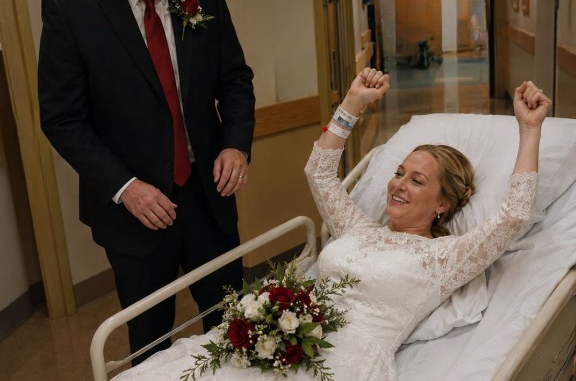
Six days after I slipped a wedding ring onto Margaret’s swollen finger in a hospital room, I stood beside her grave, still wondering why she had suddenly changed her mind about marrying me.
My name is Daniel. For four years, I had watched the woman I loved battle a rare autoimmune disease. I drove her to appointments, reduced my hours at work, and spent nearly everything I had saved for a home on her care.
I had proposed more than once, but Margaret always said no. She was terrified that if she died, I would be left drowning in medical bills.
Then, one week before a risky surgery, everything changed.
Margaret took my hand and quietly asked me to marry her.
We held a small ceremony with around twenty relatives, friends, doctors, and nurses. There was a simple grocery-store cake, and Margaret wore a white cardigan over her hospital gown.
Six days later, complications from her surgery took her life.
She was only 31.
Afterward, I barely answered my phone. I stopped sleeping in our bed and struggled to get through each day.
Then Margaret’s longtime family lawyer, Walter, called.
He told me Margaret had prepared a will before her surgery.
Then he said something that made my stomach drop.
“I think I finally understand why she wanted to marry you.”
Apparently, Margaret had inherited an interest in an old family trust—something I had never known about. Much of the trust had been protected by strict conditions while she was alive.
Walter explained that Margaret’s decision to marry me had changed what would happen to that money after her death.
Because she had died as my wife, I became eligible for her remaining trust benefits and inheritance, totaling slightly more than $400,000 after expenses and obligations.
At first, I was angry.
I had sold my car, drained my savings, struggled with rent, and even turned down a career opportunity in Chicago because I believed we had almost nothing left.
But Walter explained that Margaret had never been able to simply access the trust money and use it freely for medical bills or everyday expenses.
Instead, she had carefully arranged her estate so that I would have something to rebuild my life with after she was gone.
She wanted me to recover financially.
She wanted me to have the chance to buy the house with the porch I had always dreamed about.
She wanted me to rebuild my savings and have something invested for my future.
There was no hidden legal battle or family dispute waiting for me.
There were simply carefully prepared documents—and a letter Margaret had written specifically for me.
In it, she explained that she didn’t want the money to become another reminder of everything her illness had taken from us.
She wanted it to become a future.
I couldn’t bring myself to touch the money for almost a year.
Using it felt like admitting that Margaret was truly gone.
Then I found an old house.
The paint was peeling, the shutters were crooked, and the floors were worn, but it had the ridiculous wraparound porch I had talked about for years.
I bought it.
I repaired the floors, painted the kitchen, and slowly turned it into a home.
Eventually, I adopted a shelter dog with one floppy ear.
I named him Stanley, after the IV pole Margaret had jokingly given the same name during her treatments.
Four years have passed since I lost her.
Our wedding rings now sit together in a small box beside my bed.
Sometimes people look uncomfortable when I tell them my marriage lasted only six days.
But six days doesn’t come close to describing what Margaret and I shared.
She didn’t marry me because she wanted to make me wealthy.
She married me because, in the end, she found a way to leave this world without believing she had destroyed my future.
The money helped me rebuild.
But Margaret’s greatest gift wasn’t the inheritance.
It was giving me permission to keep living without feeling guilty for moving forward.
She left me a future—and a way to carry her with me into it.
Leave a Reply