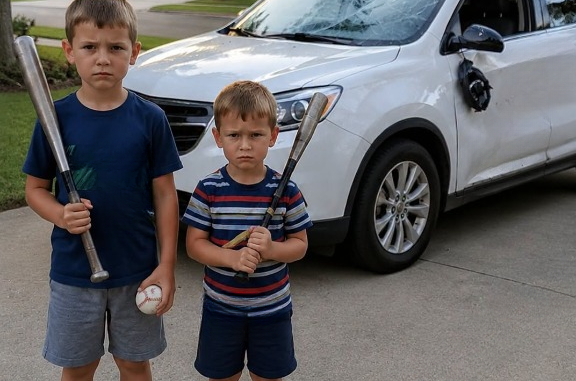
The sharp sound of breaking glass brought every conversation in our backyard to an immediate stop. I rushed toward the driveway and found my sister-in-law Megan’s two sons, Bruno and Nick, standing beside our brand-new crossover. Bruno was still holding the baseball bat.
The damage was awful. The side mirror was hanging by a wire, several deep dents covered the driver’s door, and the windshield was filled with cracks.
Martin and I had spent three years saving for that car. We had skipped vacations, put almost every bonus into our savings, and were still recovering financially from the medical expenses that came with my mother’s cancer treatment.
When Megan approached with a glass of lemonade, I expected her to be horrified.
Instead, she looked at the car and laughed.
“They’re just kids,” she said casually when I told her she needed to take responsibility for the repairs.
At that moment, I thought her attitude was the worst part of the situation.
I was wrong.
The backyard became strangely quiet, but Megan behaved as though nothing serious had happened.
Later, while I was carrying cups through the hallway, I heard her speaking quietly to the boys inside the guest room.
“You did exactly what Mommy told you,” she said, promising them new toy cars because they had listened to her.
Then she instructed them to tell everyone they had simply been playing.
My husband, Martin, reached for the door when Bruno suddenly said, “But you told us to hit Aunt Priscilla’s car.”
I stopped him.
If we confronted Megan immediately, she’d have time to deny everything and create her own version of events.
By the following morning, I had already decided on a different approach.
First, we photographed every part of the damage.
Then we contacted our insurance company and got a professional estimate for the repairs. I also spoke with a lawyer friend about preserving the details of what we’d heard, especially in case Megan refused to pay and the situation eventually became a legal matter.
We had worked too hard to build our savings and secure our home and future to allow someone else’s resentment to create another financial problem.
But we weren’t interested in punishing Bruno and Nick.
Instead, we contacted Howard, a family friend who owned an auto-detailing business.
I prepared a large box for Megan containing child-sized work shirts, gloves, sponges, buckets, and an appointment card for the following Saturday.
Megan called me furious.
Martin remained calm.
“They’re children,” he reminded her. “That’s exactly why we’re holding their mother responsible for what happened.”
On Saturday, Howard showed the boys how much effort goes into properly caring for a vehicle while professionals handled the actual repairs.
When Nick learned that Martin and I had spent three years saving for the crossover, his attitude changed completely.
Megan arrived carrying expensive remote-control cars she planned to give the boys as rewards.
But neither boy wanted them.
“I don’t think I earned this,” Nick quietly said.
That moment said more than any argument could have.
Before Megan left, she finally agreed to pay the repair bill.
She also accepted our new boundary: the boys were no longer allowed to come to our house unless we had given permission first.
But the moment I remember most had nothing to do with the money or the damaged car.
Bruno quietly placed his battered little toy car beneath my windshield wiper.
“I saved for six weeks to buy this,” he explained.
Then he looked at our repaired car.
“You saved for yours, so now your car has a car.”
For the first time since the windshield shattered, I laughed.
The boys had made a serious mistake, but they were still young enough to understand the consequences and make a better choice.
Megan had tried to teach them that destroying someone else’s happiness could earn them a reward.
Instead, that Saturday taught them something completely different.
Sometimes the most valuable lesson isn’t about punishment at all—it’s about learning what your actions cost, taking responsibility, and choosing to do better next time.
Leave a Reply