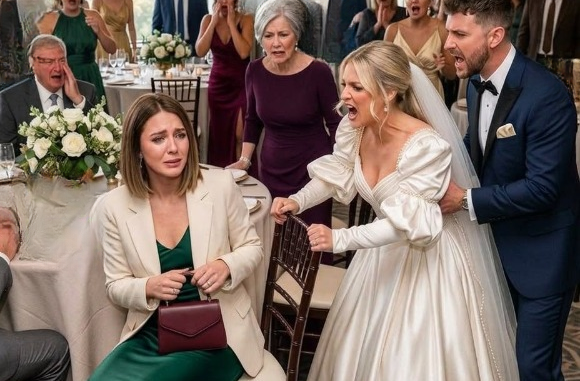
PART 2
I never wanted to be the person who helped destroy my sister’s marriage.
Whatever issues existed between Brooke and Ethan were theirs to deal with.
So I looked at Ethan and spoke softly.
“I’m not staying here to put your wife on trial.”
Brooke let out a bitter laugh.
“How convenient.”
Grandma Rose turned toward her.
“Enough.”
Ethan looked completely drained.
Then he asked me another question.
“Has Brooke ever borrowed money from you before?”
I paused.
Brooke quickly answered.
“That was years ago.”
“That’s not what I asked,” Ethan said.
I could feel everyone around us listening.
“Eight thousand dollars. Two years ago.”
“For the certification program?” Ethan asked.
The question caught me off guard.
I nodded.
“That’s what she told me.”
Ethan looked at Brooke.
“You told me your father paid for that course.”
“He was supposed to.”
“You also told me you completed it.”
“I did most of it online.”
I shook my head before I could stop myself.
Ethan noticed immediately.
“What?”
“There was no course,” I said quietly. “At least, not one she spent my money on.”
Brooke stared at me.
“You don’t know that.”
“You posted pictures from Miami the same week you told me your enrollment had been delayed. When I asked you for a tuition receipt, you stopped responding.”
“That proves nothing.”
“No. But it does explain why I refused to lend you another twelve thousand dollars.”
Linda tried to step in.
“Everyone is emotional right now. This can wait until tomorrow.”
Ethan turned toward her.
“Did you know Brooke asked Claire for money for the wedding?”
Linda admitted she knew Brooke had been short on cash.
Then Ethan’s father, Robert, stepped forward. As a retired accountant, he suddenly looked at the situation as though the numbers were no longer making sense.
“How much money are we talking about?”
Ethan pulled out his phone.
“Brooke and I have a joint account for the wedding. We agreed to contribute thirty-five thousand dollars each. My share is still there. She told me hers was too.”
Brooke whispered:
“Don’t.”
Ethan opened the banking app.
His expression immediately changed.
“There’s only fourteen thousand dollars left.”
Robert frowned.
“After the final vendor payments?”
“No. Before them.”
Brooke began to cry.
“I was going to fix it.”
“How much is missing?” Ethan asked.
She covered her mouth.
“Brooke.”
“Twenty-one thousand.”
Linda gasped.
“Where did twenty-one thousand dollars go?”
Brooke said nothing.
Then Kelsey, her maid of honor, finally spoke.
“Tell him.”
Brooke turned sharply.
“Stay out of this.”
Kelsey looked miserable.
“You told me he already knew.”
“Knew what?” Ethan asked.
“The credit cards.”
The truth began coming out piece by piece.
Six months earlier, Brooke had secretly accumulated nearly maxed-out balances on three credit cards without telling Ethan. She used some of the money she had saved for the wedding to pay them down, expecting to replace it when her year-end bonus arrived.
But the bonus was much smaller than she expected.
Instead of cutting back on the wedding, she upgraded everything—premium flowers, expensive champagne, additional lighting, and a designer second dress.
Once the bills started arriving, she began borrowing money.
Two thousand dollars from Linda.
Three thousand from Kelsey.
Five thousand from a retirement account.
Then she came to me asking for twelve thousand, assuming I would agree like I had so many times before.
When I refused, she panicked.
And apparently decided that I deserved to be punished for saying no.
“So you moved your own sister to a back table because she refused to cover money you secretly spent?” Ethan asked.
“It wasn’t like that.”
“Then what was it like?”
“She judged me.”
“I said no,” I replied. “That’s all I did.”
“You made me feel pathetic.”
“I never told anyone you asked me for money.”
Ethan looked at me.
“Not even Grandma?”
“No.”
Grandma raised her eyebrows. Even she hadn’t known.
Brooke stared at me as the truth finally sank in.
Even after she had publicly humiliated me, I had still protected her secret.
But instead of apologizing, she whispered:
“You always get to be the good one.”
That was when I finally understood.
There was no way I could ever win with Brooke.
If I defended myself, I was arrogant.
If I stayed quiet, I was manipulative.
If I helped her, I was showing off.
If I refused, I was selfish.
The only way the game could continue was if I agreed to keep playing.
“I don’t need to be the good one,” I told her. “I just refuse to be your target anymore.”
Then I hugged Grandma, said goodbye to my aunts, and walked outside.
This time, nobody tried to stop me.
A moment later, Grandma came outside, followed by several aunts and cousins.
“You really don’t all have to leave,” I told them.
Grandma gave me a knowing look.
“We know.”
And that was exactly the point.
They weren’t leaving because I had demanded that they take my side.
They were leaving because Brooke had forced everyone to decide whether humiliating me was acceptable.
And they had made their choice.
PART 3
Instead of going home, we ended up at a twenty-four-hour diner about ten minutes away.
Grandma ordered pancakes at eleven at night. Someone got fries for the table. A few relatives loosened their ties and kicked off their uncomfortable shoes.
Nobody celebrated what had happened to Brooke.
Mostly, we talked about anything other than the wedding.
At 11:42 p.m., Ethan sent me a message.
I’m sorry for what happened. You didn’t cause this. I asked Brooke to stay with her mother tonight. We’re not leaving for the honeymoon tomorrow.
I stared at the message for a long time before responding.
I’m sorry you’re dealing with this. I hope you make whatever decision is right for you.
Then I put my phone away.
Three days later, Brooke called me fourteen times.
I ignored every call.
Her messages changed depending on who she wanted to blame.
First, I had supposedly ruined her reception.
Then it was Grandma’s fault.
Then she claimed Ethan’s family had always disliked her.
Then Kelsey became the traitor.
Eventually, Brooke admitted she had been under “impossible financial pressure.”
Finally, she wrote:
I shouldn’t have moved your seat. I was angry because you could have helped me and chose not to.
That sentence made me realize she still didn’t understand.
I replied only once.
My money was never yours to expect. Neither was my silence. Don’t contact me again until you can talk to me without blaming me for your own decisions.
Then I blocked her.
Despite what several relatives expected, Ethan didn’t immediately end the marriage.
Instead, he moved into his brother’s apartment for six weeks.
He demanded complete financial transparency from Brooke.
The honeymoon was postponed indefinitely.
They started marriage counseling and separately met with a financial adviser.
Brooke sold her second wedding dress, several designer handbags, and jewelry she had bought using credit. Eventually, Ethan returned home, but only after they agreed to strict boundaries: separate personal accounts, complete visibility into household spending, no secret debt, and a structured repayment plan.
What nearly destroyed their marriage wasn’t the scene at the reception.
It was the deception.
My own life changed too.
I stopped feeling like I had to prove that I deserved a place in my family.
When Thanksgiving came, Grandma hosted dinner and invited both Brooke and me.
Brooke arrived first.
I came twenty minutes later.
For a moment, we stood awkwardly in the entryway.
Without the wedding dress, the crowd, and the belief that everyone should bend to her anger, Brooke seemed different.
“I’m in therapy,” she said.
I nodded.
“I know that doesn’t make everything better.”
“No.”
She swallowed hard.
“I was cruel to you.”
It was the first apology I could remember hearing from her that didn’t come with a “but.”
“I know.”
Her eyes filled with tears.
“For years, I thought that whenever people loved you, there was somehow less love left for me.”
“That was never how it worked.”
“I understand that now.”
I didn’t hug her.
I didn’t tell her everything was forgiven.
Trust doesn’t magically return because someone apologizes once.
But I stepped aside and walked with her into the dining room.
Grandma had placed two cards next to each other.
BROOKE.
CLAIRE.
My sister stared at them.
Then she reached toward my chair.
For a moment, I froze.
But this time, she didn’t pull it away.
She pulled it out from the table so I could sit.
“Thank you,” I said.
Brooke nodded and sat beside me.
Nothing was magically fixed that night. Years of resentment couldn’t disappear over one Thanksgiving dinner.
But there was no public humiliation.
No loyalty test.
No expectation that I had to pay for the privilege of belonging.
When Grandma raised her glass, everyone remained around the same table.
And for the first time, I understood something I should have learned years earlier.
I had spent too much of my life believing family was something I had to earn by being useful, generous, or endlessly forgiving.
It wasn’t.
Because a seat that is freely offered will always mean more than one you have to pay to keep.
Leave a Reply