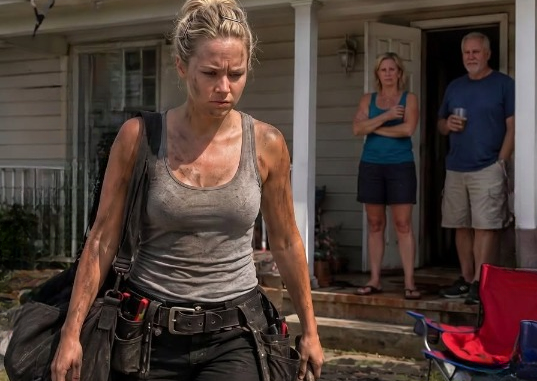
My parents claimed they couldn’t afford to hire a professional roofer, so I spent my July days climbing across their scorching roof for free while they relaxed in lawn chairs, snacked on cherries, and recorded my exhaustion like it was entertainment.
My father laughed and said, “Don’t be so sensitive. Everyone knows we’re just joking.”
I kept working.
At least, I did until I stepped into their air-conditioned kitchen, saw their already-booked luxury European vacation sitting on the table, and quietly decided I was done before the first storm ever reached their house.
By the end of that first day, the skin on the back of my neck felt burned and raw.
My hands throbbed with blisters. My shoulders shook from exhaustion. Every bundle of shingles I lifted seemed heavier than the last.
But I kept repeating the same thought I had carried my entire life:
They need me.
That had always been my role in the family.
Audrey fixes things.
Audrey handles problems.
Audrey shows up.
And if she ever complains, she apologizes afterward.
So when my parents told me they couldn’t afford the labor costs for a new roof, I believed them.
I spent two weekends preparing. I measured the roof’s pitch, estimated materials, and even called a contractor friend to get a realistic labor quote.
“Twelve thousand dollars just for labor,” he told me. “Honestly, they’d be getting a bargain.”
I remember thinking about how grateful my parents would be once they realized how much I was saving them.
Instead, my father simply whistled.
“Thank goodness we have a daughter who knows her way around a ladder.”
My mother smiled proudly.
“This is why having smart children is such a blessing.”
But in my family, being smart never meant being appreciated.
It meant being available.
I arrived before seven the next morning with all my equipment. I unloaded the tools, organized the shingles, covered the driveway, and climbed onto the roof before the sun had fully taken over the day.
My parents stood on the porch with coffee in their hands, watching.
At first, I assumed they were just interested in the work.
Then my father lifted his phone.
I thought he was recording the progress.
I was wrong.
He filmed me carrying heavy bundles up the ladder, stopping to catch my breath, and slipping on loose shingles before catching myself.
When I finally climbed down for water, dizzy and covered in dust, he held up the phone.
“This is going to make great content.”
My mother laughed.
“Maybe you’ll finally go viral.”
I forced a smile and asked my father if he could hold the ladder while I brought more supplies up.
He took another sip of his drink.
“I don’t want to get in your way.”
That night, while walking through the living room, I heard something that made me stop.
My own voice was coming from the television.
My father had shared the videos with the family.
There I was on the screen—sweaty, exhausted, and struggling beneath a bundle of shingles.
The caption mocked me for trying so hard to prove I was useful.
My uncle responded with a joke.
My sister added a cruel comment.
My cousins laughed along.
When my father noticed me standing there, he didn’t look embarrassed.
He just smiled.
“Don’t be sensitive. Everybody knows we’re kidding.”
Something inside me went silent.
Not shattered.
Not destroyed.
Just locked away.
The next morning, I still returned to the roof.
Sometimes your body continues following the rules you were raised with long after your heart has finally understood the truth.
Later that afternoon, I climbed down for water and walked into the kitchen.
That was when I saw the papers spread across the table.
Paris.
Florence.
Nice.
Barcelona.
First-class airfare.
Private transportation.
Luxury hotels.
A six-week European vacation.
Everything had already been arranged.
Everything had already been paid for.
They had the money.
They just didn’t want to spend it on the roof.
My father noticed me looking at the itinerary.
“Your mother found an incredible deal out of JFK,” he said casually. “You can still travel comfortably if you know how to plan.”
I stared at the papers.
“You told me you couldn’t afford the labor.”
My mother looked at me as if I had misunderstood something simple.
“We couldn’t afford both.”
And there it was.
The truth sitting between the fruit bowl and the vacation documents.
They didn’t need me because they were helpless.
They needed me because I made their lives easier.
I went back outside with shaking hands.
The next afternoon, I looked through the kitchen window and saw them inside enjoying the air conditioning, eating watermelon, and replaying the videos of me working.
My father exaggerated the way I carried the shingles.
My mother laughed until she had to sit down.
And that was the moment everything finally became clear.
I climbed off the roof.
I packed my tools.
I put away the nail gun.
I coiled the equipment and covered the unfinished section with the heavy tarp I had brought for protection.
Then I walked inside.
“I have to leave,” I said. “There’s a family emergency.”
My father barely looked up.
“Try not to leave us with a cliffhanger.”
I didn’t answer.
I loaded my truck, drove away, and never looked back.
Three nights later, the storm arrived.
At exactly 12:17 a.m., my phone started ringing.
Leave a Reply