PART ONE: THE ROLE THEY EXPECTED ME TO PLAY
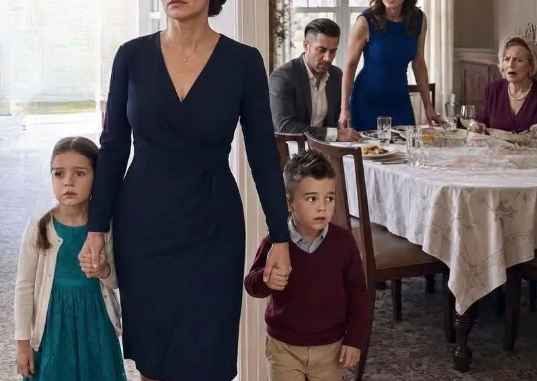
My sister-in-law slapped me across the face during my own anniversary dinner, right in front of my children, because I dared to serve myself before serving her.
“You’ve clearly forgotten where you belong in this family,” she said.
Her hand stayed raised, and there was a look of satisfaction on her face, as if she had corrected some offense and restored the order she believed I had disturbed.
My husband, Grantham, stared down at his plate.
He did not stand.
He did not ask if I was okay.
He did not defend me.
I quietly placed my fork beside my plate and used the linen napkin I had carefully prepared earlier that morning to wipe my hands. Then, before another year of silence could convince me to accept what had happened yet again, I leaned forward and slapped her back.
Once.
The room fell silent.
Everyone looked shocked.
But I was no longer looking at my sister-in-law.
I was looking at the man I had loved since I was twenty-two.
“A husband who watches his wife be humiliated and chooses silence does not deserve to keep calling himself her husband.”
I reached for my daughter’s hand with one hand and my son’s with the other.
Still dressed in the outfit I had chosen for our anniversary, I walked out of the home I had helped pay for, renovate, and turn into a place filled with memories.
Two years later, the same family that constantly reminded me to “know my place” would finally discover where their own choices had placed them—through financial records, legal documents, and the consequences of everything they believed they could hide.
My name is Joselyn Callaway.
I was raised just outside Raleigh, North Carolina, in a large brick house with white columns and a driveway wide enough for delivery trucks to turn around comfortably.
My father built much of his success from nothing more than a small construction loan, an old truck, and an unstoppable determination that sometimes looked like stubbornness.
He was not born into wealth.
But by the time I was old enough to understand money, he had created a life where I never worried about college expenses, medical bills, or whether we could afford basic necessities.
I had everything money could provide.
Except the one thing I wanted most.
I wanted someone to love me for who I was—not because of my family name, my father’s company, or the money attached to me.
I never wanted a marriage arranged through business connections or family expectations.
I did not want someone chosen because his family’s bank account matched mine.
I wanted a man who saw Joselyn—not the inheritance, the house, or the opportunities that came with my background.
I thought I found that person in Grantham Thorn.
I met him when I was twenty-two at a small coffee shop near my college apartment on a rainy Tuesday afternoon.
He was completely different from the polished men my mother occasionally introduced me to at charity events.
Grantham drove an aging car with nearly two hundred thousand miles on it. He worked exhausting hours at a modest architecture firm, creating designs for buildings he was not yet senior enough to lead himself.
His shirts were often wrinkled by the end of the day.
His shoes were simple.
He did not care about impressing people who had influence or money.
During our first conversation, he made me laugh so hard that I accidentally knocked over my drink and spilled it over both of us.
Neither of us cared.
We talked for four hours straight.
I completely forgot about a study session I had promised to attend.
My father was cautious about Grantham. He had always been suspicious of young men who appeared without a respected family background.
My mother was even more honest.
“A man who marries into wealth,” she once warned me, “might eventually love the comfort surrounding the woman more than the woman herself.”
I insisted she was wrong.
Eight months after meeting Grantham, I stood in my parents’ kitchen defending him with the confidence of someone who had never experienced the pain of being mistaken.
“You don’t understand what we have,” I told them.
At that moment, I truly believed it.
We married in a small garden ceremony behind my grandmother’s old church.
My parents paid for the wedding, but I wanted something simple.
There were white chairs beneath flowering trees, blue flowers along the aisle, and a small reception in the church hall.
Grantham’s family attended, but their behavior felt distant and uncomfortable.
At the time, I assumed they were simply nervous around people different from them.
I was wrong.
It was not discomfort.
It was observation.
They were measuring me.
Grantham’s mother, Finanella Thorn, ruled her family with the confidence of someone who believed she belonged above everyone else.
She rarely insulted people directly.
Instead, she delivered criticism wrapped in kindness, making anyone who challenged her look unreasonable.
Her daughter, Willamina, was the unquestioned favorite.
Willamina was unmarried and financially dependent on the family catering company started by her late father.
From the outside, the business looked successful.
The storefront was beautiful.
The advertisements were impressive.
The wedding photos online looked luxurious.
But behind the scenes, the company survived because Finanella refused to let it collapse.
Willamina hated anyone who threatened her position as the center of attention.
And without realizing it, I became that threat.
I had my own money.
My own opinions.
And, for a time, a husband who seemed to value me more than his sister’s approval.
That eventually changed.
The first major warning sign came during our second Thanksgiving as a married couple.
I spent the entire day preparing a meal using recipes handwritten by my grandmother.
The house smelled of herbs, baked desserts, and warm food. Rain tapped against the windows while everyone gathered together.
Then Willamina tasted the stuffing, lowered her fork, and spoke loudly enough for everyone to hear.
“It’s adorable when people work so hard to prove they belong somewhere they clearly weren’t born into.”
People laughed.
Not because it was funny.
Because they were uncomfortable.
Grantham immediately changed the subject.
He never defended me.
The following year, during our son’s christening, Finanella approached me while I held my newborn baby.
In the sweetest voice, she said:
“Money can create a beautiful nursery, but it cannot create good manners. I worry about what children learn when they are surrounded by too much of it.”
I stood there holding my child.
And again, I said nothing.
Over time, I learned that speaking up only created more tension afterward.
Grantham never confronted his family.
He never apologized on their behalf.
He simply allowed everything to happen.
Years later, when Willamina’s catering business could not afford to host Finanella’s birthday celebration, I quietly paid the entire bill.
Instead of gratitude, Willamina announced:
“It’s nice that Joselyn finally found something useful to do with all that family money.”
I laughed along with everyone else.
By then, pretending things did not hurt had become my way of surviving.
For eleven years, small insults continued.
They were always disguised as jokes.
Always delivered in front of others.
Always followed by Grantham’s silence.
He convinced himself he was innocent because he never joined in.
But he also never protected me.
I spent years telling myself our marriage was worth saving.
I told myself love meant patience.
I told myself my children deserved a relationship with their grandparents.
I reminded myself that I had chosen Grantham despite other options my parents had suggested, and I needed to make that choice work.
During those eleven years, I told myself countless things.
Most of them were simply ways to survive.
By then, we had two children.
Our daughter, Beatatrix, was seven and noticed far more than adults realized.
Our son, Callahan, was five and loved his father with complete trust.
I had also built a successful career.
The interior-design company I created with my partner Hian grew from a tiny office into a respected business with eleven employees.
Eventually, I earned more than Grantham.
I never mentioned it.
I did not want him to feel insecure.
Even when I covered the mortgage because his money was being directed elsewhere, I stayed quiet.
Because I traveled frequently for work, Grantham gradually took over managing our finances.
At first, it seemed like a normal partnership.
I never imagined that arrangement would later become the way his family gained access to everything I had built.
Our home was a Colonial-style house with a wide porch and pale shutters.
My father helped with the initial purchase, but I paid for the renovations myself.
I redesigned the kitchen.
Restored the floors.
Created a studio where I could work.
Legally, the house belonged to both Grantham and me.
But his family treated it as if it belonged to them.
They acted as though I was only allowed to stay there as long as I remembered my position.
I did not understand then how seriously they meant that.
Our eleventh anniversary arrived on a Saturday in October.
For once, I wanted a celebration that reminded me of the beginning of our marriage.
Something warm.
Something personal.
Something that belonged only to us.
Then Grantham asked if his mother and sister could attend.
“Just this once,” he said.
But with his family, “just once” never meant just once.
Still, I agreed.
I spent three days preparing.
I cooked a special meal.
I baked dessert.
I decorated the table.
I pressed every napkin.
That morning, I picked flowers from my mother’s garden.
Finanella arrived and inspected the dining room like she was judging a business she expected to fail.
Willamina arrived late, as always.
Without asking, she sat at the head of the table.
Grantham allowed it.
In our home.
At our anniversary dinner.
And he did not even look at me.
I ignored it.
I always ignored things.
Until I couldn’t anymore.
When dinner began, I served the children first.
Then I filled my own plate and sat down.
I had barely lifted my fork when Willamina’s hand crossed the table and struck my face.
For a moment, everything went blurry.
“You forgot your place,” she said.
My daughter dropped her fork.
My son froze.
The entire room became silent.
I looked at Grantham.
The man I had married.
The man whose family I had supported for eleven years.
He stared at his plate.
And something inside me finally broke.
I placed my fork down.
Slowly, I wiped my hands.
Then I reached across the table and slapped Willamina once.
Everyone gasped.
They reacted as if my response was the shocking act.
As if her cruelty had been acceptable, but my refusal to accept it was not.
I stood and looked directly at my husband.
“A husband who cannot defend his wife when everyone is watching does not deserve to remain her husband.”
He said nothing.
I took my children’s hands.
And I walked away.
Leave a Reply