My wife, Helen, passed away on a Tuesday morning, just as the maple tree outside our kitchen window began turning a deep shade of red.
For forty-three years, that kitchen had been the center of our family.
Helen cooked there.
I fixed broken toys there.
Our three children grew up sitting around that table, sharing pancakes and stories.
After her funeral, they all promised they would never leave me alone.
My oldest daughter, Karen, cried into my shoulder and said, “Dad, we’ll be here every Sunday.”
My son, Michael, promised he would call me every night.
My youngest, Denise, told me the house would always be “home.”
For the first few weeks, they kept their promises.
Then Sundays became harder to schedule.
Phone calls became short messages.
Messages became holiday greetings.
By the second year, I was cooking full meals for people who never arrived.
By the fifth year, I stopped setting out six plates and only prepared enough for myself.
By the eighth year, I stopped making excuses for why they were late.
Every Thanksgiving, I roasted a turkey.
Every Christmas, I decorated the tree.
Every birthday, I left a voicemail.
“Just wanted to check on you.”
“Hope everything is okay.”
“Dinner is ready if you want to come.”
No one came.
Ten years after Helen died, I sat alone at the kitchen table with a roast dinner, three desserts, and my phone lying face down beside me.
Nobody showed up.
Nobody called.
That night, I walked through the house slowly, touching the walls that held decades of memories.
Helen’s sewing room.
The hallway where I marked the children’s heights as they grew.
The guest room that my grandchildren had not used in years.
Then I made a decision.
It was not fueled by anger.
It felt like finally being able to breathe again.
I sold the house without telling my children.
I gave away most of the furniture.
I closed the bank accounts they knew about.
I changed my phone number.
I moved to a quiet coastal town in Maine and began using my middle name, Thomas Reed.
The only things I carried with me were Helen’s recipe box and our wedding photo.
For an entire year, nobody found me.
No birthday messages.
No worried calls.
No questions about where I had gone.
I learned to drink coffee by the ocean.
I learned that silence could be peaceful when it was something I chose.
Then, one rainy afternoon, my new phone rang.
The number was unfamiliar.
I almost ignored it.
But something made me answer.
A young girl’s voice spoke softly.
“Grandpa?”
My heart stopped.
“Who is this?”
“It’s Lily,” she said. “Mom told me you were dead.”
I gripped the edge of the table.
Lily was Karen’s daughter.
She was twelve years old now.
Her voice trembled.
“Grandpa… are you really alive?”
For several seconds, I could not speak.
Rain tapped against the window, and the pain I thought I had buried suddenly returned.
“Lily,” I asked gently, “who told you I died?”
“Mom did,” she whispered. “She said after Grandma passed away, you got sick and then you were gone.”
I closed my eyes.
Karen had not just forgotten me.
She had erased me while I was still alive.
“Where are you right now?”
“In my room. I found an old Christmas card you sent Mom. I recognized your handwriting, so I searched your name and found the house sale records.”
Smart girl.
Helen would have loved her curiosity.
“Does your mother know you called?”
“No. Please don’t tell her.”
“Are you safe?”
“Yes. I just wanted to know if I really had a grandfather.”
That sentence hurt more than all those empty years.
I told her the truth.
I told her I had been alone.
I told her I had reached out.
I told her I had waited.
But I did not tell her that her mother had hurt me.
Children should never have to carry the mistakes of adults.
The next day, I called my attorney, Samuel Price.
He had handled the house sale and knew where I lived.
“I need to come back,” I told him.
“Robert,” he said, using my real name, “are you certain?”
“No,” I admitted. “But my granddaughter thinks I’m dead.”
Three days later, I drove back to Vermont.
I did not go to Karen’s house.
I went to the cemetery first.
Helen’s grave was still beautiful because I had arranged for it to be cared for after I left.
I stood there holding flowers.
“They told our granddaughter I died,” I whispered.
The wind moved through the maple trees.
For the first time in years, I felt anger strong enough to remind me that I still mattered.
I met Lily at a small diner after school.
She looked like Karen had at that age, but she carried Helen’s eyes.
She ran toward me and hugged me tightly.
“I knew it,” she cried. “I knew Mom wasn’t telling the truth.”
I held her and tried not to break down.
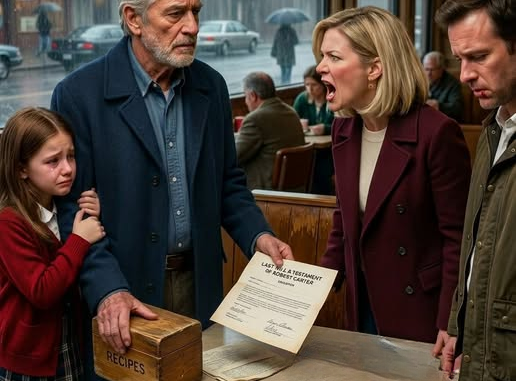
Then Karen walked into the diner.
The color disappeared from her face.
Michael and Denise followed behind her.
All three stared at me like they were looking at someone who had returned from the dead.
Karen grabbed Lily’s arm.
“Stay away from him.”
Lily pulled back.
“He’s my grandfather.”
Michael was the first to speak.
“Dad… where have you been?”
I looked at them.
“At the same place where I waited for ten years.”
Denise started crying.
Karen remained cold.
“You embarrassed us by disappearing.”
I let out a quiet laugh.
“You told my granddaughter I was dead.”
Her expression hardened.
“It was easier than explaining why you left.”
“No,” I said.
“It was easier than explaining why you were never there.”
The diner went silent.
Lily stayed close beside me.
My children looked older than I remembered.
Not wiser.
Just older.
Michael sat down.
“Dad, I thought Karen was checking on you.”
Denise wiped her tears.
“I thought Michael was.”
Karen crossed her arms.
“Don’t pretend you’re innocent. None of us wanted to deal with him.”
There it was.
Not confusion.
Not regret.
Convenience.
I looked at the daughter I once carried through storms and sickness and saw someone who had turned her guilt into blame.
“I cooked,” I said.
“I called.”
“I waited.”
Karen shook her head.
“You made us feel guilty.”
“No, Karen. Your choices did that.”
Lily looked up at me.
“Did you really make pies every Christmas?”
“Yes.”
“For us?”
“Yes.”
Her eyes filled with tears.
That pain was different.
A child was grieving memories that adults had taken away from her.
Samuel arrived shortly afterward.
I had asked him to come because I knew the conversation might become about money.
I was right.
Michael asked about the money from the house.
Denise asked about the accounts.
Karen asked if I had changed my will.
I placed Helen’s recipe box on the table.
“This is what I wanted to give you.”
Karen looked confused.
“That’s all?”
“No,” I said.
“I came back to meet my granddaughter.”
Samuel opened his folder.
After Helen died, my original will divided everything equally among my children.
But after ten years of silence, I changed it.
Most of my estate would now fund scholarships in Helen’s name.
A protected trust would be created for Lily.
My children would each receive one dollar and a letter explaining why.
Karen stood up.
“You’re punishing us.”
I shook my head.
“No. I’m putting the truth in writing.”
Michael began to cry.
“I’m sorry, Dad.”
Maybe he meant it.
Maybe he was only realizing what he had lost.
I would never truly know.
Denise asked if there was any way to fix things.
I looked at Lily.
Then at Helen’s recipe box.
“There is a way forward,” I said. “But there is no going back.”
Over the next year, Lily visited me in Maine during school breaks.
We baked Helen’s apple pie.
We walked along the harbor.
She learned that family is built through love and effort, not just shared blood.
Karen challenged the trust and lost.
Michael called occasionally.
Denise wrote letters.
I answered when I wanted to, not because I felt obligated.
I never returned to being the lonely man sitting at that old kitchen table.
I built a smaller life.
But it was warmer.
The next Christmas, Lily and I cooked dinner together.
Two plates.
Two mugs of cocoa.
One candle beside Helen’s photograph.
She looked at the empty chairs and asked, “Are you sad?”
I thought about it.
“Yes,” I said. “But I’m not waiting anymore.”
She smiled and handed me Helen’s recipe card.
“Then we should eat before the pie gets cold.”
For ten years, I believed being forgotten was the end of my story.
It wasn’t.
It was the chapter that showed me who wanted me and who only wanted what I provided.
Sometimes disappearing is not about revenge.
Sometimes it is the first honest choice after years of hoping someone will remember you.
Leave a Reply