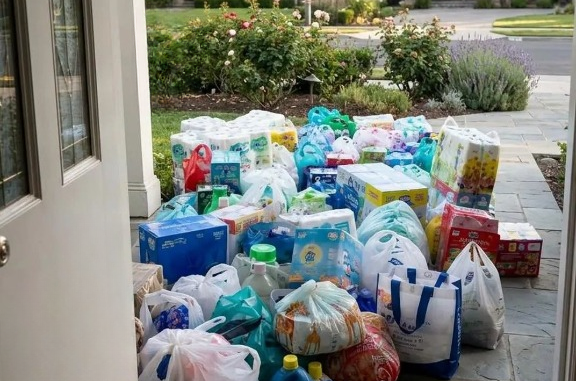
At exactly 6:38 on the morning of Steve’s birthday, I opened my front door and froze. My entire porch was covered with grocery bags. Inside were fresh bread, blankets, cleaning supplies, canned goods, towels, vegetables, and warm socks. For five years, this same mysterious delivery had appeared before sunrise on the day that always hurt the most. But this year was different—because I had finally installed a security camera above my door.
I carried the bags inside, opened my laptop, and replayed the overnight footage with my heart racing. At 4:47 a.m., a woman entered through my gate and began carrying bags from the trunk of a dark-colored car. When she stepped into the porch light and looked toward the camera, I felt my breath disappear. I knew exactly who she was—the one person I never imagined would be behind it all.
Five years earlier, my husband Steve had died unexpectedly from an undiagnosed heart condition, leaving me alone at just thirty years old. The year before his death, our financial situation had slowly collapsed. We had nearly $18,000 in medical bills, a $1,340 monthly mortgage payment, home repairs we couldn’t afford, and less than $2,500 left in savings. I was working full time, but after losing Steve, even basic daily tasks felt overwhelming.
On the first birthday after his passing, I heard a quiet knock at the door and found enough groceries and household supplies to last for months. There was no name, no receipt, and no explanation. The next year, the same thing happened. Then again. And again.
My neighbor Rochelle never saw anyone. Local organizations had no record of helping me. Even the elderly couple across the street had no idea who kept arriving before dawn. The deliveries became a yearly mystery, but what made them feel so personal was what they contained—Steve’s favorite coffee, the tea we always drank together, and the exact laundry detergent he swore was the only one that truly smelled fresh.
The woman on my computer screen was Diane—Steve’s mother.
We hadn’t spoken since his funeral. That day, standing beside his grave, she had blamed me for not noticing the signs that could have saved him. Doctors had explained there was nothing I could have done, but her accusations stayed with me for years.
My hands shook as I called her.
After several rings, she answered cautiously. When I asked why she had been on my porch, silence filled the phone.
Finally, Diane admitted the truth.
She had been the one delivering every bag of groceries, every blanket, and every box of supplies for the past five years.
She told me she regretted the things she said at the funeral but had been too ashamed and stubborn to come back and face me. I told her that anonymous gifts couldn’t erase the pain she had caused, and she quietly admitted I was right.
Then she revealed why she had done it.
Two days before he died, Steve had called her after feeling discomfort in his chest. He thought it was probably stress and planned to see a doctor after finishing an important work project. But even then, his biggest concern wasn’t himself—it was me.
He knew I had been skipping meals, putting off appointments, and pretending our money problems weren’t as serious as they were.
Diane told me Steve asked her to make sure I always had what I needed if anything ever happened to him.
Later, the attorney who handled Steve’s estate helped me sort through the paperwork, keep the house secure, and transfer his retirement funds into a survivor account. There wasn’t some hidden fortune, secret trust, or unexpected inheritance waiting for me.
There was only Steve’s final request.
Diane confessed that grief and anger had caused her to lash out at me at the funeral. But the next day, she discovered a voicemail Steve had left for her, thanking her for promising to look after me.
She sent me the recording.
As Steve’s voice filled my kitchen, I heard him say that I always tried to appear strong even when I was scared. He asked his mother not to wait for me to ask for help. Then he ended with four words that shattered both of us:
“Please be kind to her.”
I didn’t forgive Diane instantly. I didn’t pretend her apology could erase five years of hurt. But I asked her to come over.
Twenty minutes later, she stood on my porch looking older, quieter, and completely different from the woman I remembered. She had no bags in her hands—only tears in her eyes.
Together, we put away the groceries while talking about Steve: his awful singing, the way he always forgot to close cabinet doors, and the ridiculously strong coffee he loved making.
For the first time in five years, his birthday became a day to celebrate the man he was instead of only mourning the fact that he was gone.
Diane never left another anonymous delivery.
The following year, she came after sunrise, knocked on my door, and carried the groceries inside with me.
Steve had asked her to make sure I never felt completely alone. It took us five years to understand that his final act of love wasn’t just about food and supplies—it was about finding our way back to the family grief had broken apart.
Leave a Reply