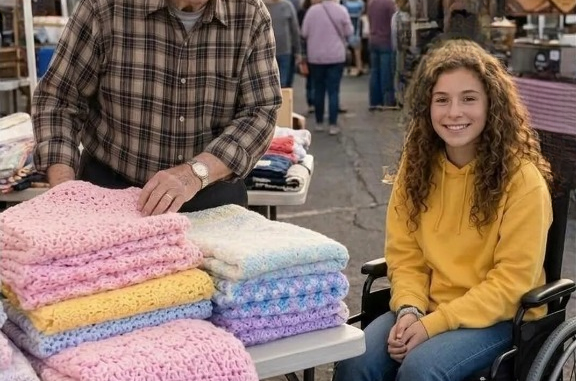
The flea market went completely quiet when the gray-haired biker pointed toward our quilt booth and said, “Benjamin, you told me your daughter and her child were dead.” Grandpa’s trembling hands gripped the back of my wheelchair so tightly that his fingers turned pale. A woman browsing one of our handmade quilts slowly lowered it, while my best friend Tessa stood motionless behind the cash register. I stared at the stranger in the leather vest, then at Grandpa’s stunned expression, waiting for someone to laugh and reveal it was all a misunderstanding. Instead, Grandpa tried to wheel me away. I stopped him, locked the chair, and demanded to know why this stranger was talking about my mother, Hannah. The biker wiped away tears, placed an old envelope on the table, and said, “My name is Cole. I’ve spent twenty years trying to find both of you.”
Before that moment, Grandpa Benjamin had been the person I trusted more than anyone. He had raised me since I was born after my mother died, made my lunches, learned how to do my hair, and showed up alone to every school event and meeting. When I was fifteen, a serious car accident changed my life and left me unable to walk. Doctors said intensive physical therapy was my best hope for recovery, but our insurance only covered part of the cost. Each appointment left us paying nearly $275, not including equipment, transportation, and specialist visits. Grandpa was already working long hours stocking shelves for a small wage, but at seventy-six, he took extra shifts and stayed awake late into the night sewing quilts on Grandma’s old machine. He sold small blankets for $35, medium quilts for $60, and larger handmade pieces for over $100 at the weekend flea market. I often found him working after midnight, his hands aching and his chest hurting, but he always told me my chance to walk again mattered more than his exhaustion. A few days before Cole appeared, I started helping by redesigning quilts, taking photos, and creating affordable versions that cost less to make. The quilt covering my legs that day was made with yellow floral fabric from one of my mother’s old dresses.
Cole opened the envelope and pulled out a photograph of Hannah wearing that same yellow dress, standing beside him when they were young. On the back, she had written that they had found their way back to each other after five years apart and hoped they could finally create a future together. Grandpa admitted he had never accepted Cole because he was twenty-one, struggling financially, and repairing motorcycles when he first dated my eighteen-year-old mother. He had forced Hannah to choose between Cole and her family, then hid the letters Cole sent after she left. Years later, Hannah found those letters, reconnected with Cole, and came home pregnant with me. After she died shortly after my birth, Grandpa told Cole that neither Hannah nor the baby had survived. Cole believed the lie for years—until he saw my picture on the flea market’s website and recognized Hannah’s features in my face.
Grandpa begged me to talk somewhere private, but instead I placed every photo and letter on the table and asked Tessa to record everything. Then Cole handed me one final letter from my mother, and the first words changed everything I thought I knew about my past. Hannah had written that I was healthy, growing stronger every day, and that Grandpa had no right to remove Cole from my life. A DNA test later confirmed that Cole was my biological father. But I told him that sharing my blood did not instantly erase fifteen missing years or make him my parent overnight. Cole promised he would not fight for custody or force me into a painful court battle. He said he had already lost enough time and would not take away the years we still had left. With the help of an attorney, we created visitation arrangements while Grandpa remained my legal guardian. We also reviewed medical expenses, the mortgage, and the small account connected to my mother’s estate.
Cole offered to cover all my therapy costs, but I refused to let money become his way of fixing the past. Instead, I showed both men my idea for adaptive quilts designed with wheelchair users in mind—secure straps, accessible pockets, and safer materials that wouldn’t interfere with movement. Grandpa created the first sample, Cole bought the supplies, and I tracked every expense and sale in a ledger. Within two weekends, we received enough orders to pay for two additional therapy sessions. Before we returned to the market, I asked Grandpa to stand in front of the other vendors and admit the truth: Cole had never abandoned Hannah. He didn’t try to justify himself with everything he had done for me. He simply said, “I loved Maisie, but I built that love on a lie. One truth doesn’t erase the other.”
Months later, I stood in the therapy room with my walker while Grandpa and Cole watched from a few steps away. My leg trembled, and both men looked ready to catch me, but neither moved until I asked. I took one step, then another. When I finally reached the other side of the room, I sat down laughing and crying at the same time. Cole asked if he could hug me, and Grandpa quietly waited for my answer instead of deciding for me. I still loved the man who raised me, but love couldn’t erase the years of secrets or the choices he made on my behalf. I was also learning to know Cole slowly, understanding that shared DNA could begin a relationship but couldn’t replace lost time.
Our adaptive quilts continued to sell, helping pay for my therapy and eventually supporting another family facing medical struggles. For fifteen years, Grandpa believed protecting me meant controlling the truth. But once the truth finally surfaced, both men learned the same lesson: my life, my choices, and the family I chose to build belonged to me.
Leave a Reply