The Meal He Never Touched
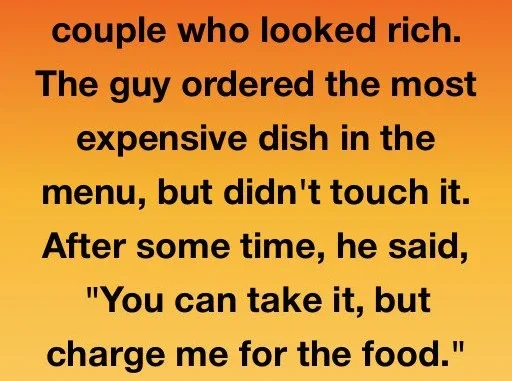
During my very first shift at an upscale dining establishment, I waited on a wealthy-looking couple. The man selected the most costly item on the menu, but when it arrived, he didn’t take a single bite. After a while, he told me, “Feel free to clear the plate, but make sure you charge me for it.” Confused by his request, I asked for clarification. He explained, “I’m really just paying to occupy this table for an hour. The food doesn’t matter.”
I stood there stunned, wondering if he was being serious. He wasn’t joking. The woman sitting across from him stared silently at her wine glass, radiating tension. She was dressed like a fashion icon, but her demeanor suggested she desperately wished to be anywhere else.
I hesitated before turning to leave, but he added, “Please don’t ask any more questions. Just bring us the bill.”
I nodded and complied, yet the strange interaction lingered in my mind long after.
That night, I kept pondering the situation. Who spends over a hundred dollars simply to sit in a restaurant booth without eating? Something felt off. Even though I was new to the job, I had grown up around people who masked deep secrets behind polite smiles.
Two weeks later, the man returned—this time on his own. He took the exact same table, placed the identical order, and left his plate completely untouched once again. I delivered the meal, which he ignored entirely, and eventually handed him the bill.
Driven by an overwhelming urge to understand, I decided to gently push past my professional boundaries.
“Are you doing alright?” I asked softly as I set the receipt down. “You don’t have to explain anything, but I’ve been concerned.”
He looked up and offered a faint, melancholy smile.
“You remind me of someone,” he remarked. “You’re far too observant.”
I offered a quiet, nervous laugh, but he motioned for me to take a seat, adding, “As long as your manager won’t mind.”
I sat down.
Leaning back and gazing at the untouched steak, he began, “Three years ago, my fiancée and I dined here every single Friday. This was our designated spot.”
He paused, and I waited in silence.
“She was killed in a hit-and-run accident, and the driver was never found.”
My heart heavy, I listened closely.
“This is the exact table where I proposed to her. She didn’t even care for this specific dish, but she ordered it that evening to celebrate the occasion. She was so overcome with joy that she couldn’t even finish it.”
He locked eyes with me. “Now, I come here to sit alongside the memory of her. I order the meal because I want to keep that moment alive.”
I was completely at a loss for words.
Throughout the night, thoughts of him consumed me—specifically how profound grief drives people to unusual habits. In my mind, I began referring to him as Mr. Friday.
Over the following months, his visits became a routine. He returned every two weeks, always alone, soft-spoken, and respectful.
One night, while handing him his check, he asked, “Do you believe in signs?”
“On occasion,” I replied. “Why do you ask?”
Glancing toward the window, he said, “Because I think I received one today.”
He placed a tiny envelope on the table. “Someone left this at her headstone. There was no signature—just a sketch of a red sedan and the words, ‘Forgive me.’”
My eyes widened. “Do you think it came from the person responsible?”
“I can’t be certain, but it’s possible.”
After that evening, weeks passed without any sign of him.
Then, one Friday, a young woman entered the restaurant alone, looking anxious. She requested Table 9—his usual spot.
I immediately recognized her face from pictures he had previously shared on his phone; she was his late fiancée’s younger sister.
After placing her order, I leaned in and asked quietly, “Are you connected to Mr. Friday?”
She looked surprised. “Mr. Friday?”
I gave a warm smile. “He was a regular here who always ordered the same plate.”
Her expression softened. “He’s my brother-in-law, in a sense—though they never had the chance to marry. He mentioned you to me.”
I was caught off guard.
“He asked me to visit tonight,” she explained. “He said that if he couldn’t return himself, I should deliver a message to the person who remembered him… to let you know he found peace.”
“What happened?” I inquired gently.
She handed me the exact same envelope from before. Inside was a letter. Though it wasn’t directly addressed to me, she granted me permission to read it:
“To the stranger who treated my heartache with compassion—
I want you to know that your small acts of kindness kept me grounded. I never imagined a server could become a friend, but you truly saw me when I felt invisible.
I received a confession. Shortly after our last conversation, a person reached out anonymously. Initially, I assumed it was the driver, but it turned out to be his son.
His father passed away, but prior to his death, he confessed to the hit-and-run, leaving behind the drawing and a written apology.
The son gathered the strength to locate me. He was just a kid when the accident happened, and he had carried immense guilt for years because he couldn’t stop his intoxicated father from driving that night.
We met face-to-face, wept together, and ultimately, I offered him forgiveness. Holding onto that bitterness was doing nothing to honor her memory.
I’ve decided to relocate abroad—not to run away, but to begin living fully again and make her proud.
Thank you once more. Your presence meant more than you could ever realize.”
A lump formed in my throat.
As the young woman prepared to leave, she retrieved a small wrapped item. “He wanted you to keep this.”
After my shift concluded, I unwrapped it to find a well-worn journal filled with personal reflections, poetry, and passages about grief and love.
On the final page was a photo of him and his fiancée laughing together at Table 9, his gaze full of adoration.
Below the picture, he had penned:
“Do not delay your life. And whenever you encounter someone carrying pain, simply share your presence with them. You never know the comfort you might bring.”
That experience permanently reshaped my view of my work.
I still carry trays and clear tables, but now I pay closer attention to the guests who walk through the doors.
On a later date, a man arrived looking distressed with a bouquet of flowers, having been stood up. Rather than letting him endure the awkwardness alone, I joined him at his table during my break to listen and chat. He expressed deep gratitude for not being ignored.
A week later, he returned with a fresh set of flowers specifically for me, as a gesture of thanks. Kindness has a way of multiplying.
Months down the line, I was promoted to manager—not for speed or intelligence, but because guests remembered the warmth they felt while in my care.
Eventually, I discovered a note left on a napkin by a returning guest that read:
“You don’t merely serve food. You serve humanity.”
It’s remarkable how a single, untouched steak provided a greater life lesson than any book ever could.
Ultimately, those who say the least are often carrying the heaviest burdens. Your daily actions, words, and small acts of consideration carry real weight.
Never underestimate your ability to make an impact—you might just be the quiet answer someone has been hoping for.
Leave a Reply