PART 1: THE LEASE
My mother-in-law ordered me out of the apartment just weeks before her great-grandchild was due to arrive.
I did not argue with her.
I did not beg my husband to defend me.
And I certainly did not try to convince anyone that I deserved to stay.
I simply nodded and agreed to leave.
But the moment the movers had carried away nearly everything I had purchased for that apartment, I turned to my husband and his family and calmly said, “From now on, the $9,800 monthly rent is your responsibility.”
I spoke with the same cold composure Eleanor had shown when she decided I had outlived my usefulness.
“Be out by tomorrow,” she had said. “My grandson’s baby is coming, and we don’t need you taking up space here anymore.”
Eleanor sat comfortably at the head of our dining table, one hand beside her wineglass, as though she were announcing an ordinary household decision.
For several seconds, I simply stared at her.
Outside the windows, Manhattan glowed beneath the setting sun. Cars moved along the streets far below our Upper East Side apartment, completely unaware that my twelve-year marriage had just been reduced to a single sentence.
“You seriously want me gone?” I asked.
My voice barely sounded like my own.
“Yes, Sarah.” She didn’t even bother looking at me. “You’ve been in the way long enough. Leo and Valerie are starting a family. They need the space. It’s time this apartment belonged to a proper family.”
A proper family.
That phrase hurt more than the eviction itself.
I had been married to Eleanor’s son, Arthur, for twelve years. For eight of those years, I had lived with his mother and endured her polished insults, constant judgment, and cruelty disguised as concern.
To Eleanor, a woman’s value seemed to begin and end with motherhood.
When I was twenty-seven, I survived a serious illness that left me unable to have children. Once Eleanor learned that, she began treating me as though I were somehow incomplete.
“You never gave Arthur a child,” she reminded me. “We were kind enough to let you play a motherly role with Leo. You should be grateful for that.”
I swallowed hard.
Leo was Arthur’s son from his first marriage. He had been eleven when I entered his life—withdrawn, cautious, and deeply affected by his parents’ divorce.
During our first year together, he hardly spoke to me.
Still, I never stopped trying.
I helped him with his schoolwork when he permitted me to. I attended parent-teacher meetings Arthur couldn’t be bothered to attend. I remembered his birthdays and kept his favorite cereal stocked in the pantry.
For nine years, I stood outside the emotional walls Leo had built around himself, hoping he would eventually understand that I genuinely cared about him.
But Eleanor was always there first.
“His family is his father and me,” she would say with that pleasant smile of hers. “Don’t confuse the poor boy.”
Only later did I realize how much damage she had actually done.
She had lied to Leo.
She told him I hated having him around. She claimed I wanted him gone and that Arthur and I would have been happier if he had never existed.
Year after year, she built a completely false version of me in his mind.
While I desperately tried to earn his trust, she quietly taught him to see me as an enemy.
There was just one thing Eleanor didn’t know.
The apartment she loved displaying to guests—the spacious rooms, polished floors, private terrace, and doorman downstairs—was not being paid for by Arthur.
It had not been for four years.
I was the one paying for it.
Every month, $9,800 left my personal account because Arthur’s business was slowly collapsing and he could no longer maintain the lifestyle his mother assumed he was funding.
Arthur paid for groceries, electricity, and internet. Those were the bills everyone could see, allowing him to maintain the illusion that he was supporting the household.
But the rent, furniture, and most of the things that made the apartment comfortable came from me.
I worked as a pharmaceutical chemist. I also held a part-time position at a private hospital and regularly accepted emergency shifts when they were available. Some shifts lasted fourteen hours, but the extra income kept our household financially stable.
I earned considerably more than Arthur.
Four years earlier, he had taken my hands and begged me to keep that fact from his mother.
He said she would humiliate him if she discovered the truth.
He said it would destroy his pride as a husband.
He told me that a good wife protected her husband’s dignity.
I agreed.
At the time, I believed that was what love meant.
Now I’m not sure whether I was protecting him or simply confusing silence with devotion.
“Does Arthur know you’re telling me to leave?” I asked Eleanor.
A faint smile appeared on her lips.
“My son is tired of carrying you,” she replied. “Perhaps he has finally found someone who makes him feel like a man.”
Something inside me went completely still.
Suddenly, all the things I had spent years refusing to examine came rushing back.
Arthur’s unexplained trips.
His phone always placed face-down on the table.
Messages disappearing before I could see them.
The unfamiliar scent of perfume on his shirts.
The way he avoided eye contact whenever I questioned him.
And the strange warmth in Eleanor’s voice whenever she mentioned Valerie.
I didn’t yell.
I wasn’t going to fall apart in front of the woman who had spent eight years methodically tearing down my confidence.
I picked up my purse.
“Fine,” I said. “I’ll be gone tomorrow.”
Eleanor lifted her chin, clearly pleased with herself.
She had no idea that the woman she had just thrown out was the person financially keeping that apartment alive.
I didn’t rent a hotel.
Instead, I drove to my sister Naomi’s apartment in Queens.
Around eleven that night, I told her everything.
Naomi had never been someone who avoided confrontation. Within minutes, she had made two calls.
The first was to a moving company willing to work through the night for an additional fee.
The second was to her friend Priya, an attorney who specialized in residential leases.
Priya listened carefully before asking me one question.
“Whose name is actually on the lease?”
“Mine,” I answered. “Only mine. Arthur’s credit had been damaged by his business problems, so the building wouldn’t approve him. I signed the lease alone four years ago.”
There was a short silence.
Then Priya said, “Sarah, do you realize what that means?”
I did.
The moment Eleanor called them a “real family,” I had already begun to understand.
I just needed someone qualified to confirm it.
The movers arrived at seven the following morning.
Later, Eleanor told relatives that I had emptied the apartment out of spite.
That wasn’t true.
I only took what belonged to me.
It just happened that I had purchased almost everything.
The couch.
The dining table.
The rugs.
The lamps.
The televisions.
The bookcases.
The wine refrigerator.
The expensive armchair Arthur had barely ever sat in.
I took the bed frame, the credenza, and most of the books as well.
When Arthur’s company started collapsing, I had quietly paid for the life we continued pretending he was providing.
And thankfully, I had kept every receipt.
Not because I expected this day to come.
I simply believed in keeping records.
PART 2: THE EMPTY APARTMENT
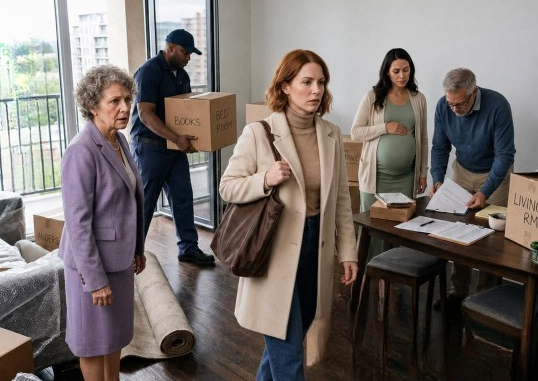
At 7:40 that morning, Eleanor stepped out of her bedroom wearing a silk robe and froze when she saw two movers carrying the dining table toward the elevator.
“What are you doing?” she demanded.
“Moving,” I said.
“That table belongs to me!”
“No. I purchased it in 2019. The receipt has my name on it.”
Arthur appeared behind her, looking exhausted, unshaven, and clutching his phone.
He looked like a man who had known his mother planned this but had never bothered to think about what would happen afterward.
He never asked me to stay.
That hurt more than I expected.
After twelve years of marriage, he stood there and didn’t once say that he wanted his wife to remain.
“Sarah, seriously,” he muttered. “Don’t do this.”
“Don’t do what?”
“Act petty.”
I laughed once.
It was a short, bitter sound.
Both Arthur and Eleanor visibly recoiled.
Then Leo walked out of his bedroom.
He was twenty now, taller than his father, his hair still messy from sleep.
Behind him stood Valerie, thirty-two weeks pregnant, one hand resting over her stomach.
She looked frightened.
And in that moment, I reminded myself that none of this was Valerie’s fault.
Whatever Arthur had promised her and whatever Eleanor had told her, she wasn’t responsible for the years of mistreatment I had endured.
By 9:40, the apartment looked almost unrecognizable.
Most of my belongings were gone.
Arthur’s clothes remained. So did Eleanor’s bedroom furniture and Leo’s personal belongings.
The rest was empty space.
Eleanor stood in the middle of the living room with her arms crossed.
“You’re behaving like a spoiled child,” she said. “This is still our home. You’re the one choosing to leave.”
That was when I finally said what she hadn’t expected.
“Then starting today, you can pay the $9,800 rent yourselves.”
Nobody spoke.
Arthur finally broke the silence.
“What are you talking about?”
He didn’t sound truly surprised.
He knew.
“For four years, you’ve paid the electricity, internet, and groceries,” I said. “I’ve paid the rent. Every single month since your business started falling apart.”
Then I turned toward Eleanor.
“Every dinner party you’ve hosted here, every guest you’ve impressed, every time you’ve bragged about living in this building—it all happened because I paid for it.”
For the first time, her confident expression cracked.
Then she quickly composed herself.
“That’s ridiculous.”
“Priya Raman will send Arthur the documentation this afternoon. Forty-eight months of bank statements.”
I grabbed my purse.
“But there’s something else you need to know.”
I explained the lease.
My name was the only name on it.
Arthur’s poor credit had prevented him from qualifying, so I had signed the agreement alone. It had been renewed twice since then, yet Eleanor had apparently never considered checking whose signature was on the paperwork.
She had simply assumed that someone she considered insignificant couldn’t possibly be the person supporting the household.
“I gave management my notice this morning,” I said. “I’m not renewing. The lease expires in sixty-one days. Management will send the official notice. After that, you’ll all need somewhere else to live.”
I looked at Eleanor.
“Sixty-one days is much more notice than you gave me.”
Before leaving, I placed an envelope on the bare floor and wrote Arthur’s name across it.
He opened it.
Inside were three things.
A copy of the lease bearing only my signature.
The official notice confirming that I would not renew it.
And a photograph of Leo at fourteen.
He was standing at his school science fair with a second-place ribbon pinned to his shirt.
His expression wasn’t cheerful, but his eyes were looking directly into the camera.
I had taken that photograph.
Arthur had been in Chicago that day.
Eleanor had claimed she was busy.
So I went alone.
I stayed for three hours.
Afterward, I bought Leo a hamburger.
For forty-five minutes, he talked nonstop about ion exchange.
It was the longest conversation we’d ever shared.
That night, I cried alone because I thought maybe the wall between us had finally begun to come down.
On the back of the photograph, I had written:
“I was there every time. Ask her why she told you I wasn’t.”
Then I left.
Priya took over the legal side of everything.
There wasn’t much anyone could challenge.
The lease was a contract, and the building management had no interest in resolving our family drama.
Eleanor called the management office twice, insisting there had been some mistake.
During the second call, they politely told her to stop contacting them.
They moved out fifty-eight days later.
Arthur, Valerie, and the baby rented a two-bedroom apartment in Yonkers.
At first, Eleanor moved in with them and took the second bedroom.
But six weeks after the baby was born, that room became the nursery.
Eleanor eventually rented a small studio in Riverdale, paid for through her widow’s pension and her late husband’s annuity.
The expensive lifestyle she had spent years displaying was finally beyond her means.
PART 3: THE TRUTH
I learned most of what happened afterward from Leo.
Arthur called me eleven times during the first month.
I finally answered the ninth call.
He wanted to explain what had happened between himself and Valerie.
I told him I wasn’t interested in hearing the details. Valerie was pregnant, and whatever promises he had made were between the two of them.
Then I asked him one question.
“When your mother told me to leave, did you already know she was planning to do it?”
Arthur was silent for a long time.
Eventually, he answered.
“She said she’d take care of it.”
Those words explained far more than he realized.
He had allowed his mother to decide what happened to me.
I filed for divorce the following week.
Arthur didn’t fight it.
The divorce took nine months.
When it was finally over, I felt almost nothing.
That emptiness frightened me more than sadness would have.
Then, the following April, something happened that I never expected.
Leo called me.
I didn’t recognize the number.
“It’s Leo,” he said.
Neither of us spoke for several seconds.
Then he said, “I found the photograph.”
Arthur had left the envelope on a shelf in the Yonkers apartment.
Leo found it while searching for a phone charger.
“I remember that day,” he said. “The science fair. The hamburger. I remember it clearly. But I’ve also spent years remembering that you never came. Why was I told that?”
Three days later, we met at a diner on Northern Boulevard.
Leo arrived carrying a list of questions written on the back of a receipt.
His first question was whether I had ever said I wanted him out of the apartment.
“No,” I told him. “Never. Not once.”
He stared down at the paper.
“She told me you did. I was thirteen. She said she’d heard you tell Dad that.”
He covered his face with both hands.
“She told me so many things. I believed her because she was always around.”
“She was,” I said quietly.
“But you were around too,” he answered. “That’s what I don’t understand. You were there the whole time, but she convinced me you weren’t. And whenever I tried being nice to you, she’d get angry.”
He looked down.
“I was a kid. But I’m not a kid anymore. I should have figured it out.”
I told him he had grown up surrounded by adults who had controlled the story.
“You don’t owe me an apology.”
“I think I do,” he said.
So I let him apologize.
Sometimes, when someone sincerely wants to accept responsibility, you have to let them.
We started meeting for coffee once a month.
For nearly a year, our conversations were awkward.
We talked about his classes, my work, ordinary things.
We rarely touched the painful history between us.
Eventually, though, it became easier.
Then those meetings became something I genuinely looked forward to.
The next spring, Leo graduated with a degree in chemical engineering.
Before the ceremony, he admitted something that surprised me.
His choice of career had been influenced by me.
I sat in the fourth row during his graduation.
Arthur sat in the second row with Valerie and their four-year-old daughter, Wren.
Eleanor wasn’t there.
By then, Leo had cut contact with her.
He had confronted her when he was twenty-two about everything she had told him.
She never apologized.
Instead, she tried to justify herself.
Leo later told me that her excuses hurt more than the original lies.
I never told him to cut her out.
He insisted the decision had nothing to do with me anymore.
I believed him.
Today, I live alone in a one-bedroom apartment in Astoria.
It is mine.
I bought it using the money I stopped pouring into a home where I had never truly been valued.
The apartment is smaller.
But every inch belongs to me.
The enormous dining table from the Upper East Side apartment sits in the middle of my living space.
It is absurdly large for the room.
I don’t care.
Over the years, I’ve spent a lot of time thinking about why I tolerated everything for so long.
Arthur asked me to hide the truth about the rent because he was ashamed.
I convinced myself I was keeping the secret because I loved him.
But looking back, I don’t think my silence was love.
It was a transaction.
Every month, I handed over $9,800 and surrendered another piece of myself in exchange for the privilege of sitting at a table where everyone treated me as though I should be grateful they allowed me there.
Eleanor didn’t simply take my place from me.
I gave it away slowly.
One sacrifice after another.
And then I acted shocked when she began behaving as though I had never owned it.
Of everything that happened, the lease is what stays with me.
I signed it alone because Arthur’s credit wasn’t good enough.
I remember feeling embarrassed for him as I sat in that leasing office signing every page while he waited downstairs, too ashamed to come inside.
For four years, that document sat quietly in a drawer.
It seemed meaningless.
Then one evening, Eleanor told me I was no longer wanted.
Suddenly, that lease became the most important piece of paper I owned.
I would never tell someone enduring mistreatment that the solution is simply to find financial leverage.
Not everyone has that option.
I know how fortunate I was.
But I would tell them this:
A lie can continue only as long as people keep agreeing to live inside it.
For years, everyone in that apartment—including me—accepted the same fiction.
Arthur was the provider.
Eleanor was in charge.
And I should feel grateful just to be included.
But at seven o’clock one morning, while a moving truck waited outside, I stopped playing along.
Leo now comes to my apartment for dinner on the first Sunday of every month.
He usually sits in the same chair his grandmother once claimed and still eats too quickly, exactly as he did when he was fourteen.
Last month, he brought Wren.
Valerie had suggested she come.
Wren looked around my small apartment and asked who I was.
Leo answered without hesitation.
“This is Sarah. She came to all my science fairs.”
That simple sentence somehow carried the weight of nine years.
Nine years of standing outside Leo’s bedroom.
Nine years of trying to prove that I cared.
Nine years of wondering whether he would ever understand.
All of it reduced to one sentence spoken to a four-year-old girl over dinner.
I stood up and walked into the kitchen.
For a moment, I let the faucet run, just as I had after that science fair years ago.
Then I returned to the table, sat beside them, and asked Wren if she’d like another piece of bread.
Leave a Reply