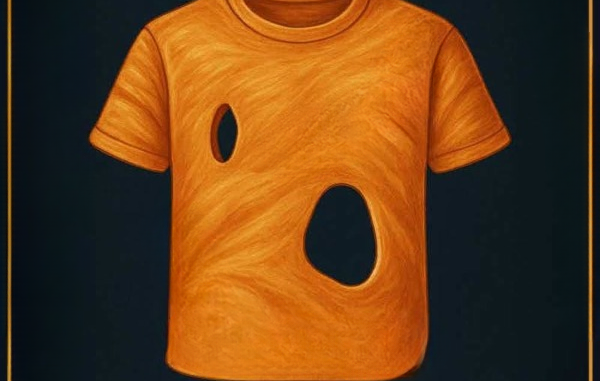
If you believe you can crack this puzzle in just a few seconds, you might want to think again. A simple orange T-shirt has become an internet sensation, confusing millions and revealing how easily our minds can misinterpret what we see. Countless people have looked at the image, yet many struggle to find the expected answer because their brains automatically rely on assumptions and shortcuts. Are you someone who notices every detail, or will your mind trick you into missing what is right in front of you? Take a closer look.
This viral challenge is more than a simple counting game. It offers an interesting look at how we process information and interpret the world around us. The puzzle appears easy: an orange shirt with several holes cut into the fabric. At first, it seems like all you have to do is count. You might count the visible holes on the front, consider whether they continue through the back, and come up with your answer. But the reason this image has created so many arguments online is because it challenges the way we define what we see. You are not only counting holes—you are dealing with assumptions, different interpretations, and visual details that influence your conclusion.
Most debates focus on whether the natural openings of the shirt should also be included. Should the neck opening count? What about the sleeves or the bottom of the shirt? Someone who thinks literally may say only the damaged areas in the fabric matter. Someone who looks at the bigger picture might argue that every opening in the shirt is technically a hole. This is where the so-called personality test comes into play. Your answer may reflect whether you focus mainly on obvious details or whether you tend to consider the larger structure behind something. It reveals the way your brain organizes information before you even realize it.
One commonly shared answer is eight. People who choose this number usually count the two torn holes in the front, the two visible openings in the back if the tears pass through, the neck opening, the two sleeve openings, and the bottom opening. Others argue the answer is only two because they count just the ripped sections. Some people say four, six, or even more depending on how they define a hole. The different answers show that the result depends heavily on the perspective and rules each person uses.
That is what makes the T-shirt puzzle so interesting—it proves that what seems “obvious” to one person may not be obvious to everyone. In today’s world, people often make quick judgments and rush to defend their opinions. This simple image encourages us to slow down and think. When someone else reaches a different answer, it does not necessarily mean they are wrong. They may simply be viewing the same image through a different perspective.
The real lesson behind this challenge has little to do with the shirt itself. It is about how we observe and understand things. Many people move through life believing their own interpretation is the only correct one. But just like this shirt has visible holes and possible hidden openings, everyday situations are filled with details, meanings, and assumptions that we often overlook.
We notice the obvious problems—the “tears” in a situation—but sometimes fail to recognize the bigger picture that holds everything together. The way we understand conversations, relationships, and events is shaped by our experiences and the information we choose to focus on.
So when someone sees the puzzle differently than you do, remember the orange shirt. They may simply be counting things you didn’t consider, or using a different definition of what qualifies as a hole. The challenge teaches an important lesson in humility: our brains are constantly creating explanations from incomplete information, and sometimes those explanations are not the whole truth.
The next time something seems completely obvious, take another look. Consider the details you might have missed. The person who sees eight holes is not necessarily smarter than the person who sees two—they are simply using a different way of interpreting the image.
In a world where people often disagree about what is true, this simple shirt reminds us of something important: we may all be looking at the same thing, but we do not always see it the same way.
Sometimes the greatest insight comes from being willing to question our first impression. The puzzle is not just about finding an answer—it is about understanding how we see the world.
Leave a Reply