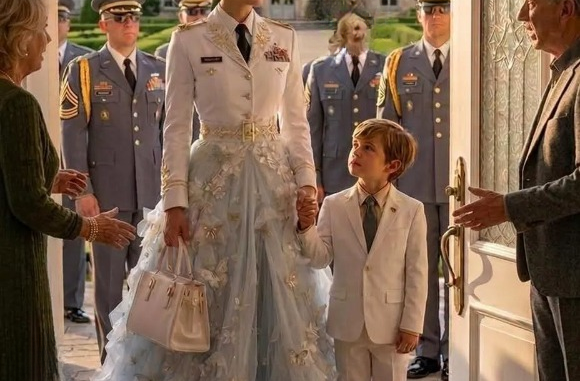
At 2:13 in the morning, my parents placed our suitcases on the side of a deserted desert highway and drove away—taking my phone and wallet with them inside their truck. My seven-year-old son, Eli, stood beside me in nothing more than a thin sweatshirt, holding tightly onto my hand as their taillights disappeared into the darkness.
The freezing wind cut through us, and there was no nearby shelter, no buildings, and no cars passing by.
My parents believed they were teaching me a lesson. They were convinced that fear would finally force me to obey them.
Nearly an hour later, a truck driver named Hank Diaz found us. He wrapped Eli in a warm blanket and immediately called the sheriff.
As patrol lights illuminated the empty road, my commanding officer called with shocking news: my parents had already reported me as unstable, unemployed, and accused me of stealing $32,000.
They thought the authorities would believe their version of events.
What they didn’t know was that a highway surveillance camera had captured exactly what they did.
My name is Colonel Mara Whitaker, although my parents believed I only held a minor administrative position in military logistics.
For twelve years, I had led high-risk operations, maintained an active security clearance, and raised Eli on my own after my husband, Daniel Reeves, died four years earlier.
My parents never respected my career. They treated my independence like an act of rebellion and considered my decisions about Eli a challenge to their authority.
Six months before they abandoned us, my father tried to remove Eli from school without my permission. I had to file a formal complaint to stop him.
They also insisted Daniel had left behind nothing except financial problems, so I trusted them to hold onto his personal documents while I managed the funeral, childcare, and another military assignment.
What I never realized was that they had been collecting rental income from property that belonged to me while secretly making plans to gain control over Eli.
At the sheriff’s office, my father demanded that officers arrest me.
My mother claimed they had only acted out of concern for their grandson.
Then Major Anne Hensley from the Army’s legal division placed my custody documents and service records on the table.
Detective Alvarez followed by showing surveillance images of my parents unloading our bags on the highway before driving away.
My mother’s expression changed.
“There were cameras?” she asked.
That one question revealed everything.
She wasn’t shocked that a child had been left freezing on the side of the road.
She was shocked that someone had recorded it.
When investigators questioned them separately, my mother finally admitted they had wanted to “teach me a lesson,” destroying their claim that it had all been a misunderstanding.
A search of her phone uncovered messages discussing temporary guardianship, Daniel’s hidden trust, and the silver key he had given me before his final deployment.
Police then searched my parents’ home.
Inside, they discovered forged paperwork, Eli’s private records, and a locked metal container marked D-17.
But what they found inside revealed that abandoning us had only been the beginning of their plan.
Daniel had left behind a recorded message explaining everything.
He revealed that he had created a protected trust for Eli and purchased a home near Carson City on land my grandmother had passed down to me.
My parents had hidden the property from me, collected the rental income, and planned to use guardianship of Eli as a way to gain access to the trust, investments, and eventually my estate.
At the emergency custody hearing, my attorney presented the highway footage, the false police report, forged documents, prepared missing-person materials, and messages proving the entire situation had been carefully planned.
Investigators examined years of property records, rental payments, insurance documents, and hidden financial activity.
My parents’ attorney tried to describe everything as a family misunderstanding.
That argument fell apart when my father admitted the plan was meant to scare me into submission.
The court restored my full custody of Eli, issued a permanent protective order, denied their guardianship request, and referred evidence of fraud and document forgery for further investigation.
Months later, Eli and I moved into the Carson City house Daniel had chosen for us.
The porch needed repairs. The pipes made strange noises. The walls needed fresh paint.
But it was ours.
No one there demanded obedience in exchange for love.
Hank helped rebuild the front steps. Major Hensley helped secure the remaining legal documents. Eli personally picked out new locks for every door.
Using part of Daniel’s trust, I later helped create a desert emergency network connecting highway cameras, truck drivers, and local authorities to help stranded travelers get rescued faster.
Eli named it “The Warm Road.”
His reason was simple:
“Nobody should be left alone in the cold.”
One year later, an emergency alert came through at exactly 2:13 a.m., confirming that the system had helped rescue a family stranded during a winter breakdown.
My parents believed that hour would be remembered as the moment they took control of our lives.
Instead, it became the moment Eli and I began building a home where fear no longer had the power to decide our future.
Leave a Reply