PART 2
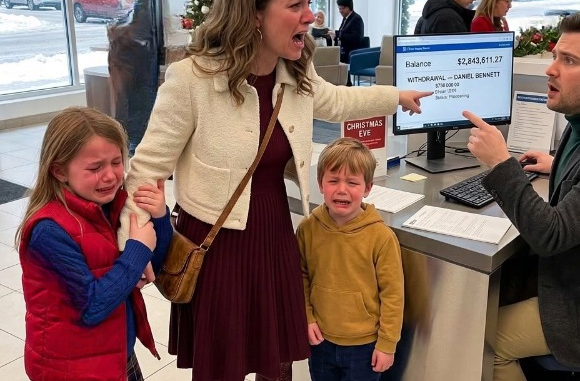
Branch manager Denise Walker escorted us into a private office while an employee brought Sophie and Noah mugs of hot chocolate from the staff lounge.
I assumed the account balance had to be some kind of error.
Instead, Denise printed out the trust documents.
Seven years earlier, my mother had established the Margaret Cole Family Trust.
The funds came from stock she had quietly accumulated while working for a medical-device company. She had never lived lavishly, so I had no idea those investments had grown into something so valuable.
The trust listed me as the beneficiary but restricted access until I either turned forty or experienced a verified financial hardship.
Being homeless after a divorce qualified.
Denise then explained that Daniel’s attempt to withdraw funds had triggered the bank’s fraud-detection system. The power of attorney he submitted claimed I had authorized him months earlier to manage the trust on my behalf.
“I never signed that,” I told her.
Denise nodded. “Then you need both an attorney and the police.”
She immediately contacted the bank’s fraud department.
Because it was Christmas Eve, there were limits to what could happen that day, but all outgoing transfers were frozen. The bank also arranged an emergency cashier’s check from a protected account.
I withdrew enough money to cover a hotel, food, and several weeks of expenses.
That evening, after Sophie and Noah fell asleep in a hotel room overlooking a snow-covered parking lot, I called my divorce attorney, Rachel Kim.
She answered almost immediately.
When I explained everything, she became unusually quiet.
“Claire, Daniel never disclosed any interest in your mother’s trust during the divorce proceedings, correct?”
“I didn’t even know the trust existed.”
“And he tried to access it before forcing you out of the house?”
“Yes.”
Rachel asked me to send photos of every document Denise had provided.
Ten minutes after receiving them, she called back.
“There’s something else,” she said. “Daniel’s filings included a sworn statement claiming you had no inherited assets. If he knew about this trust and hid that information while trying to take the money, we may be looking at fraud involving both the bank and the court.”
On Christmas morning, Daniel sent a text.
Hope you and the kids found a place to stay. Don’t make this more difficult than it has to be.
I read it twice and never responded.
The day after Christmas, Rachel filed an emergency motion concerning the house, the children’s living situation, and Daniel’s suspected financial misconduct.
Meanwhile, the bank’s investigators contacted local police.
By midday, I learned how Daniel had discovered the trust.
Months earlier, after my mother’s belongings were stored in our basement, he had opened a locked document box. Inside were trust statements, account information, and a letter addressed to me.
He photographed everything.
Then he paid a questionable mobile notary to witness a forged power of attorney using my signature.
But Daniel made one critical mistake.
The bank still had surveillance footage from the day he submitted the paperwork.
He had walked into the branch himself.
Later that afternoon, Rachel called again.
“Claire, don’t contact Daniel,” she warned. “And don’t give him any indication of what’s happening. The detective already has enough evidence to pursue a warrant.”
I looked across the hotel room at Sophie, who was decorating the window with paper snowflakes, while Noah built a fort from pillows.
For eleven years, Daniel had controlled nearly every major financial decision in our lives and repeatedly insisted I could never make it on my own.
For the first time, he had no idea what was about to happen.
PART 3
The warrant didn’t arrive with flashing lights or dramatic headlines.
It arrived at 7:12 the next morning, while Daniel was drinking coffee in the kitchen that used to be mine.
Rachel called shortly after Detective Marcus Hill contacted her.
“They’re searching the house,” she said. “Daniel’s there.”
Sitting on the hotel bed in my pajamas, I asked, “Are they arresting him?”
“Not yet. Right now, they’re gathering evidence.”
For several hours, I heard nothing.
I took Sophie and Noah downstairs for pancakes and tried my best to act normal.
Sophie noticed me checking my phone repeatedly.
“Is Dad angry with us?” she asked.
“No,” I said carefully. “None of this is your fault.”
It was the most honest answer I could give an eight-year-old.
Just after noon, Detective Hill called.
During the search, investigators found my mother’s original trust documents in Daniel’s desk, copies of my identification, pages filled with practice versions of my signature, and emails exchanged between Daniel and the mobile notary, Stephen Voss.
They also discovered a spreadsheet.
Its title was “Exit Plan.”
The file listed my mother’s trust as being worth approximately $2.7 million nearly six months before Daniel filed for divorce.
Beside it were several notes:
POA before decree.
Claire unaware.
Move after access.
When Rachel later sent me copies, I felt physically sick.
This wasn’t a reckless decision made after our marriage fell apart.
Daniel had planned everything.
Suddenly, years of behavior made sense.
The pressure to quit my bookkeeping job.
The claims that mortgage costs were draining our savings.
His refusal to show me certain financial accounts.
The rush to finalize the divorce quickly.
Even locking me out on Christmas Eve had served a purpose.
He believed that if I was scared, homeless, and financially desperate, I would agree to whatever he wanted.
He thought poverty would make me compliant.
Instead, forcing me out triggered the exact emergency condition that legally granted me access to the trust.
That evening, Daniel was arrested on suspicion of forgery, attempted theft, identity fraud, and other financial crimes.
Rachel reminded me that charges were not convictions and that the prosecutor would determine the final case.
I understood.
But for the first time, the truth existed somewhere Daniel couldn’t alter or rewrite.
Two days later, we appeared in family court.
Daniel attended remotely with his criminal-defense attorney.
He looked exhausted.
I had seen that expression before whenever he wanted sympathy.
The judge was unmoved.
Rachel presented evidence regarding the lockout, the children’s ages, the attempted transfer, and Daniel’s failure to disclose knowledge of the trust while submitting sworn divorce documents.
Daniel’s attorney argued that the house had already been awarded to him and that the criminal allegations remained unproven.
The judge agreed that the criminal case was still pending.
Then she focused on what was already documented.
Daniel had displaced two minor children on Christmas Eve without ensuring safe housing.
He had also violated temporary parenting requirements related to major living-arrangement changes.
The court granted me temporary exclusive use of the home with the children while the divorce settlement and surrounding circumstances were reviewed.
Daniel was allowed to enter only under supervision to retrieve approved belongings.
Three days after he forced us out, I walked back through the front door holding Sophie’s hand.
Noah immediately ran to his room.
“My dinosaurs are still here!” he shouted.
That was the moment I finally cried.
Not at the bank.
Not during the police interviews.
Not when I discovered I was a millionaire.
I cried because my six-year-old had been worried his plastic dinosaurs might disappear.
Sitting on his bedroom floor, I listened as he proudly showed me each one.
The trust changed my financial situation, but Rachel reminded me that inherited assets needed to remain separate and protected.
I opened new accounts, hired an independent financial adviser, and ignored suggestions that I celebrate by buying something extravagant.
Instead, my first major expense was hiring a forensic accountant.
Her name was Priya Shah.
Within two weeks, she discovered that the trust was only one piece of Daniel’s deception.
During our marriage, Daniel had secretly moved approximately $186,000 of marital income into an account tied to a consulting company he created without my knowledge.
He had also undervalued business interests during the divorce and used marital funds to pay Stephen Voss.
Armed with that evidence, Rachel petitioned the court to reopen the financial portion of the divorce settlement.
Daniel’s situation deteriorated quickly.
Facing legal trouble of his own, Voss agreed to cooperate.
He admitted Daniel had brought him the unsigned power-of-attorney form and paid him to falsely certify that he witnessed my signature.
Bank surveillance footage contradicted Daniel’s claims.
Metadata from the “Exit Plan” spreadsheet showed exactly when it had been created and edited.
Yet Daniel still refused to admit what he had done.
Through his attorney, he insisted I had verbally authorized him to manage my mother’s money.
Then investigators recovered a deleted voice memo from his phone.
It wasn’t a confession.
In some ways, it was worse.
In the recording, Daniel rehearsed what he planned to tell bank employees:
“Claire gets overwhelmed by money. She signed everything and asked me to handle it.”
My voice never appeared on the recording.
No authorization existed.
Months later, Daniel accepted a plea agreement on multiple financial charges rather than take the case to trial.
The court ordered restitution, imposed incarceration followed by probation, and placed restrictions on his future financial activities.
Family court separately revised our divorce settlement after determining that significant financial information had been concealed.
I didn’t recover every dollar.
Real cases rarely end that neatly.
But I recovered enough assets to create a far fairer outcome than the original settlement.
Most importantly, the house was sold under the revised order rather than remaining Daniel’s reward.
After the mortgage and court-approved distributions were completed, I used my portion—not the trust itself—to make a down payment on a modest four-bedroom home near the children’s school.
Sophie chose the bedroom with a maple tree outside the window.
Noah chose the room closest to the stairs because, according to him, it would help him get to breakfast faster.
I eventually returned to work full-time and became an accounting manager for a local construction supplier.
I wanted my children to understand that money should provide security—not become the center of a person’s life.
Eventually, I read the letter my mother had left inside the locked box.
Her handwriting trembled across three pages.
She explained that she kept the trust secret because Daniel had repeatedly questioned her about her investments.
She didn’t trust his interest in my finances, but she feared that warning me too aggressively might drive a wedge between us while I was still trying to save my marriage.
So instead, she built a safeguard.
She instructed the trustee to allow early access if I ever faced homelessness, serious illness, or another major crisis before turning forty.
At the bottom of the final page, she wrote a sentence I will never forget:
“Security is not the same as wealth. Security is having choices when someone tries to leave you with none.”
I folded the letter and placed it inside a new safe-deposit box.
The following Christmas Eve, Sophie, Noah, and I were home long before dark.
There were no packed suitcases.
No frantic hotel searches.
No emergency calls to lawyers.
Sophie helped decorate cookies while Noah buried a crooked Christmas tree under an absurd amount of tinsel.
Snow gathered along the porch railing outside.
At 6:30 p.m., my phone buzzed.
Daniel had sent a message through the court-approved parenting app.
Merry Christmas to Sophie and Noah. I hope they enjoy the gifts I sent.
I confirmed that the gifts had arrived at the visitation center and replied only with information about the children’s scheduled call.
Then I put my phone away.
Not because I had won.
Not because I wanted revenge.
There was simply nothing left to negotiate.
A year earlier, Daniel had stood behind a locked door believing that eighty dollars defined my future.
He had been wrong about the money.
And even more wrong about me.
Later that night, after the children were asleep, I sat beside the Christmas tree and briefly opened my banking app.
The trust was still there, professionally managed and largely untouched.
But I didn’t focus on the balance.
Instead, I looked around my home.
Two backpacks hung near the kitchen.
Bills were neatly organized on my desk.
Breakfast dishes were ready for the morning.
The mortgage payment was scheduled.
My paycheck would arrive on Friday.
Ordinary things.
Reliable things.
The kinds of things I once allowed someone else to control because I confused control with competence.
The bank card my mother gave me is no longer active. It was replaced during the fraud investigation.
But I kept the original.
It sits beside my mother’s letter in the safe-deposit box.
Not as a reminder of millions of dollars—
but as a reminder of the night Daniel tried to take everything from me and accidentally exposed everything he had been hiding.
Leave a Reply